







What Is an SEO Audit? How It Helps You Outrank Competitors
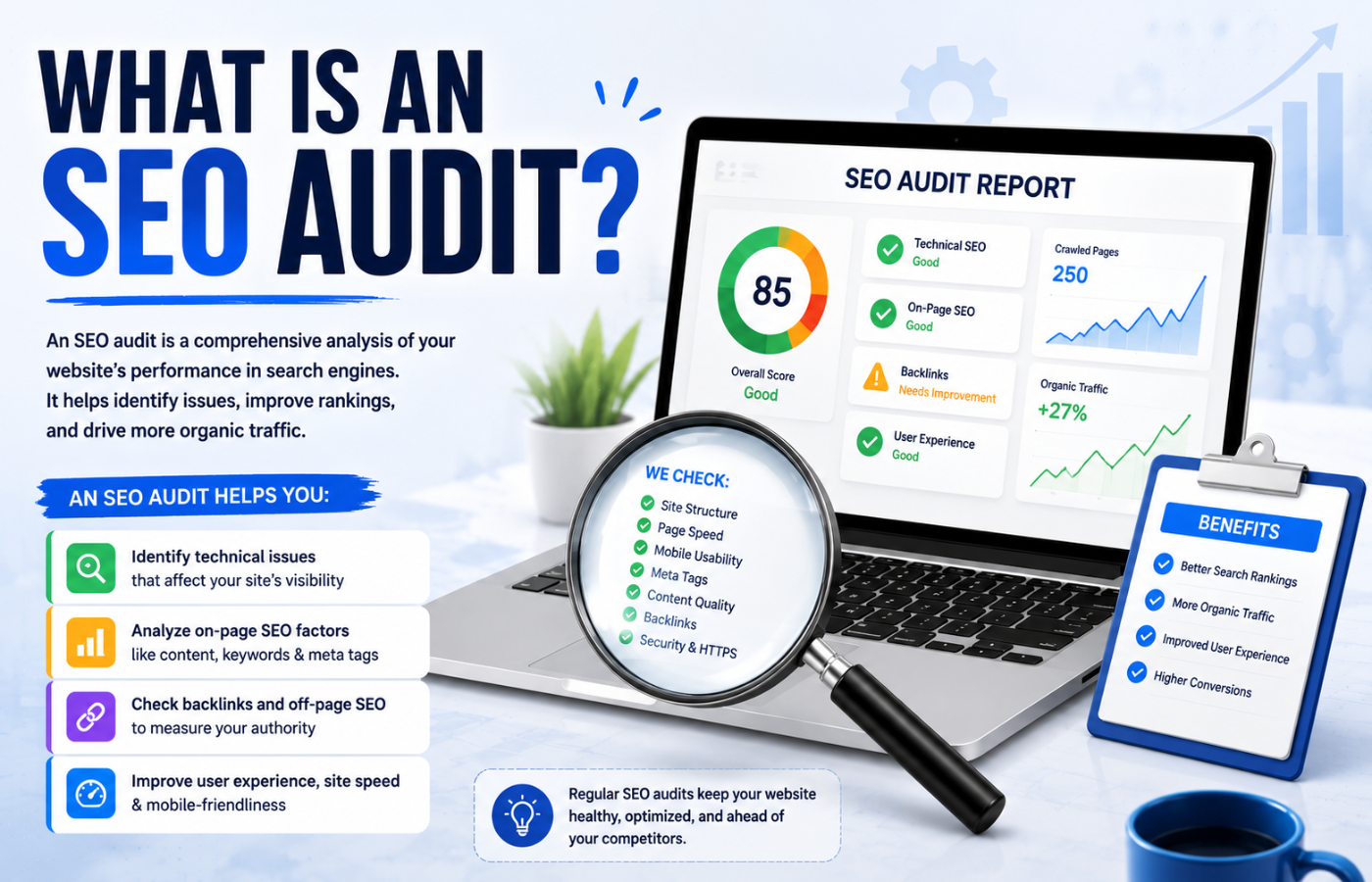
What is an SEO audit? Simply put, it is a comprehensive health check for your website that identifies exactly why you are not outranking your competitors. An SEO audit analyses over 200 technical, on-page, and off-page factors — from page speed and mobile usability to broken links and duplicate content. Without answering what is an SEO audit and applying its findings, you are essentially guessing why competitors appear above you in search results. A proper audit replaces guesswork with data, giving you a clear, prioritised roadmap to overtake the competition.
Why Most Businesses Lose to Competitors (Without Knowing Why)
You have better products, better service, and better prices — yet your competitor ranks higher. The reason is almost always invisible to you: slow load times they have fixed, schema markup they have implemented, or internal linking they have optimised. An SEO audit uncovers these hidden advantages your competitors have already built. Once you know what they are doing, you can do it better.
What Is an SEO Audit? Breaking Down the Three Core Components
Now that you understand what is an SEO audit at a high level, let us break down the three essential components that help you outrank competitors:
1. Technical SEO Audit (The Foundation)
This examines whether search engines can crawl and index your site properly. Key checks include:
-
Crawlability: Is your robots.txt blocking important pages? Are there orphan pages with no internal links?
-
Indexation: Are your most important pages actually in Google’s index? Use
site:yourdomain.comto check. -
Page speed: Core Web Vitals (LCP under 2.5s, CLS under 0.1)
-
Mobile responsiveness: Does your site work perfectly on all devices?
-
HTTPS security: Is your SSL certificate valid and properly configured?
-
XML sitemap: Is it submitted to Google Search Console and up to date?
-
Canonical tags: Are you preventing duplicate content issues?
Why this beats competitors: Most small business websites fail at least three of these checks. Fixing yours gives you an immediate advantage.
2. On-Page SEO Audit (The Content)
This examines every page’s optimisation for target keywords:
-
Title tags: Are they unique, under 60 characters, and include primary keywords?
-
Meta descriptions: Are they compelling, under 160 characters, and drive clicks?
-
Heading structure: One H1 per page? Logical H2-H6 hierarchy?
-
Keyword usage: Are keywords naturally in first 100 words, headings, and alt text?
-
Internal linking: Do your pages link to each other with descriptive anchor text?
-
Image optimisation: Are file sizes compressed? Alt text present?
-
Content quality: Is it helpful, original, and longer than competitor pages?
Why this beats competitors: Your competitor might have thin, outdated, or poorly optimised content. A single well-optimised page can outrank dozens of mediocre ones.
3. Off-Page SEO Audit (The Authority)
This examines how the rest of the web views your site:
-
Backlink profile: How many quality backlinks do you have? From which domains?
-
Referring domains: Are they relevant and authoritative? (Not spammy directories)
-
Anchor text distribution: Natural mix vs over-optimised exact match anchors?
-
Brand mentions: Are people talking about you without linking? (Earn those links)
-
Local citations: Is your NAP consistent across directories?
-
Social signals: Not a direct ranking factor, but correlated with authority.
Why this beats competitors: If a competitor has 500 backlinks from low-quality sites and you have 50 from local chambers and industry blogs, you win. Quality beats quantity.
What an SEO Audit Reveals About Your Competitors
A thorough audit does not just look at your site. It analyses competitors to identify:
| Competitive Advantage | What the Audit Finds | Your Action |
|---|---|---|
| Faster load times | Competitor’s LCP is 1.8s; yours is 4.2s | Optimise images, enable caching, upgrade hosting |
| Better internal linking | Competitor links related posts with keyword anchors | Audit and improve your internal link structure |
| More review snippets | Competitor has review schema on service pages | Add Product or LocalBusiness schema to your site |
| Higher quality backlinks | Competitor is listed on industry resource pages | Outreach to those same sites for links |
| Better content depth | Competitor’s pillar page has 5,000 words; yours has 800 | Expand your best-performing content |
The SEO Audit Process: Step by Step
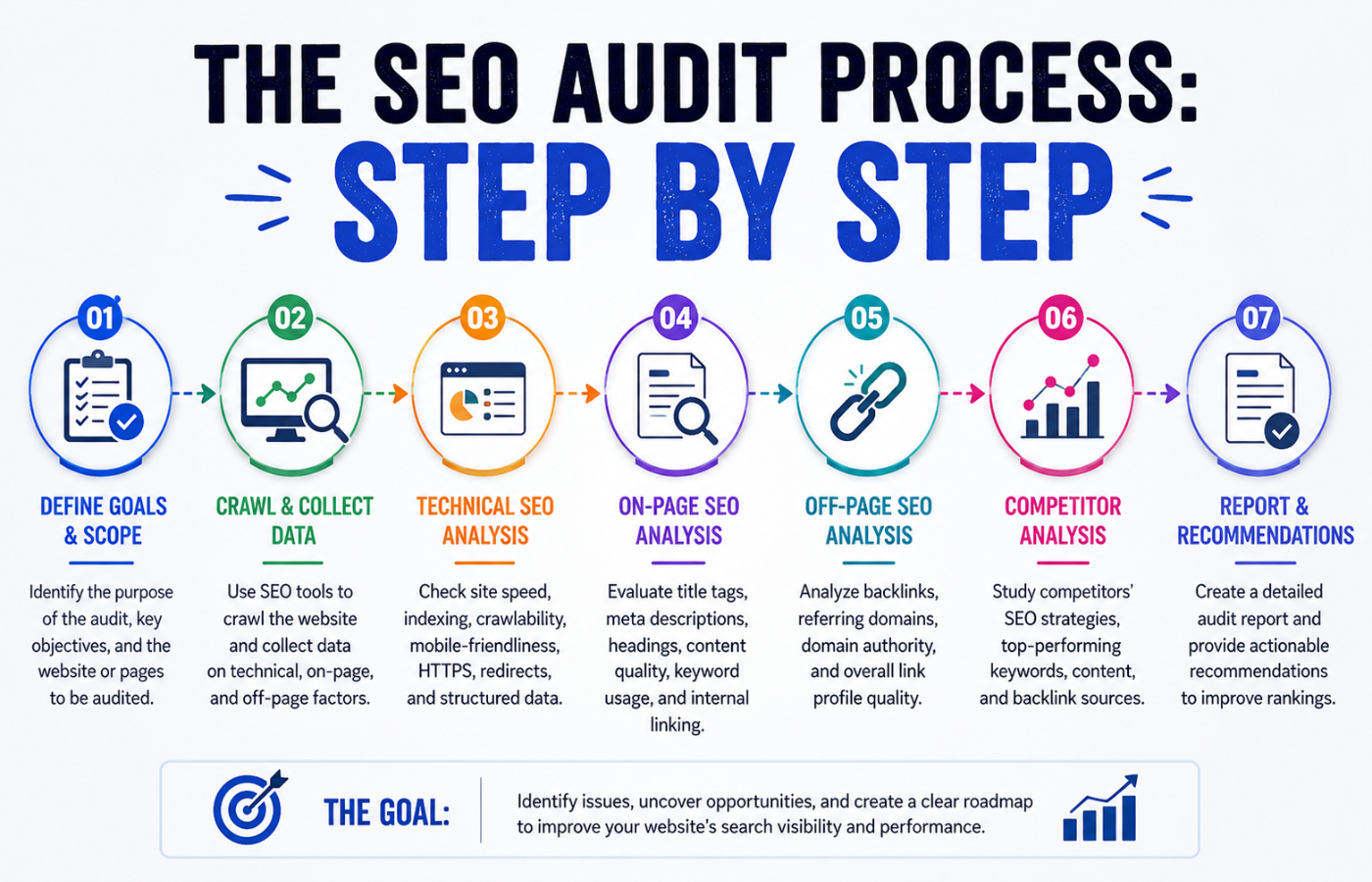
Step 1: Crawl Your Website
Use tools like Screaming Frog, Ahrefs, or Semrush to crawl every page. This finds broken links, duplicate content, missing meta tags, and redirect chains.
Step 2: Analyse Google Search Console
Check for indexing issues, crawl errors, Core Web Vitals failures, and mobile usability problems. Search Console tells you exactly what Google thinks is wrong.
Step 3: Review Google Analytics
Identify your best-performing pages (high traffic, low bounce rate) and worst-performing pages (high bounce, low time on site). Prioritise fixes on high-value pages.
Step 4: Conduct Competitor Gap Analysis
Identify your top 3 competitors. Compare their:
-
Top-ranking keywords (that you do not rank for)
-
Backlink sources (that you do not have)
-
Content topics (that you have not covered)
Step 5: Create a Prioritised Action Plan
Not all issues are equal. Prioritise by:
-
High impact, low effort: Fix broken links, missing meta descriptions, image compression
-
High impact, high effort: Content expansion, backlink outreach, site migration
-
Low impact, low effort: Minor text changes, alt text additions
-
Low impact, high effort: Redesigning entire site architecture
How Often Should You Audit Your SEO?
| Frequency | What to Audit |
|---|---|
| Monthly | Core Web Vitals, crawl errors, new backlinks, ranking changes |
| Quarterly | Full technical audit (broken links, duplicate content, redirects) |
| Annually | Complete competitive analysis, content gap audit, site architecture review |
| After major changes | Site redesign, platform migration, URL structure changes |
Common SEO Audit Mistakes
| Mistake | Why It Hurts | Fix |
|---|---|---|
| Auditing everything at once | Overwhelming, nothing gets fixed | Prioritise high-impact, low-effort issues first |
| Ignoring competitor analysis | You only know your problems, not their advantages | Run competitor gap analysis quarterly |
| Fixing issues but not retesting | You do not know if fixes worked | Re-crawl after changes, compare metrics |
| No documentation | You forget what you fixed and why | Keep an audit log with dates and outcomes |
| One-time audit only | SEO decays over time | Schedule regular audits (quarterly minimum) |
Tools to Run Your Own SEO Audit
| Tool | Best For | Free Version Available |
|---|---|---|
| Google Search Console | Indexing, crawl errors, Core Web Vitals | Yes (full) |
| Google Analytics | Traffic, bounce rate, conversions | Yes (full) |
| Screaming Frog | Crawling up to 500 URLs | Yes (limited) |
| Ahrefs Webmaster Tools | Backlinks, keyword rankings | Yes (limited) |
| PageSpeed Insights | Core Web Vitals, speed recommendations | Yes (full) |
| Mobile-Friendly Test | Mobile usability issues | Yes (full) |
Conclusion: Audits Reveal the Path to Outranking
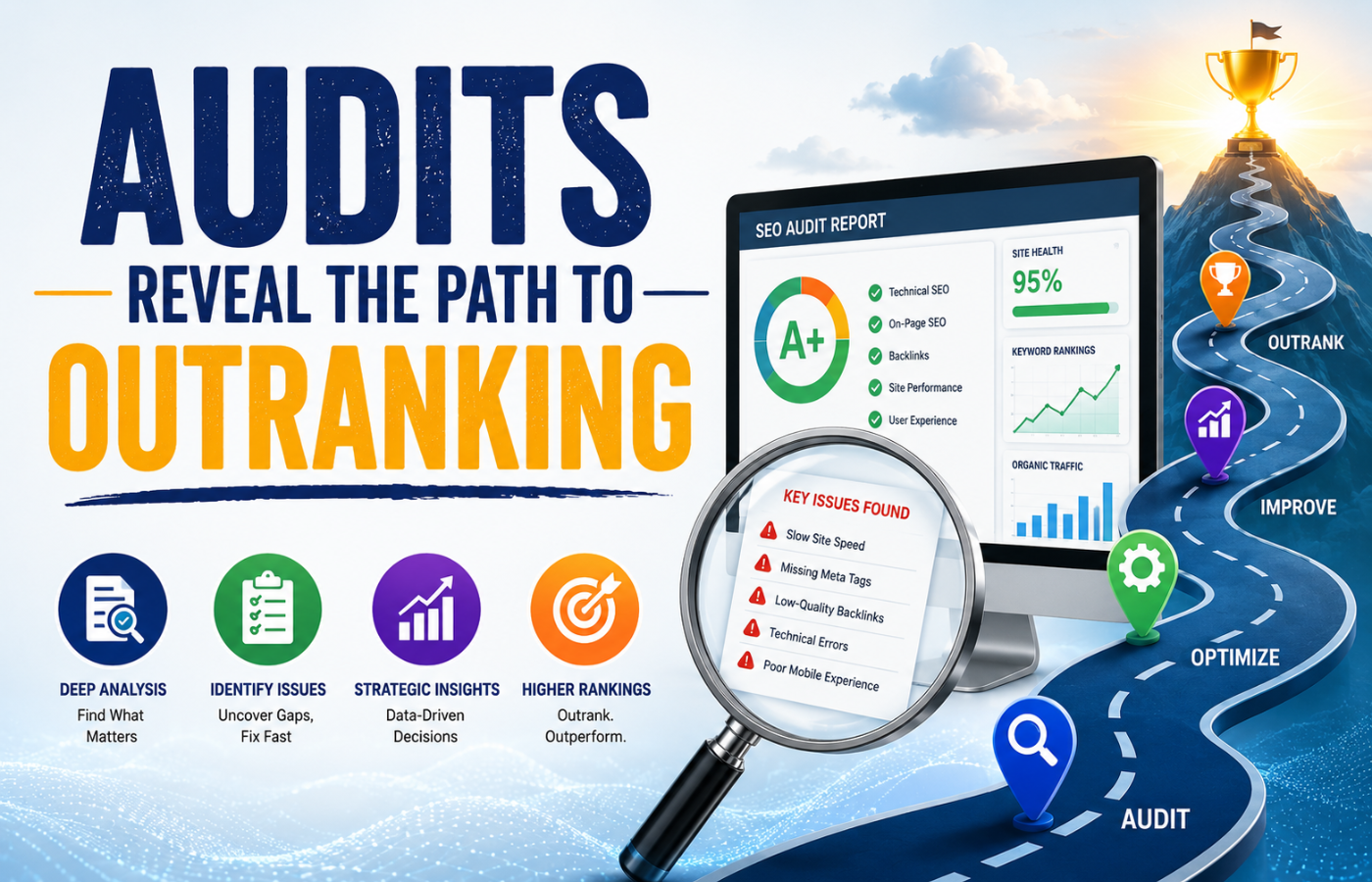
Want a complete SEO audit that reveals exactly why competitors outrank you — with a clear, prioritised roadmap to overtake them?
Get in touch with Orbitix today.