







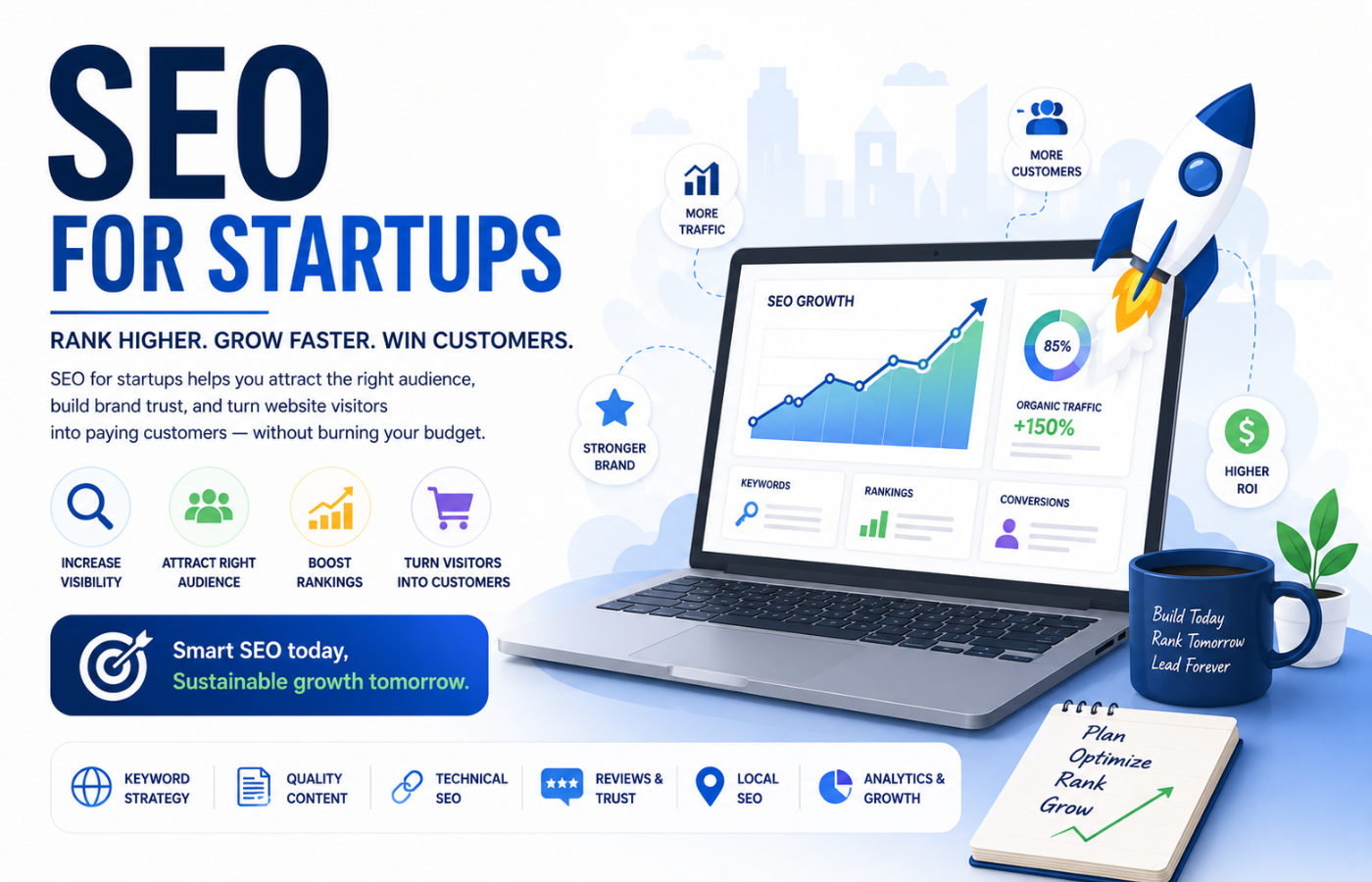
SEO for Startups: Turning Website Visitors Into Customers
Why Startups Fail at SEO
Most startups make the same mistakes: targeting keywords that are too competitive, publishing generic blog posts that nobody reads, and ignoring technical fundamentals. With limited resources, you cannot outrank established brands on broad terms like “project management software.” But you can dominate long-tail, high-intent searches like “project management for remote design agencies” or “best SEO tool for Shopify startups.” The key is strategic focus, not brute force.
How SEO for Startups Turns Visitors Into Customers
Effective SEO for startups follows a conversion-first playbook:
1. Target High-Intent, Low-Competition Keywords
Forget “CRM software” (impossible). Target:
-
Problem-based: “How to track sales leads from Gmail”
-
Audience-specific: “CRM for freelancers with invoicing”
-
Comparison-based: “HubSpot vs Pipedrive for small teams”
-
Alternative-based: “Cheap alternative to Salesforce”
These keywords have lower search volume but 5-10x higher conversion rates.
2. Build Topic Clusters, Not Random Posts
Instead of isolated blog posts, create a pillar page linking to cluster content:
Pillar: “Complete Guide to Email Marketing for E-commerce”
Clusters:
-
“How to recover abandoned carts with email”
-
“Best email automation tools for Shopify”
-
“Welcome email templates for online stores”
This structure signals authority to Google and keeps visitors on your site longer.
3. Convert Visitors With Strategic CTAs
Every piece of content must have a next step:
-
Top of funnel (awareness): Email newsletter signup (capture leads early)
-
Middle of funnel (consideration): Lead magnet (checklist, template, webinar)
-
Bottom of funnel (decision): Free trial, demo booking, consultation call
Never publish content without a relevant CTA.
4. Leverage Product-Led SEO
Your product itself can generate SEO value:
-
Public roadmap pages (rank for “[competitor] alternative”)
-
Comparison pages (your product vs competitors)
-
Changelog and updates (rank for “new features in [category]”)
-
Case studies with customer names (rank for “[customer name] solution”)
5. Prioritise Technical Fundamentals on a Budget
You do not need expensive tools. Focus on:
-
Core Web Vitals (fast load times = higher rankings)
-
Mobile responsiveness (over 60% of startup traffic is mobile)
-
Schema markup (Product, FAQ, HowTo schema for rich snippets)
-
Internal linking (no orphan pages)
The Startup SEO Conversion Funnel
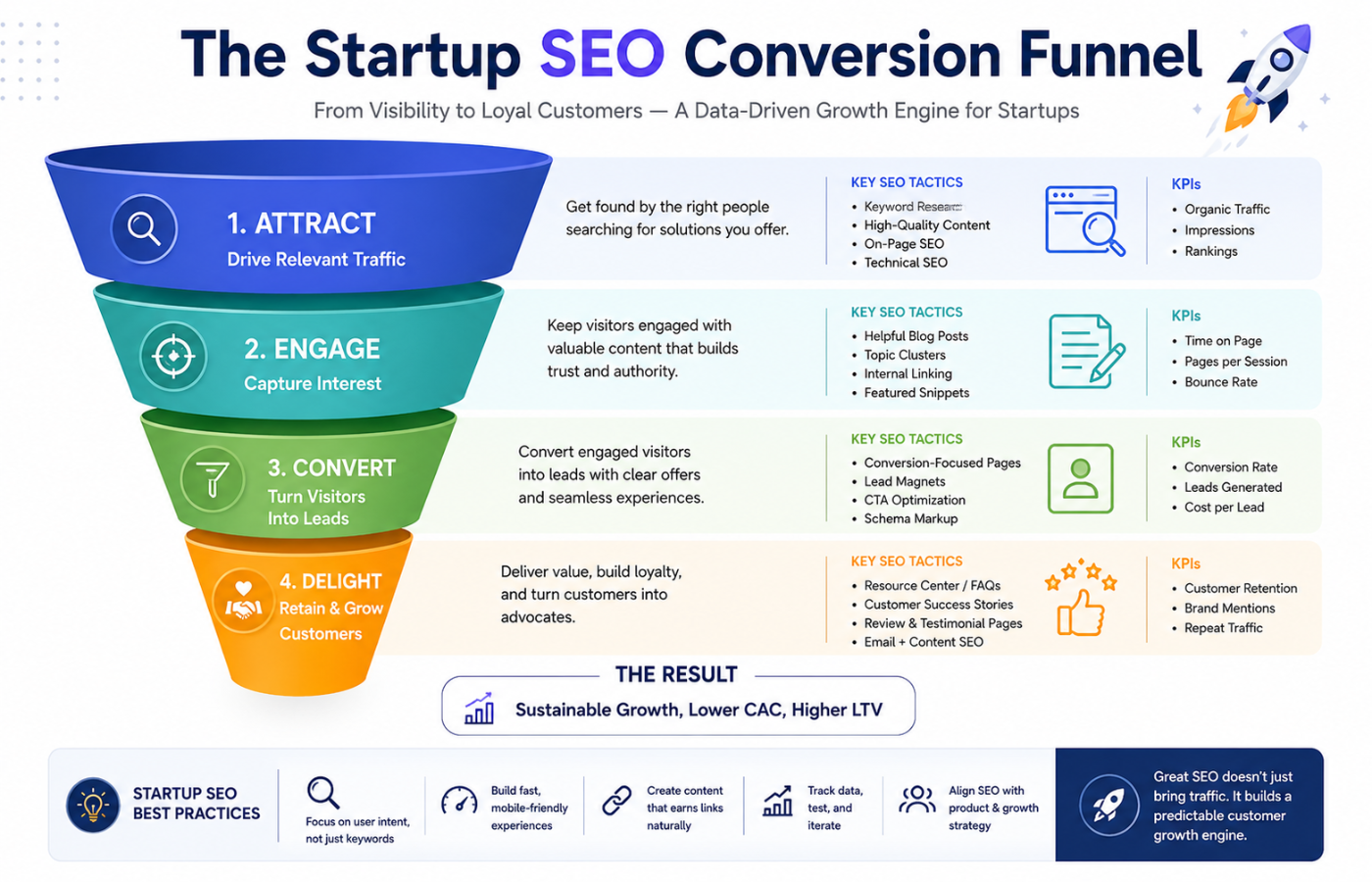
| Stage | User Intent | SEO Tactic | CTA |
|---|---|---|---|
| Awareness | “How do I solve X?” | Problem-based blog post | Email newsletter |
| Consideration | “Which tool is best?” | Comparison guide | Lead magnet (template/checklist) |
| Decision | “Should I try this?” | Case study, free trial page | Demo booking, free trial |
| Retention | “How do I use X better?” | Tutorial, changelog | Upgrade, referral request |
Common Startup SEO Mistakes
| Mistake | Fix |
|---|---|
| Targeting keywords with no commercial intent | Only create content for problems your product solves |
| No CTAs on blog posts | Add relevant CTAs to every piece of content |
| Ignoring internal linking | Link related posts together systematically |
| Publishing inconsistently | One quality post per week beats five then silence |
| No conversion tracking | Set up goal tracking in Google Analytics from day one |
SEO Metrics That Matter for Startups
Ignore vanity metrics. Track:
-
MQLs (marketing qualified leads) from organic (not total traffic)
-
Free trial signups from SEO (bottom-line impact)
-
Conversion rate by content piece (which posts drive demos?)
-
Customer acquisition cost (CAC) from organic (compared to paid)
Conclusion: SEO Is Your Startup’s Most Scalable Channel
Want startup SEO that turns curious visitors into paying customers — not just more traffic that never converts?
Get in touch with Orbitix today.