







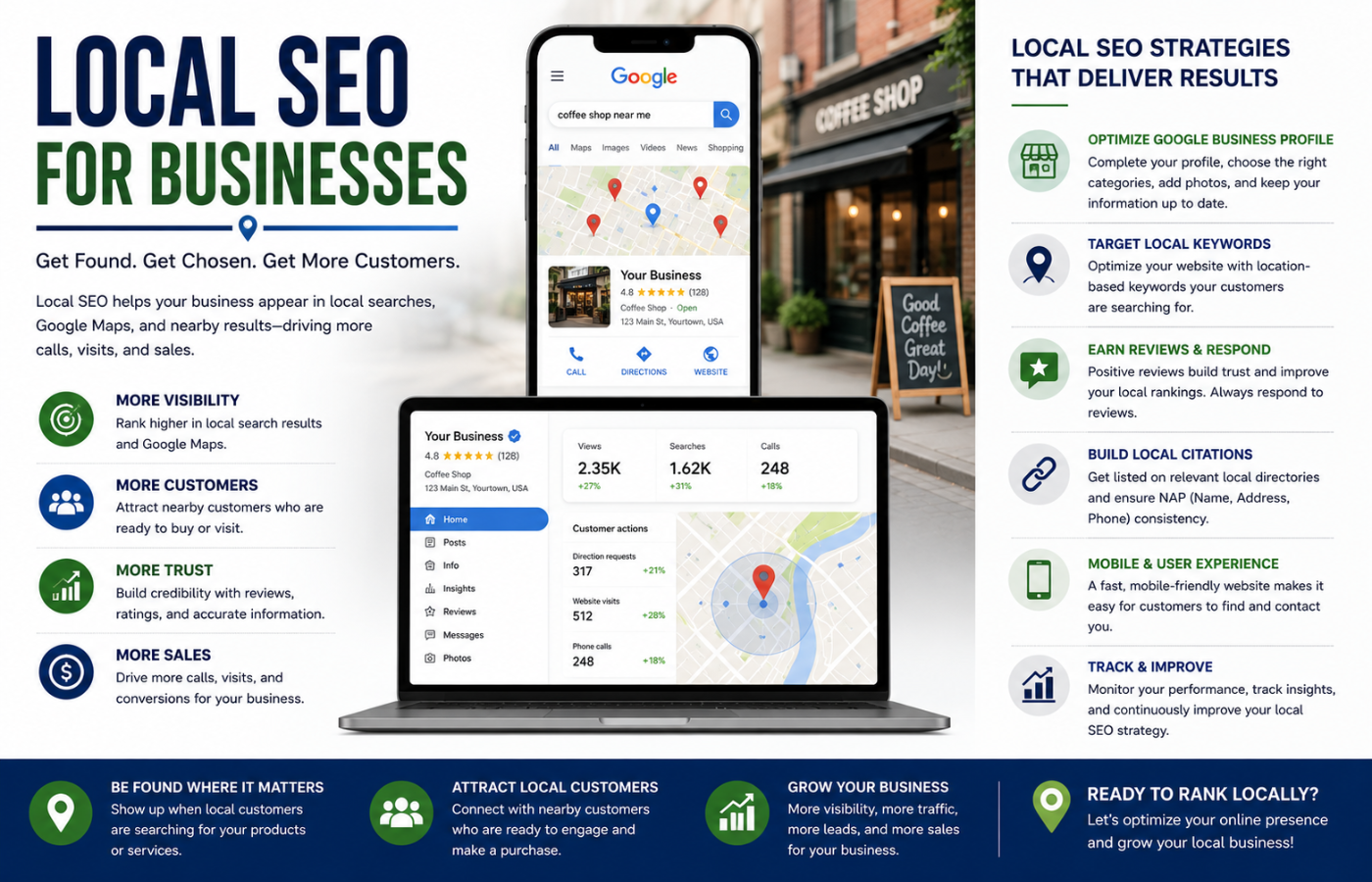
Local SEO for Businesses: A Step-by-Step Guide to Better Local Rankings
Why Local SEO Matters More Than Ever in 2026
The local search landscape has transformed. Nearly one-third of people search for a local business online every day, and almost 50% of all searches on Google are for local information . Meanwhile, AI-powered search engines like ChatGPT and Google AI Overviews are reshaping how consumers discover businesses . Yet the fundamentals remain: Google rewards businesses that are accurate, trustworthy, and genuinely connected to their communities . In 2026, local SEO isn’t just about optimising for Google—it’s about being a genuinely great business that people want to talk about .
Step-by-Step Local SEO for Businesses That Delivers Results
Effective local SEO for businesses follows a proven, structured approach. Here is your complete step-by-step guide.
Step 1: Optimise Your Google Business Profile (GBP)
Your GBP is the single most important ranking factor for local pack results . Start by claiming and verifying your profile . Then complete every field:
-
Primary category selection: Choose your most relevant primary category carefully—it is the strongest category signal
-
Business description: Naturally include location keywords and clearly explain what you do
-
Photos: Businesses with 100+ photos get 520% more calls than those with fewer than 10. Upload new photos weekly
-
Regular posts: Google rewards active profiles. Post updates at least weekly
-
Enable features: Messaging, appointments, and all applicable GBP features
Step 2: Ensure NAP Consistency Across All Platforms
NAP stands for Name, Address, and Phone Number. Consistent citations across directories reinforce Google’s confidence in your business information .
-
Audit current listings: Check Google Business Profile, Yelp, Apple Maps, Bing Places, social media, and your website
-
Fix inconsistencies: Use a standardised format for every listing—”Street” vs “St” matters
-
Add new citations: Focus on quality over quantity. Claim listings on high-authority directories
Tools: Use Moz Local, BrightLocal, or Whitespark to track your listings and spot inconsistencies .
Step 3: Master Local Keyword Research
Identify the words and phrases your local customers actually use . Great local keywords combine services with location:
-
“Best plumber Dallas”
-
“Dallas plumbing”
-
“Plumbing company Dallas”
Also target long-tail keywords that show higher buying intent—like “emergency plumber open Sunday” or “affordable family dentist in [neighbourhood]” .
Where to find keywords: Google Autocomplete, “People also ask” boxes, customer service emails, and competitor analysis .
Step 4: Build Localised On-Page SEO
Your website must clearly communicate what you do and where you do it .
-
Create dedicated location pages: For each service and each location you serve, with unique content (never duplicate city names)
-
Optimise title tags and meta descriptions: Include target keywords and location naturally
-
Add Local Business Schema Markup: Structured data helps search engines understand your business details—name, address, geo-coordinates, phone, hours
-
Ensure mobile responsiveness: Google indexes the mobile version of your website over desktop
Step 5: Build Local Citations and Links
Local citations are mentions of your business on directories, social platforms, and industry sites . Local links build authority from community sources:
-
Sponsor local events: Teams, charities, and community organisations typically include a link
-
Join your local Chamber of Commerce and business association directories
-
Contribute to local news or blogs as an expert source
-
Create locally relevant content: Community guides, local event roundups that earn natural links
Step 6: Manage Reviews Strategically
Reviews are the third most important local ranking factor behind GBP signals and proximity .
-
Build a systematic review generation process: Ask happy customers via email or SMS after service
-
Respond to every review: Google lists responding to reviews as a way to improve your local ranking
-
Aim for 4.0+ rating with consistent review velocity
Step 7: Create Five Pillars of Local Content
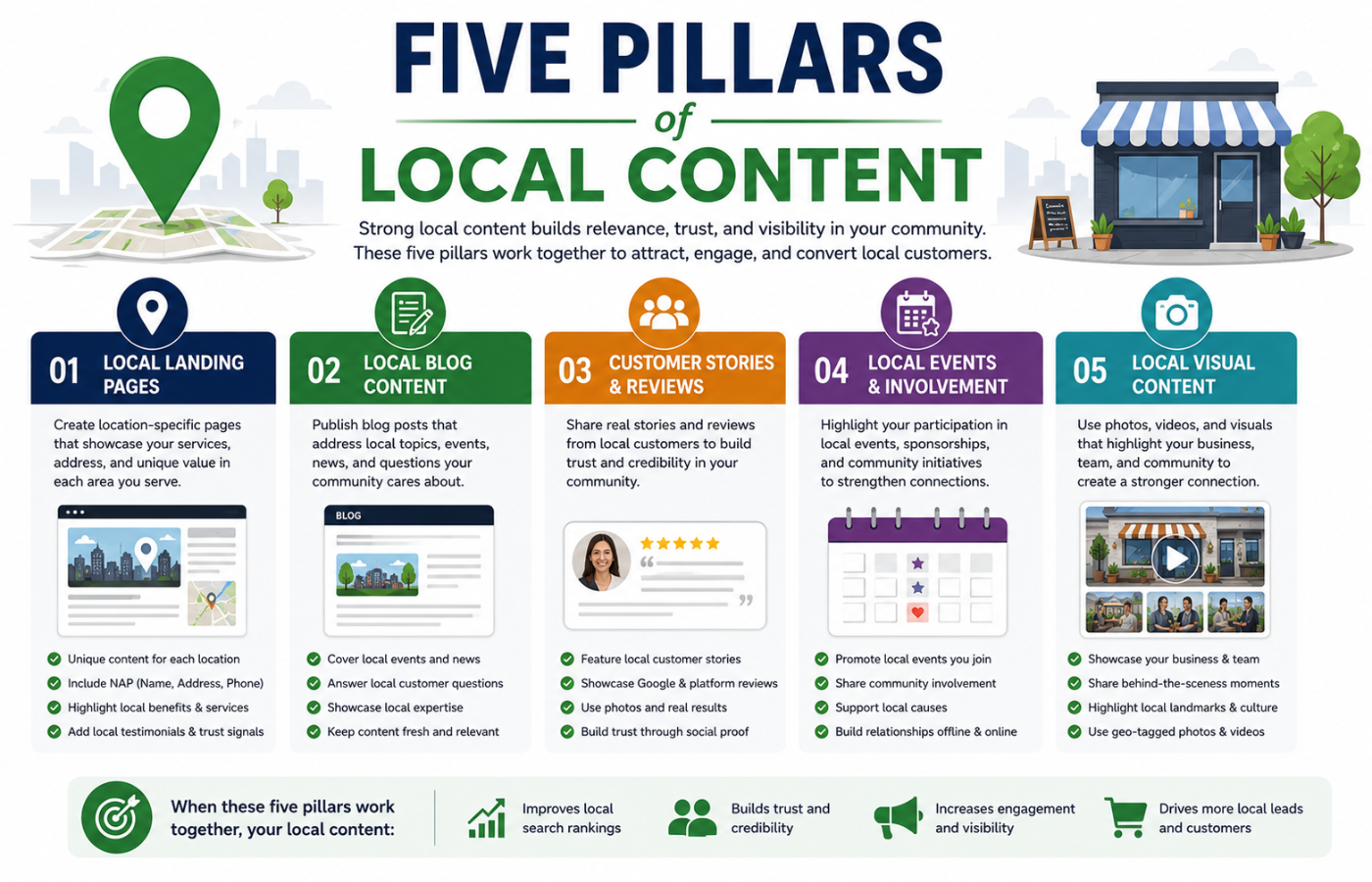
Forbes identifies five content pillars that consistently deliver results for local businesses :
| Pillar | What It Means |
|---|---|
| Core Location Pages | Neighborhood-specific hubs with local testimonials, landmarks, and community insights |
| Hyperlocal Content | Content written for the neighbourhood—not just about it |
| Local Authority Content | Industry knowledge tied to local context |
| Local Engagement Content | Document real-world community involvement (sponsorships, charity work) |
| Conversion-Focused Local Content | Tailored offers and FAQs for each neighbourhood |
Common Local SEO Mistakes to Avoid
| Mistake | Why It Hurts | Fix |
|---|---|---|
| Inconsistent NAP | Confuses Google, dilutes citation signal | Standardise and audit quarterly |
| Neglected GBP | Missing out on local pack visibility | Update photos and posts weekly |
| Ignoring reviews | 77% of consumers read reviews; they’re a ranking factor | Respond within 24 hours |
| Thin location pages | Google devalues duplicate, cookie-cutter content | Create unique, rich location pages |
| Treating SEO as one-time | Competitors who continue will overtake you | Local SEO is an ongoing process |
Measuring Local SEO Performance
Track these core metrics monthly :
-
Local pack position: For your target keywords
-
GBP impressions and actions: Calls, direction requests, website clicks
-
Organic traffic from local pages
-
Citation accuracy score
-
Review velocity and average rating
-
Conversion rate: From local search visitors
Tools: BrightLocal, Whitespark, Local Falcon .
Conclusion: The New Local SEO Mindset
Get in touch with Orbitix today.