







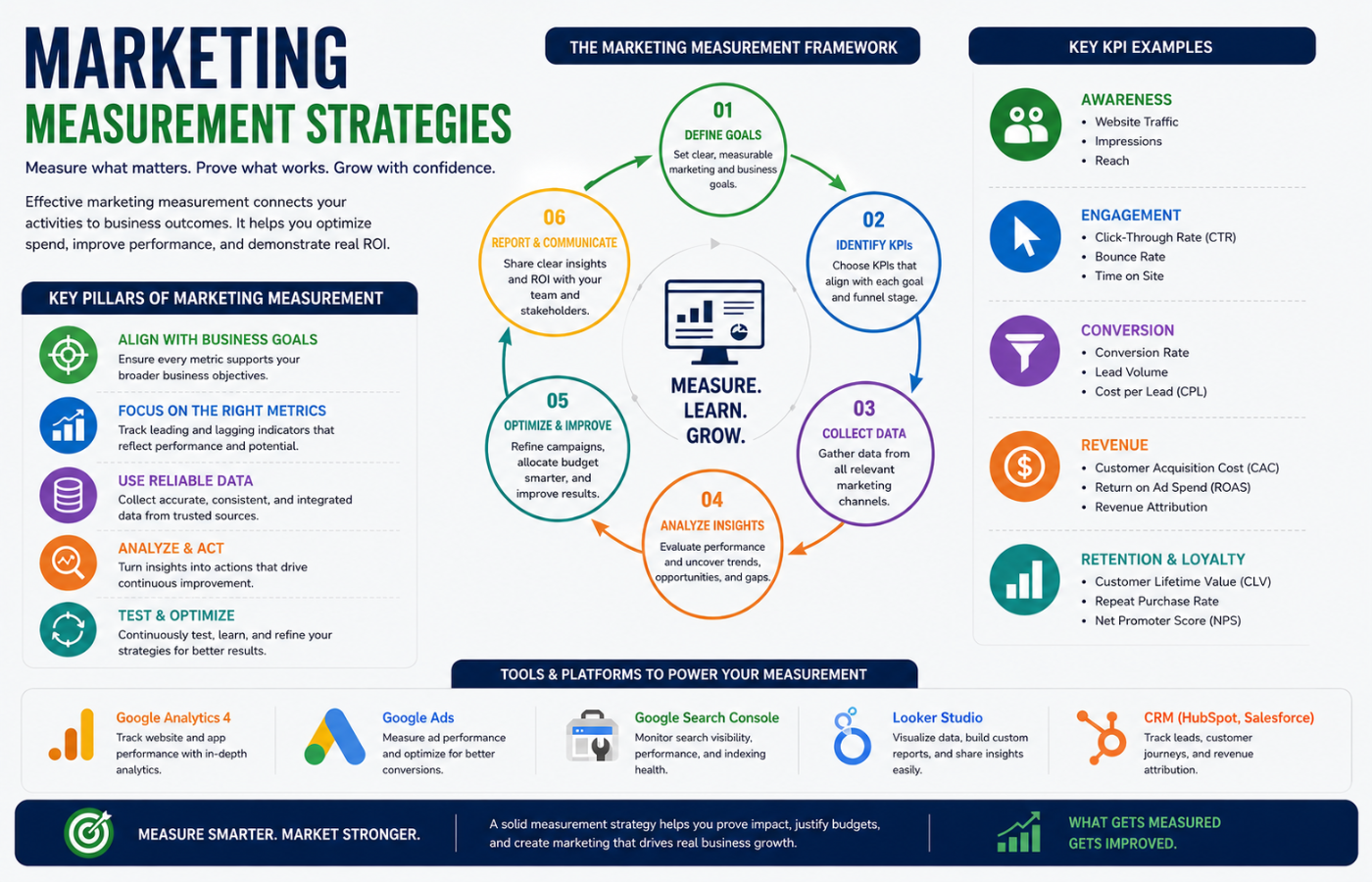
Marketing Measurement Strategies Used by High-Growth Companies
Why Most Companies Measure Marketing Wrong
7 Marketing Measurement Strategies Used by High-Growth Companies
Here are the proven marketing measurement strategies that separate high-growth companies from the rest:
1. Multi-Touch Attribution Modeling
Most businesses use last-click attribution — giving all credit to the final touchpoint before a conversion. This ignores the complex customer journey. High-growth companies use:
-
Linear attribution: Equal credit to every touchpoint
-
Time-decay attribution: More credit to touchpoints closer to conversion
-
Position-based attribution: 40% credit to first and last touch, 20% to middle
-
Data-driven attribution: Machine learning models that assign credit based on actual impact
Why it works: You understand which channels actually drive awareness, consideration, and conversion — not just the last click.
2. Customer Acquisition Cost (CAC) Analysis
CAC is the total cost of acquiring a new customer, including all marketing and sales expenses. High-growth companies track CAC by:
-
Channel: Paid search, organic, social, referrals, email
-
Campaign: Specific ad sets, content pieces, or promotions
-
Customer segment: Different CAC for B2B vs B2C, enterprise vs SMB
-
Cohort: CAC trends over time (is it increasing or decreasing?)
Why it works: You know exactly which channels are profitable and which are burning cash.
3. Customer Lifetime Value (LTV) Measurement
LTV predicts the total revenue a customer will generate over their entire relationship with your business. High-growth companies measure LTV by:
-
Cohort analysis: LTV by acquisition month, channel, or campaign
-
Segmentation: LTV by customer type (high-value vs low-value)
-
Predictive modeling: Using historical data to forecast future LTV
The gold standard: LTV should be at least 3x CAC for sustainable growth.
4. Marketing Mix Modeling (MMM)
MMM is a statistical analysis technique that measures the impact of marketing activities on sales over time. It answers questions like:
-
“What is the ROI of our TV advertising vs digital ads?”
-
“How does a 10% increase in social spend affect revenue?”
-
“What is the incremental lift from our brand campaign?”
Why it works: MMM isolates the true impact of each channel, accounting for external factors like seasonality, competition, and economic conditions.
5. Incrementality Testing
Incrementality testing measures the additional sales generated by a marketing activity — beyond what would have happened anyway. Common methods:
-
Geo-lift testing: Compare sales in test vs control regions
-
Time-lift testing: Compare sales in test vs control time periods
-
Holdout groups: Expose one group to ads, another to no ads, compare behaviour
Why it works: You stop wasting money on campaigns that don’t actually move the needle.
6. Unified Customer Journey Tracking
High-growth companies break down data silos by connecting:
-
Marketing data: Ad impressions, clicks, email opens, social engagement
-
Sales data: Calls, demos, proposals, closed deals
-
Customer data: Support tickets, product usage, retention, upsells
-
Financial data: Revenue, profit margins, refunds
Why it works: You see the complete picture — not just fragmented pieces.
7. Predictive Analytics & Forecasting
High-growth companies use historical data to predict future outcomes:
-
Lead scoring models: Which prospects are most likely to convert?
-
Churn prediction: Which customers are at risk of leaving?
-
Budget forecasting: What ROI will different budget allocations deliver?
Why it works: You allocate resources proactively, not reactively.
The Measurement Framework
| Stage | Metric | High-Growth Action |
|---|---|---|
| Awareness | Reach, Impressions, Brand Lift | Measure incrementality of brand campaigns |
| Consideration | CTR, Engagement, Time on Site | Track multi-touch attribution for assisted conversions |
| Conversion | CVR, CAC, ROAS | Calculate CAC by channel, optimise spend |
| Retention | LTV, Churn Rate, NPS | Measure LTV by cohort, identify high-value segments |
| Loyalty | Referral Rate, Upsell Rate | Track LTV-to-CAC ratio, aim for 3:1+ |
Common Measurement Mistakes
| Mistake | Why It Hurts | Fix |
|---|---|---|
| Relying on last-click attribution | Underinvests in top-of-funnel channels | Implement multi-touch or data-driven attribution |
| Ignoring offline conversions | Underestimates campaign ROI | Use call tracking, promo codes, QR codes |
| No unified tracking across teams | Fragmented view of customer journey | Implement cross-functional dashboards |
| Measuring vanity metrics | No connection to revenue | Focus on leading indicators (CAC, LTV, pipeline) |
| No incrementality testing | Wastes spend on cannibalising campaigns | Run holdout tests for all major channels |
Tools for Marketing Measurement
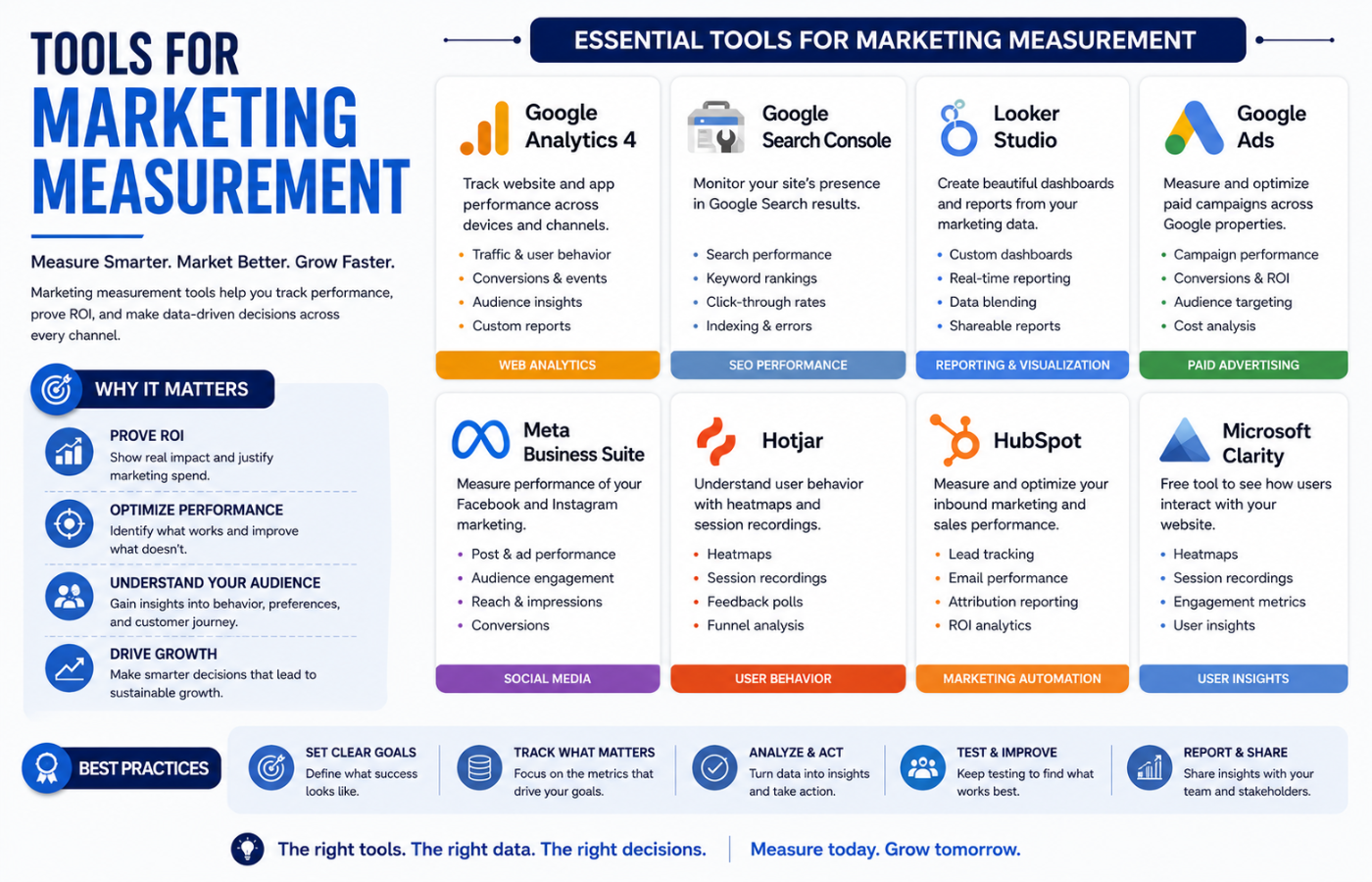
| Tool | Best For |
|---|---|
| Google Analytics 4 | Web traffic, conversions, user behaviour |
| Triple Whale | Unified e-commerce analytics (DTC brands) |
| Northbeam | Multi-touch attribution, incrementality testing |
| HubSpot | Integrated marketing, sales, and CRM analytics |
| Tableau / Looker | Custom dashboards and visualisation |
| Google BigQuery | Data warehousing for advanced analytics |
Measuring Marketing Measurement Success
Track these metrics quarterly:
-
Marketing ROI (MROI): Revenue generated per £1 of marketing spend
-
CAC payback period: How many months to recover CAC from new customers
-
LTV to CAC ratio: Target 3:1 or higher
-
Attribution accuracy: % of revenue confidently attributed to marketing
-
Forecast accuracy: Predicted vs actual performance
Conclusion: Measure What Matters
High-growth companies don’t measure everything — they measure what matters. They use multi-touch attribution to understand the full customer journey, track CAC and LTV to ensure profitability, run incrementality tests to eliminate waste, and connect data across marketing, sales, and customer success. These marketing measurement strategies turn data into decisions and decisions into revenue.
Want marketing measurement strategies that connect every campaign to revenue — so you can stop guessing and start growing?
Get in touch with Orbitix today.