






How to Measure the Success of Your Construction Company SEO Agency
Hiring a construction company SEO agency is a significant investment, but how do you know if it’s actually paying off? Unlike generic SEO, construction SEO success isn’t measured by vanity metrics like page views or keyword rankings alone—it’s about qualified leads, project inquiries, and revenue from high-value commercial and residential contracts. The same performance-focused approach applies to SEO Services for Electricians, where success is measured by more service calls, local leads, and booked jobs. A truly effective construction company SEO agency delivers measurable results that directly impact your bottom line. This guide breaks down exactly what to track and how to evaluate your agency’s performance.
Why Construction SEO Success Metrics Are Different
Construction companies face unique challenges: long sales cycles, high-value contracts, and decision-makers who research extensively before picking up the phone. Generic SEO metrics that work for e-commerce or blogging simply don’t apply. Your agency should be tracking metrics that matter for the construction industry—like phone calls from commercial project managers, form submissions for free quotes, and visibility for location-specific service terms. The same performance-driven approach is equally important for SEO for Air Conditioning Companies, where generating qualified local leads and service inquiries is essential for business growth.
8 Key Metrics to Evaluate Your Construction Company SEO Agency
Here’s how to measure whether your construction company SEO agency is delivering real value:
1. Qualified Leads (Not Just Traffic)
Traffic without leads is worthless. Your agency should track:
-
Phone calls from organic search (use call tracking numbers)
-
Contact form submissions (qualify them: commercial vs residential)
-
Quote requests and project enquiries
-
Email enquiries from your service area
What to expect: A good agency will show you a month-over-month increase in qualified leads from organic search, not just a bump in website visitors.
2. Revenue From Organic Search
This is the ultimate metric. Your agency should be able to track:
-
Estimated revenue generated from organic leads
-
Average project value from SEO-sourced enquiries
-
ROI on your SEO investment
What to expect: Your agency should demonstrate how organic search contributes to your pipeline, not just rankings. If they can’t show revenue impact, they’re not measuring what matters.
3. Local Pack Rankings
For construction companies, the Google Map Pack is often more important than organic rankings. Track:
-
Position in the “3-pack” for “[service] near me” and “[service] [city]”
-
Visibility for location-specific terms like “kitchen remodeler in [neighborhood]”
-
Google Business Profile insights (calls, direction requests, website clicks)
What to expect: Your agency should show improvement in local pack positions and an increase in GBP interactions.
4. Conversion Rate by Service Type
Not all construction services convert equally. Your agency should track:
-
Which service pages generate the most enquiries (e.g., kitchen remodeling vs. bathroom renovation)
-
Conversion rate for each service category
-
Cost per lead by service type
What to expect: Your agency should identify which services are driving the most qualified leads and optimise accordingly.
5. Organic Traffic to High-Intent Pages
It’s not about total traffic—it’s about traffic to pages that convert. Track:
-
Traffic to service pages (vs. blog posts)
-
Traffic to portfolio/case study pages
-
Traffic to contact and quote request pages
What to expect: Your agency should demonstrate increased traffic to your most important pages, not just your homepage.
6. Backlink Quality (Not Just Quantity)
Backlinks matter, but only from relevant, authoritative sources. Track:
-
Number of backlinks from construction, real estate, and home improvement sites
-
Domain Authority (DA) of linking sites
-
Referral traffic from backlinks
What to expect: Your agency should build links from industry-relevant sources—not spammy directories or low-quality sites.
7. Organic Visibility for Commercial Keywords
Construction companies often target two audiences: homeowners and commercial clients. Track:
-
Rankings for terms like “commercial construction [city]” and “industrial contractor [region]”
-
Traffic to commercial service pages
-
Enquiries from business decision-makers
What to expect: Your agency should show improved visibility for both residential and commercial keywords relevant to your business.
8. Engagement Metrics That Indicate Interest
Bounce rate and time on page matter for construction sites. Track:
-
Time on service pages (longer = higher interest)
-
Bounce rate on project portfolio pages (lower = more engagement)
-
Page views per session (indicates research behaviour)
What to expect: Users should be spending time researching your services and projects, not bouncing immediately.
Red Flags: When Your Agency Is Failing
| Red Flag | Why It’s a Problem |
|---|---|
| Only reporting keyword rankings | Rankings without leads are vanity metrics |
| Traffic increases but no lead growth | You’re attracting the wrong audience |
| No call tracking | Can’t prove calls came from organic search |
| Generic local SEO (no construction focus) | Missing high-value commercial keywords |
| No quarterly strategy review | Agency is on autopilot |
| Can’t show ROI | You have no idea if investment is paying off |
What a Good Construction SEO Agency Will Show You
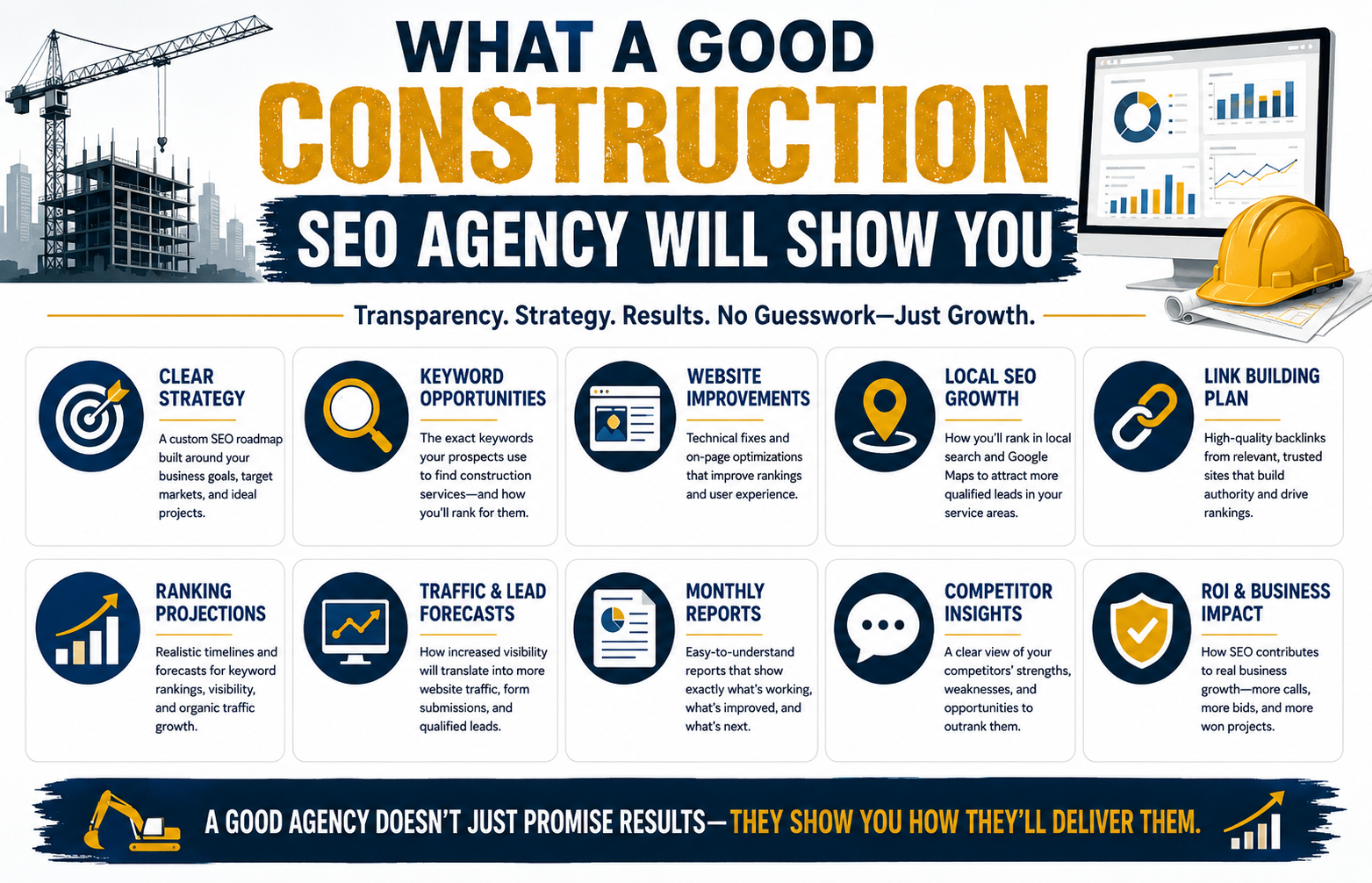
A quality agency should provide:
-
Monthly reports linking SEO activity to lead generation
-
Transparency on which keywords, pages, and strategies are working
-
Recommendations for improvement (not just data dumps)
-
Phone call recordings or transcripts from organic leads
-
Competitor benchmarking to show your relative position
Conclusion
Want a construction SEO agency that measures what matters—qualified leads, project enquiries, and revenue from commercial and residential contracts?
Get in touch with Orbitix today.