







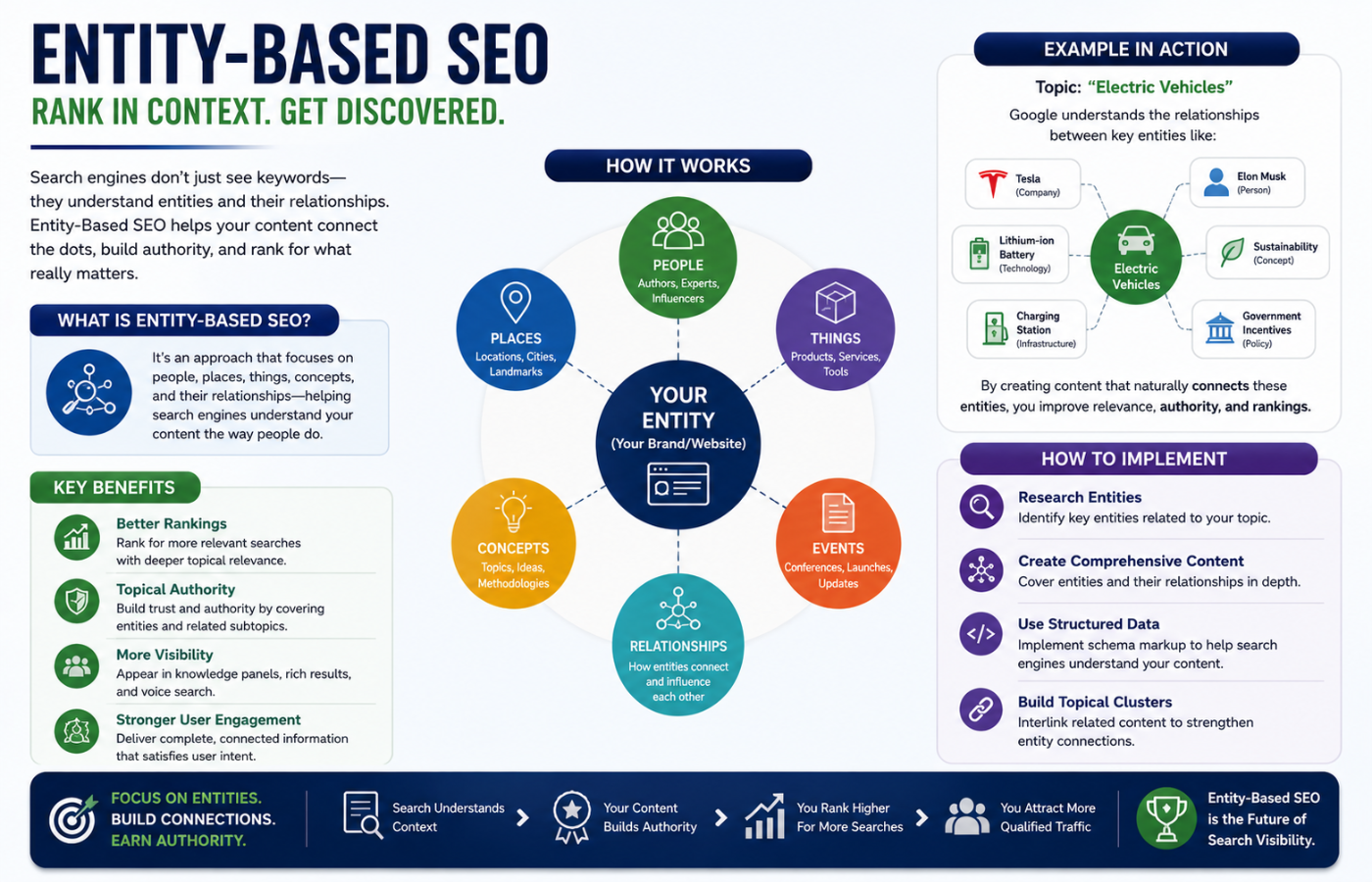
Entity-Based SEO: The Future of Search Engine Optimization
Entity-Based SEO represents the most significant shift in search optimization since Google’s original PageRank algorithm. Instead of matching keywords to web pages, modern search and AI engines now try to understand what your business actually is and how it connects to other things in the real world. While Mobile SEO Strategies ensure your website delivers a fast, responsive, and user-friendly experience across devices, optimizing for Entity-Based SEO helps search engines understand your brand, products, and services more accurately. This means optimizing for Entity-Based SEO is no longer optional—it’s essential for appearing in AI-generated answers, Knowledge Panels, and rich snippets. As search evolves from a keyword-matching engine to an AI-powered answer engine, the brands that succeed will be those with clear, consistent, and machine-readable entity identities.
What Is an Entity in SEO?
In simple terms, an entity is a specific, identifiable thing in the real world — a brand, person, place, product, or even a concept . What makes an entity different from a keyword is specificity and structure . For example:
-
A keyword: “coffee shop”
-
An entity: a specific coffee shop at a specific address with specific hours, menu items, and customer reviews
Search engines model the world using entities because they carry meaning and context that keywords alone can’t provide . Google’s Knowledge Graph now handles over 800 billion facts about 8 billion entities , connecting them through relationships like “brand makes product” and “person works at organization” .
Why Entity-Based SEO Is the Future of Search
There are several key reasons why Entity-Based SEO is becoming the dominant approach :
Traditional SEO vs. Entity SEO
| Traditional Keyword SEO | Entity-Based SEO |
|---|---|
| Matches exact phrases | Understands meaning and context |
| Targets search volume | Targets user intent |
| Low adaptability to algorithm changes | High adaptability; future-proof |
| Keyword stuffing risk | Natural, relationship-focused content |
Google’s Knowledge Graph
Google launched its Knowledge Graph in 2012 — a database of entities and their relationships that powers Knowledge Panels, rich snippets, and local search results. As highlighted in Google SEO Updates 2026, Google doesn’t just match keywords when you search for a business. Instead, it retrieves an entity from its Knowledge Graph and surfaces the attributes and relationships it has confidence in, making entity optimization more important than ever.
AI Answer Engines Need Entities
AI answer engines like ChatGPT, Gemini, and Perplexity synthesize answers from multiple sources . When someone asks “What’s the best physical therapy clinic near downtown Austin?”, the AI isn’t searching for pages containing those words — it’s querying its model of the world and asking:
-
Which entities of type ‘physical therapy clinic’ are associated with downtown Austin?
-
What attributes and reviews are associated with those entities?
-
Which ones have enough structured, consistent data to cite confidently?
Brand Mentions Without Links Now Count
Modern AI systems can evaluate trust and expertise without needing a hyperlink as a crutch . A brand mention in a reputable publication — even without a link — reinforces entity authority. Brands that consistently appear in topic-related conversations are seen as proof of real-world relevance . The data shows: brands in the top 25% for web mentions average 169 AI Overview citations, while the next quartile averages just 14 .
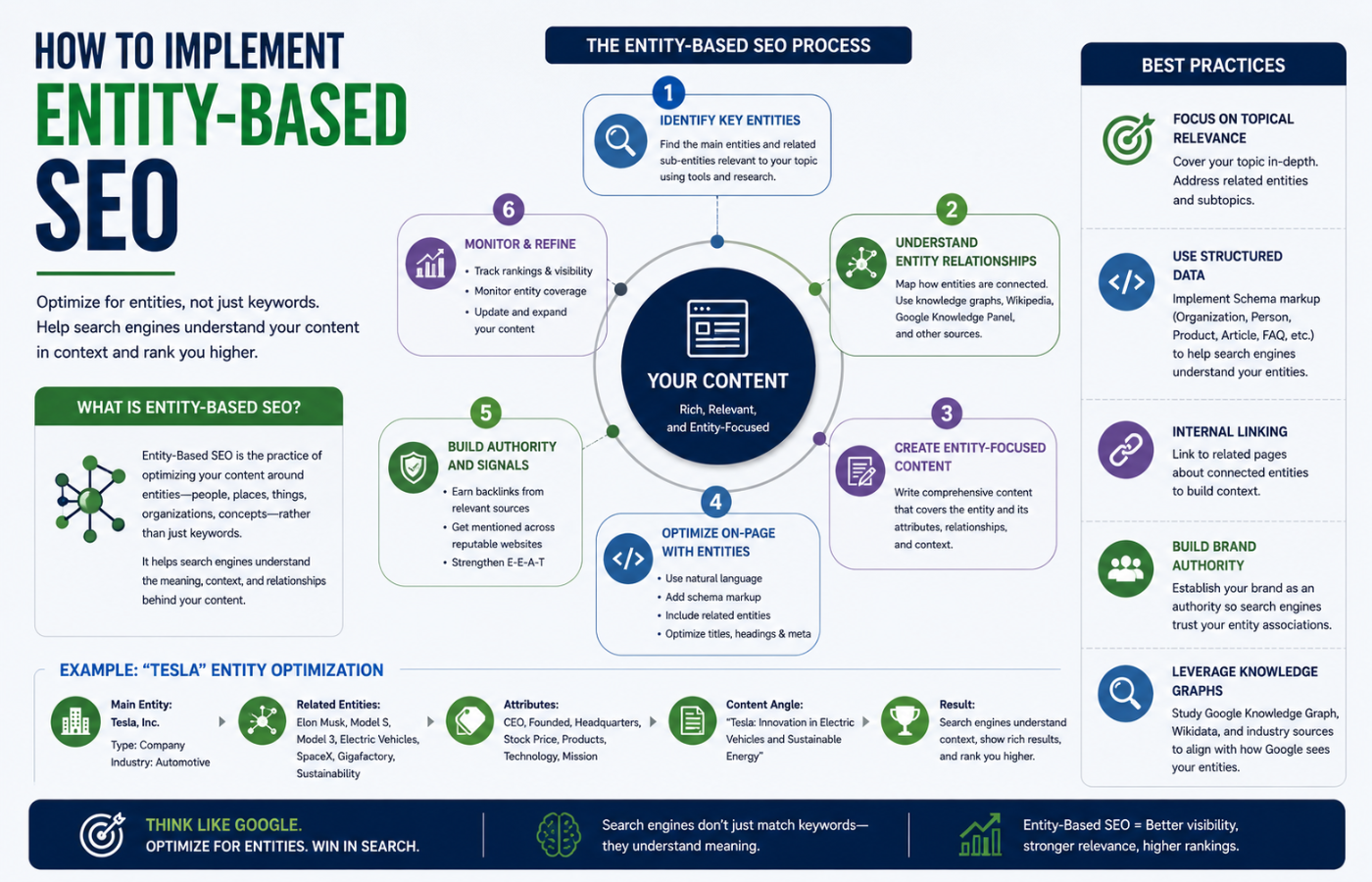
How to Implement Entity-Based SEO
1. Start With Your Canonical Entity Hub
Designate a single “About” or “Identity” page as the canonical record for your brand . Include: clear brand name, unique description, logo, core products/services, social links, and machine-readable metadata .
2. Implement Structured Data (Schema Markup)
Use JSON-LD to add schema types like Organization, LocalBusiness, Product, and Person . As Microsoft’s Principal Product Manager for Bing stated: “Schema can label your content as a product, review, FAQ, or event, turning plain text into structured data that machines can interpret with confidence” .
3. Use Entity Linking
Link your entities to authoritative sources using schema properties like sameAs, mentions, and areaServed . This reduces ambiguity, improves ranking relevance, and can help your content perform better in AI summaries .
4. Build Topic Clusters
Create a content hub (pillar page) covering a broad topic, linked to multiple cluster pages covering specific subtopics . Internal links signal relationships and boost topical authority .
5. Generate Original Research and Data
AI systems value “information gain” — the degree to which your content adds something new to the existing knowledge base . Original case studies, benchmark reports, and named expert perspectives create signals that AI models weigh heavily .
6. Expand Your Brand Presence
Get featured in authoritative publications, participate in Reddit discussions, publish thought leadership on LinkedIn and Medium — these unlinked mentions strengthen your entity across the web .
7. Conduct Entity Gap Analysis
Compare your content’s entity relationships with those found in top-ranking competitor articles to identify missing entities or relationships . Tools like InLinks, Google’s NLP API, and Rank Math’s RankBot can help automate this process .
Measuring Entity SEO Success
Traditional keyword rankings don’t tell the full story. Track these metrics instead:
-
Knowledge Panel appearances — recognition that Google understands your entity
-
Rich snippet frequency — enhanced search features
-
AI Overview citations — how often your brand appears in AI-generated answers
-
Branded web mentions — signal of real-world presence
-
Entity recognition accuracy — using Google’s Knowledge Graph API
-
Impressions for non-branded queries — category-level visibility
Conclusion
Want an entity-based SEO strategy that builds brand recognition, AI citations, and sustainable visibility — not just keywords that no longer guarantee rankings?
Get in touch with Orbitix today.