







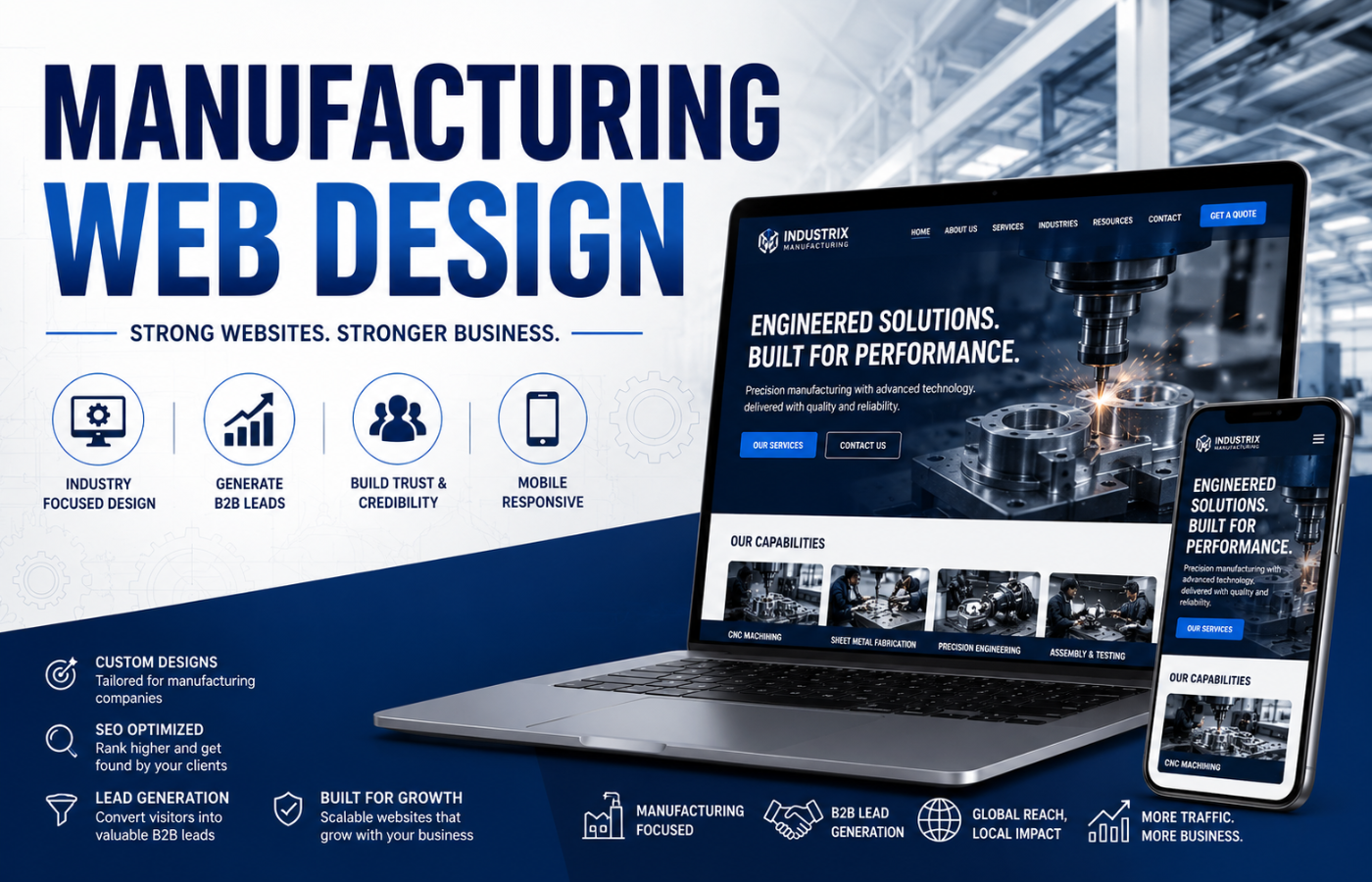
How a Professional Manufacturing Web Design Helps Generate B2B Leads
Manufacturing web design is fundamentally different from building a standard brochure site or an e-commerce store. While a retail website focuses on impulse purchases and emotional triggers, a manufacturing site must serve a highly technical B2B audience: procurement managers, engineers, plant supervisors, and C-suite executives who need detailed specifications, certifications, and case studies before making a six- or seven-figure buying decision. Much like a successful B2B website, a manufacturing website must prioritize trust, expertise, and clear communication to support longer sales cycles and complex purchasing decisions. Professional manufacturing web design bridges the gap between shop-floor capability and digital credibility, transforming a factory’s website from a passive online brochure into an active lead generation engine.
Why Manufacturers Struggle With Traditional Website Templates
Off-the-shelf templates almost always fail for industrial companies. A restaurant or salon might thrive with a beautiful homepage and Instagram integration, but manufacturers need heavy-duty functionality: downloadable PDF spec sheets, interactive product catalogs, request-for-quote (RFQ) forms, and often password-protected distributor portals. Generic templates lack these industrial-grade features, and even when they are kludged in, the user experience suffers. B2B buyers can spot an amateur site instantly — and they equate poor web design with poor manufacturing quality.
Key Features of Manufacturing Web Design That Drive B2B Leads
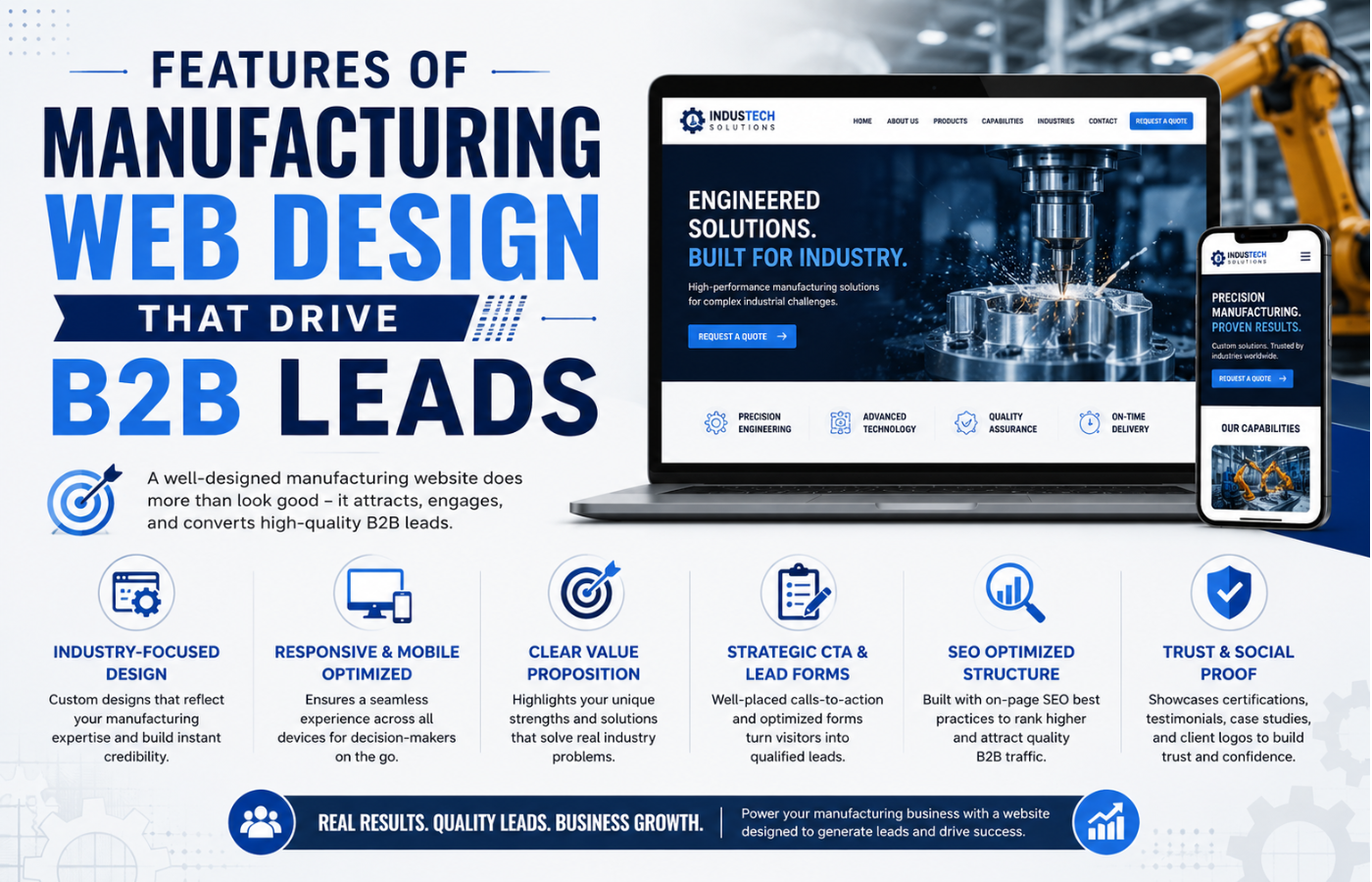
Effective manufacturing web design focuses on features that directly support the B2B buying cycle, which is longer, more research-intensive, and involves multiple decision-makers:
-
Product & Service Catalogs With Filtering: B2B buyers need to sort by material, size, tolerance, application, or industry. A well-designed catalog allows them to narrow thousands of options down to a handful in seconds.
-
Searchable Technical Documentation: Every spec sheet, CAD drawing, safety data sheet (SDS), compliance certificate (ISO, AS9100, FDA), and manual should be searchable and downloadable without a login barrier.
-
RFQ & Contact Forms That Qualify Leads: Generic “Contact Us” forms generate spam. Manufacturing-specific forms ask for company name, annual volume, required delivery date, and technical specifications — so your sales team receives warm, qualified inquiries.
-
Case Studies & Application Stories: B2B buyers want proof you have solved problems for similar companies. Each case study should include the challenge, solution, measurable results (e.g., “reduced downtime by 30%”), and a relevant testimonial.
-
Capabilities Pages (Not Just Services): Instead of listing generic “services,” manufacturers should have a capabilities matrix showing material types, maximum dimensions, finishing options, tolerances, and lead times.
-
Custom Quote Calculator (Advanced): For manufacturers with standardised products (e.g., custom gaskets, machined parts), an interactive calculator that estimates price and lead time based on user inputs can dramatically increase conversions.
-
Distributor & Dealer Portals: If you sell through channels, a password-protected portal with inventory levels, co-op marketing materials, and order tracking keeps partners loyal and active.
-
Equipment & Facility Tour: B2B buyers want to know you have the machinery to deliver. High-quality video tours, machine lists with specifications, and quality lab photos build enormous trust.
The Manufacturing Buyer’s Journey: How Web Design Maps to It
| Buyer Stage | What They Need | Manufacturing Web Design Feature |
|---|---|---|
| Awareness | “Does this company exist?” | Fast-loading homepage, clear value proposition, trust badges (ISO, UL, ASME) |
| Consideration | “Can they handle my specs?” | Searchable technical docs, spec sheets, case studies, material capabilities |
| Decision | “How do I get a quote?” | Simple RFQ form, clear lead times, customer testimonials, live chat with engineering |
| Post-Sale | “Where’s my order?” | Order tracking portal, reorder buttons, saved quote history |
Technical SEO for Manufacturing Websites
A beautiful site is useless if procurement managers cannot find it. Manufacturing web design must include:
-
Long-Tail Keyword Targeting: “CNC machining near me” is too broad. Target phrases like “5-axis CNC milling for aerospace aluminum components.”
-
Schema Markup for Products: Help Google understand your technical specs, brand, MPN, and GTIN for rich snippets.
-
Geo-Targeted Service Areas: If you ship nationally or globally, create location pages (e.g., “Precision Machining for Automotive Plants in Ohio”).
-
Internal Linking Between Specs and Products: When a buyer lands on a material page (e.g., “316 Stainless Steel”), link directly to relevant case studies, RFQ forms, and related products.
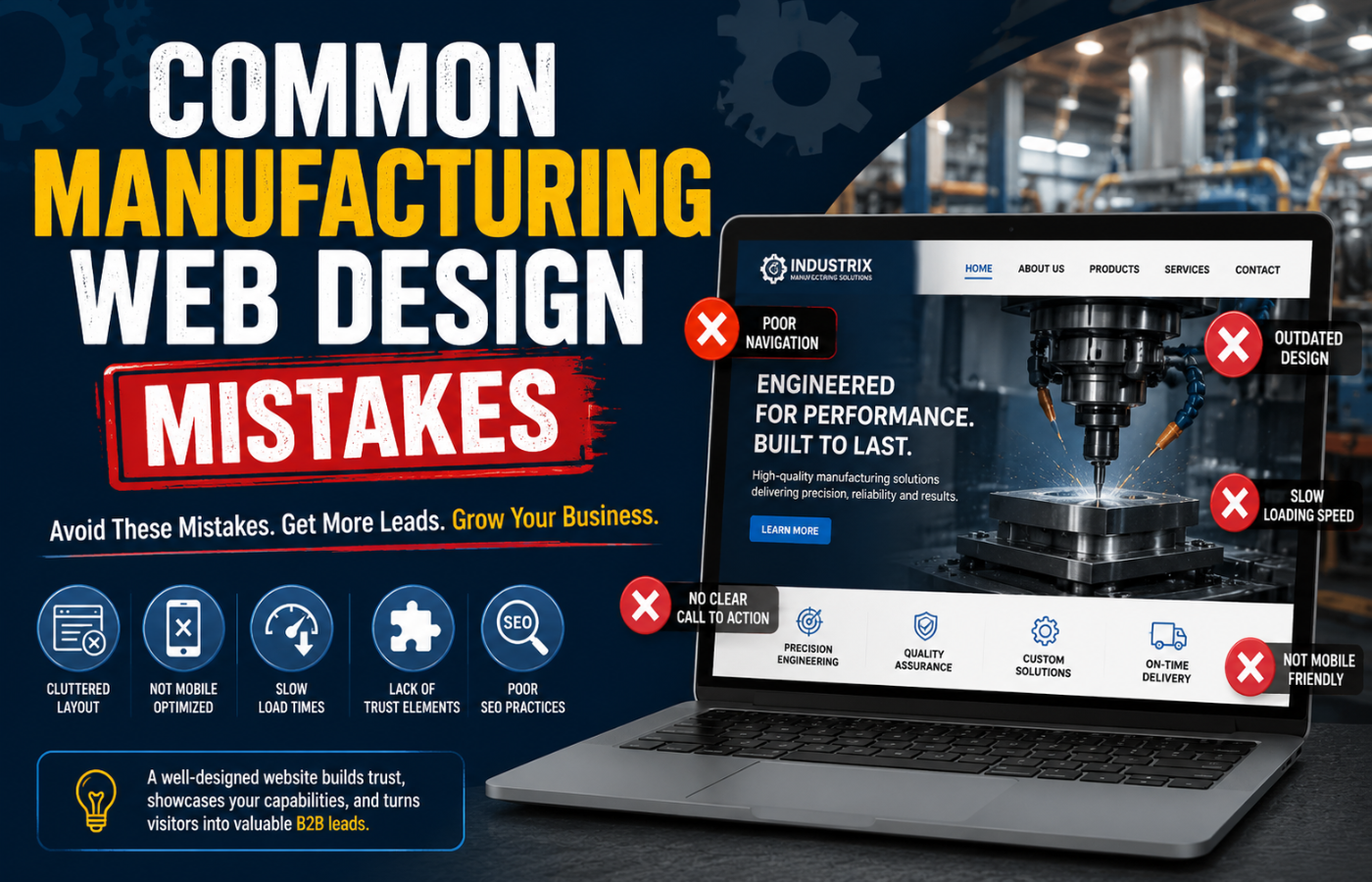
Common Manufacturing Web Design Mistakes
-
Hiding the RFQ form behind multiple clicks (every extra click drops conversion rate by 50%)
-
Using PDFs for critical content without HTML alternatives (PDFs are not mobile-friendly and are harder for Google to index)
-
No phone number or chat option (many B2B buyers want to speak to a human before submitting a formal RFQ)
-
Outdated equipment lists or certifications (if your ISO cert expired last year and is still on your site, you lose all trust)
-
Ignoring mobile users (plant managers often research suppliers from tablets or phones on the shop floor)
Measuring Lead Generation Success
Track these metrics monthly to evaluate your manufacturing web design ROI:
-
RFQ Completion Rate: Percentage of visitors who start and submit a quote request.
-
Spec Sheet Downloads: How many buyers are researching your technical capabilities.
-
Time-to-Lead: How quickly a visitor converts from first click to RFQ submission.
-
Bounce Rate on Product Pages: High bounce rates indicate poor technical content or slow load speeds.
Conclusion: Your Website as Your Best Sales Engineer
In B2B manufacturing, your website works 24/7 as a silent sales engineer — answering technical questions, providing spec sheets, and capturing qualified leads while your human team sleeps. Professional manufacturing web design transforms an ordinary industrial site into a lead generation machine that outworks any trade show booth or cold call campaign. Just as businesses investing in website design Staffordshire focus on creating user-friendly, conversion-driven websites, manufacturers must ensure their online presence is built to attract, engage, and convert potential clients effectively.
Want a heavy-duty manufacturing website that turns engineers and procurement managers into qualified leads — without the typical B2B friction?
Get in touch with Orbitix today.