







How to Perform B2B Keyword Research Using Ubersuggest Like a Pro
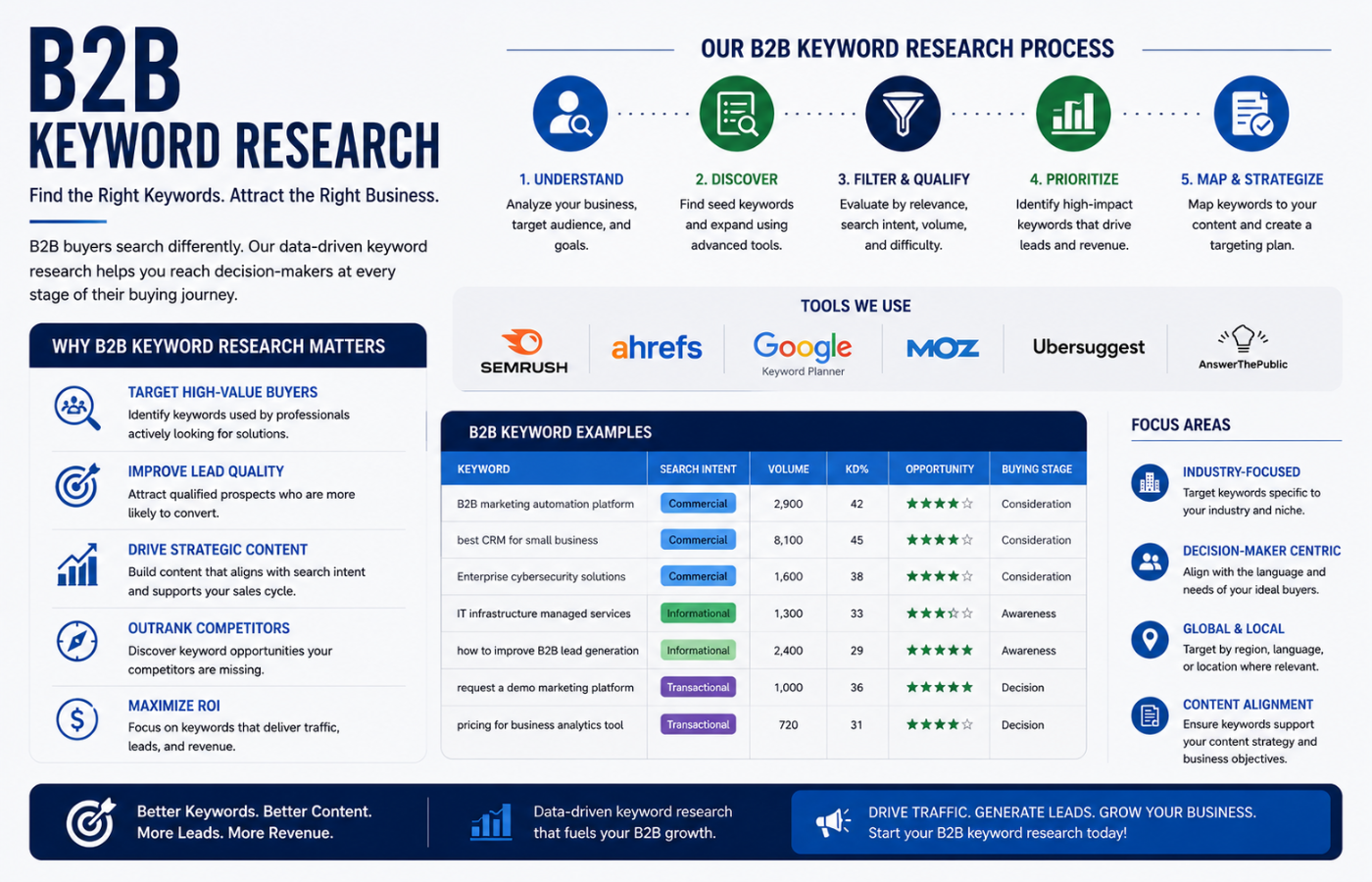
Effective B2B keyword research requires a fundamentally different approach than traditional SEO. While B2C marketing targets individual consumers with high-volume terms, B2B keyword research focuses on lower-volume, higher-value keywords that reflect a more complex buying journey. This is where Ubersuggest shines—it helps you uncover the specific phrases decision-makers use when they’re actively researching solutions for their business. As you’ll see in this B2B SEO Case Study, the right keyword strategy can significantly improve qualified traffic and lead generation. Unlike consumers, B2B buyers involve multiple stakeholders and conduct extensive research before making a purchase, meaning your B2B keyword research needs to map to every stage of the funnel. In this guide, we’ll walk through exactly how to use Ubersuggest like a pro to find high-intent B2B keywords that actually convert.
Why B2B Keyword Research Is Different
The B2B buying journey is complex. Multiple decision-makers—from end-users to IT managers to executives—each search with different questions and concerns . The sales cycle is longer, and the keywords that matter aren’t the high-volume broad terms but the specific, long-tail phrases that signal commercial intent.
Key differences :
| Aspect | B2B Keyword Research | B2C Keyword Research |
|---|---|---|
| Primary Goal | Generate qualified leads, nurture relationships | Drive direct sales, impulse buys |
| Target Audience | Multiple stakeholders | Individual consumer |
| Keyword Volume | Lower volume, higher specificity | Higher volume, broader terms |
| Sales Cycle | Months to years | Minutes to days |
Step-by-Step B2B Keyword Research Using Ubersuggest
Step 1: Start With Sales Team and Customer Conversations
Do not start in a keyword tool. Start with human conversations .
Your sales team knows exactly what prospects ask before they buy. They hear the same objections, pain points, and decision criteria repeatedly. That language? It’s keyword fuel. Ask them :
-
“What are the top questions every prospect asks before a demo?”
-
“What phrases come up in discovery calls?”
-
“What signals buying intent?”
Then talk to current customers. Ask what they Googled before they found you. What words did they use to describe their problem? Why did they choose you over a competitor ?
Log every phrase, question, and pain point. These are your foundational seed keywords.
Step 2: Use Ubersuggest to Expand Your Keyword Set
Once you’ve got seed terms from sales and customers, plug them into Ubersuggest to scale.
How to do it:
-
Enter a seed keyword (e.g., “marketing automation for enterprise”) into Ubersuggest’s search bar .
-
Navigate to “Keyword Ideas” to see related terms, autocomplete suggestions, and questions .
-
Pay attention to the “Questions” tab—this is a powerhouse for B2B. It shows actual queries like “How to choose a marketing automation platform for B2B?” .
Ubersuggest’s keyword types :
-
SUGGESTIONS – Recommended related terms
-
RELATED – Thematic variations
-
QUESTIONS – Phrased as actual questions (ideal for blog content)
-
COMPARISONS – “vs” keywords showing evaluation intent
Step 3: Analyse Intent, Not Just Volume
In B2B keyword research, high search volume doesn’t always mean high value .
A keyword like “lead generation” might pull thousands of searches but it’s broad and packed with top-of-funnel traffic. Instead, go after long-tail keywords that signal real buying intent :
High-intent patterns to look for:
-
Comparison terms: “HubSpot vs Salesforce” or “SOC 2 vs ISO 27001” – buyers actively evaluating solutions
-
Integration keywords: “CRM that integrates with QuickBooks” – signals technical alignment needs
-
Use-case specific: “Lead scoring software for SaaS” – shows solution awareness
-
Pain point phrases: “How to reduce churn in B2B SaaS” – strong entry points for solution-aware buyers
Use Ubersuggest filters :
-
Look for commercial modifiers like “vs,” “best,” “top,” “alternative to,” “review,” “pricing,” “implementation”
-
Check Cost-Per-Click (CPC) – high CPC signals commercial value (advertisers are willing to pay for that click)
-
Target low-to-medium SEO Difficulty (SD) you can realistically compete for
Step 4: Spy on Competitors (Especially in Niche B2B)
Your competitors are already ranking for terms your ideal customers search for. Reverse-engineer what’s working .
How to do competitor analysis in Ubersuggest :
-
Enter a competitor’s domain into the “Similar Websites” report.
-
Look for:
-
Common Keywords – Keywords both you and your competitors target
-
Keywords Gap – Keywords your competitors rank for, but your site does not
-
These keyword gaps are your opportunities. A competitor ranking for a high-value term means there’s search volume and commercial intent. You can create better, more comprehensive content to outrank them .
Pro tip: In niche B2B markets, a keyword with even 100 searches a month could drive qualified leads if the intent is strong and competition is low .
Step 5: Group Keywords Into Topic Clusters
A scattered list of keywords creates a scattered website. Organise your findings into a topic cluster model .
Pillar → Broad core topic (e.g., “B2B Marketing Automation Software”)
Clusters :
-
Integration: “marketing automation salesforce integration”
-
Use case: “lead nurturing for complex sales cycles”
-
Comparison: “marketo vs. pardot comparison”
This structure signals to search engines that you’re a comprehensive authority on the topic. Internally, it creates a logical journey for visitors, moving them from a cluster article directly to your main pillar solution page .
Step 6: Use Ubersuggest’s Keyword Lists Feature
Ubersuggest’s Keyword Lists feature helps you organise keywords by topic, making them easier to use for content creation and page optimisation .
How to create and use lists :
-
Free users can create up to three keyword lists; paid users enjoy unlimited lists
-
To create a list: click Keyword List → “Create Your First List” → assign a name → add keywords
-
Each keyword entry includes volume, SEO difficulty, CPC, and estimated visits
Step 7: Track Keywords With Ubersuggest Projects
Once you’ve identified your target keywords, track them in Ubersuggest’s Project feature .
How to create a project :
-
From the Dashboard, click “Add Project”
-
Insert your domain and competitors you want to track
-
Review suggested prompts to track your visibility in ChatGPT and Gemini
-
Select the keywords you want to monitor
Projects track keyword rankings weekly, and you can monitor competitors’ rankings alongside yours .
B2B Keyword Types You Should Actually Focus On
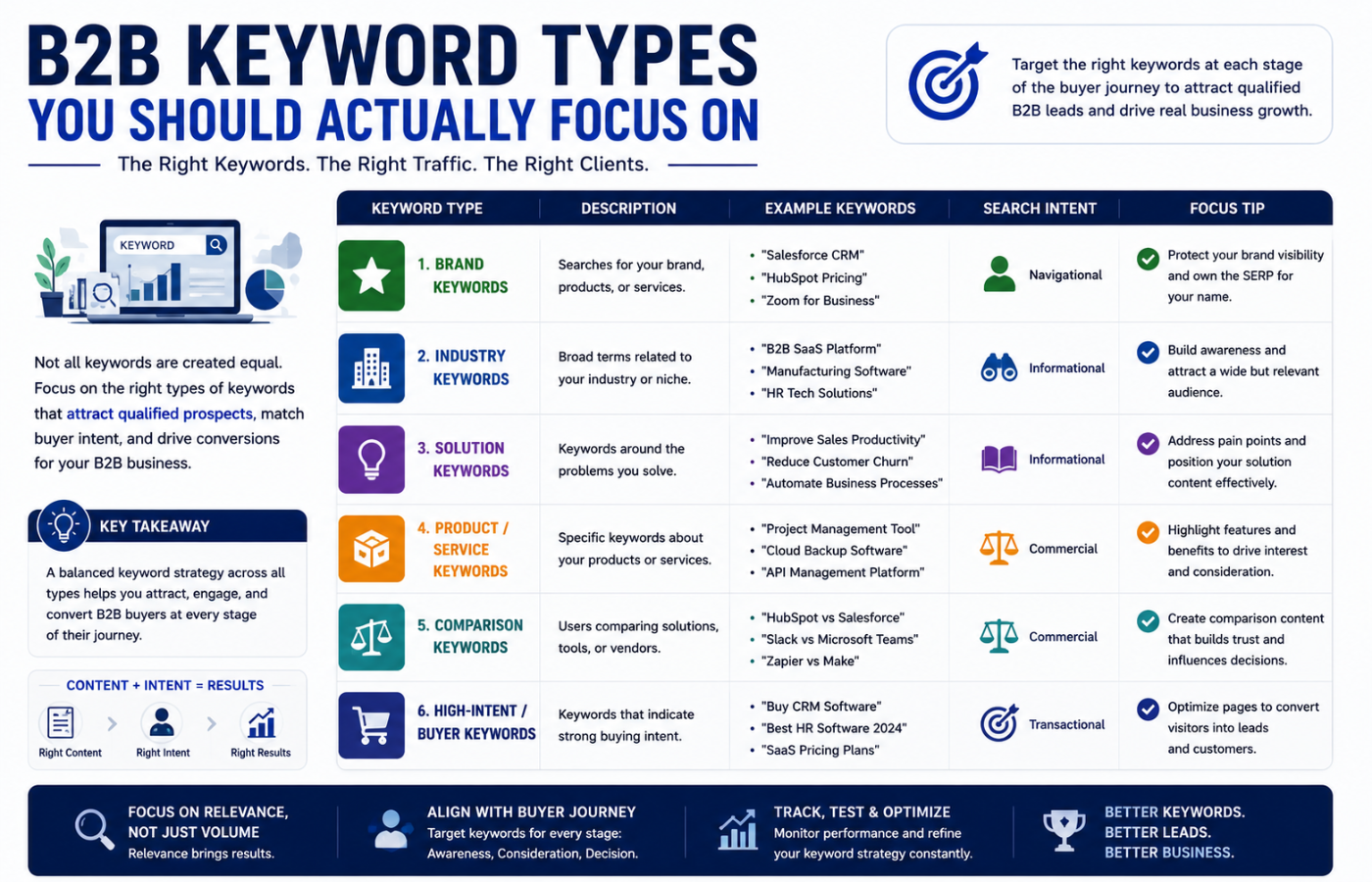
Not all keywords are created equal. Here are the four types that consistently deliver in B2B :
| Keyword Type | Example | Why It Works |
|---|---|---|
| Comparisons | “HubSpot vs Salesforce” | High-intent evaluation mode |
| Integrations | “Slack integration with project management” | Signals technical alignment |
| Use-Case Specific | “Lead scoring software for SaaS” | Specific, solution-aware traffic |
| Pain Point Phrases | “How to reduce churn in B2B SaaS” | Strong entry points for solution-aware buyers |
What to Do After You Have Your Keywords
Use them to:
-
Optimise meta descriptions and body copy
-
Create schema markup like FAQs for more useful listings
-
Build content hubs and link clusters
-
Repurpose content into different formats
Common B2B Keyword Research Mistakes to Avoid
| Mistake | Why It Hurts | Fix |
|---|---|---|
| Chasing high-volume only | Attracts fluff traffic, not leads | Prioritise intent over volume |
| Ignoring the funnel | Breaks your pipeline | Map keywords to TOFU, MOFU, BOFU |
| Not using sales team insights | Misses real buyer language | Interview sales and customers first |
| Skipping competitor analysis | Misses opportunities | Use Ubersuggest’s Keywords Gap report |
Conclusion
Want B2B keyword research that uncovers exactly what your decision-makers are searching for—so you can create content that ranks and converts high-value customers?
Get in touch with Orbitix today.