







Audience Segmentation Strategy: Types, Examples, and Best Practices
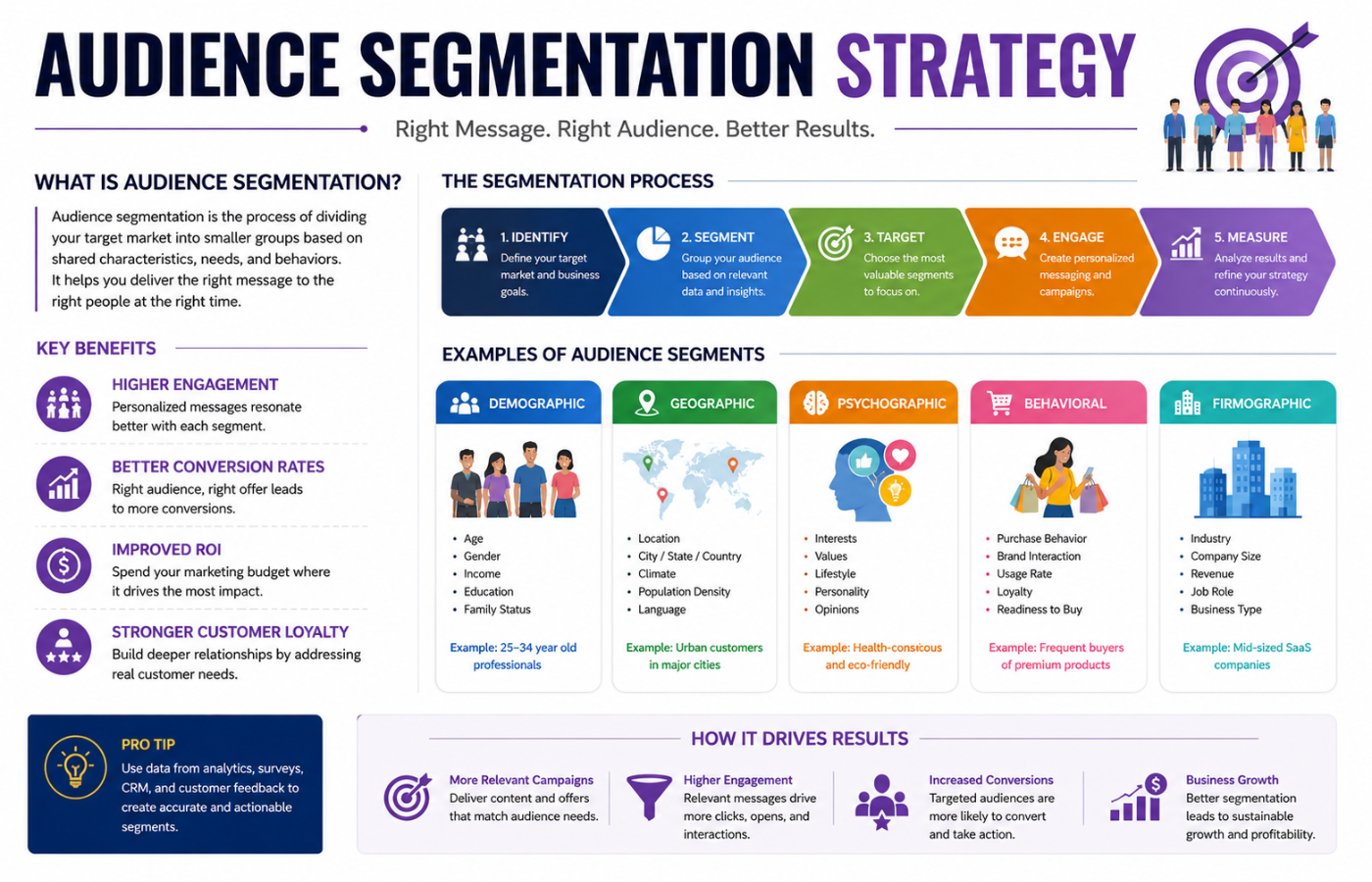
An audience segmentation strategy is the cornerstone of modern marketing success. Instead of broadcasting a generic message to everyone, audience segmentation divides your target market into smaller, more specific groups based on shared characteristics like demographics, behaviours, or psychographics . A well-executed audience segmentation strategy allows businesses to deliver the right message to the right person at the right moment, resulting in higher engagement, stronger conversions, and more efficient marketing spend .
What Is Audience Segmentation?
Audience segmentation is the practice of categorizing your audience into groups based on shared traits, enabling you to tailor your marketing efforts to each specific group. Unlike mass marketing, which treats everyone the same, segmentation acknowledges that different customers have different needs, preferences, and motivations. Insights from AI Visibility Reports can further strengthen your segmentation strategy by revealing how different audience groups interact with your content across AI-powered search platforms. The data is compelling: properly segmented campaigns can generate up to 760% more revenue than non-segmented ones.
Segmentation works across multiple dimensions, creating rich, actionable customer profiles. By combining different segmentation criteria, you can define highly specific groups that respond to personalised messaging .
Types of Audience Segmentation Strategy
An effective audience segmentation strategy uses several segmentation types, each offering a unique lens:
Demographic Segmentation
The most basic segmentation type groups audiences by age, gender, income, education, and occupation . A luxury cosmetics brand might target women aged 30–55 with high disposable income, while a budget-friendly brand focuses on younger, price-conscious consumers.
Geographic Segmentation
Grouping based on location—from continent down to postcode—helps tailor campaigns to regional preferences, climate, and culture . A clothing retailer promotes winter coats in cold regions and lightweight summer wear in warmer climates. Geographic targeting also enables localised promotions for events or holidays specific to a region .
Psychographic Segmentation
This delves into the ‘why’ behind customer behaviour: values, interests, lifestyles, and personality traits . A travel agency might create campaigns for adventure-seekers and separate campaigns for those seeking luxury relaxation.
Behavioral Segmentation
Behavioral segmentation examines what customers actually do—purchase history, website visits, content engagement, and product usage . This is one of the most powerful segmentation types because behaviour signals intent .
Firmographic Segmentation (B2B)
The B2B equivalent of demographics, firmographic segmentation groups businesses by industry, revenue, employee count, and growth stage . A 10-person startup needs a completely different sales approach than a 5,000-person enterprise.
Lifecycle Stage Segmentation
Where customers are in their journey—new visitor, active user, loyal customer, at-risk, or lapsed—determines which messages are relevant . New leads need education; existing customers need upsells and loyalty rewards; lapsed users need win-back campaigns .
Technographic Segmentation
Grouping by technology use (device, operating system, software preferences) helps deliver channel-optimised experiences . Mobile users need thumb-friendly interfaces; desktop users may prefer in-depth content.
Predictive Segmentation
Using AI to anticipate future behaviour, predictive segmentation identifies customers likely to churn, purchase again, or upgrade . This enables you to intervene proactively rather than reactively .
Examples of Audience Segmentation Strategies in Action
Example 1: E-commerce Retailer
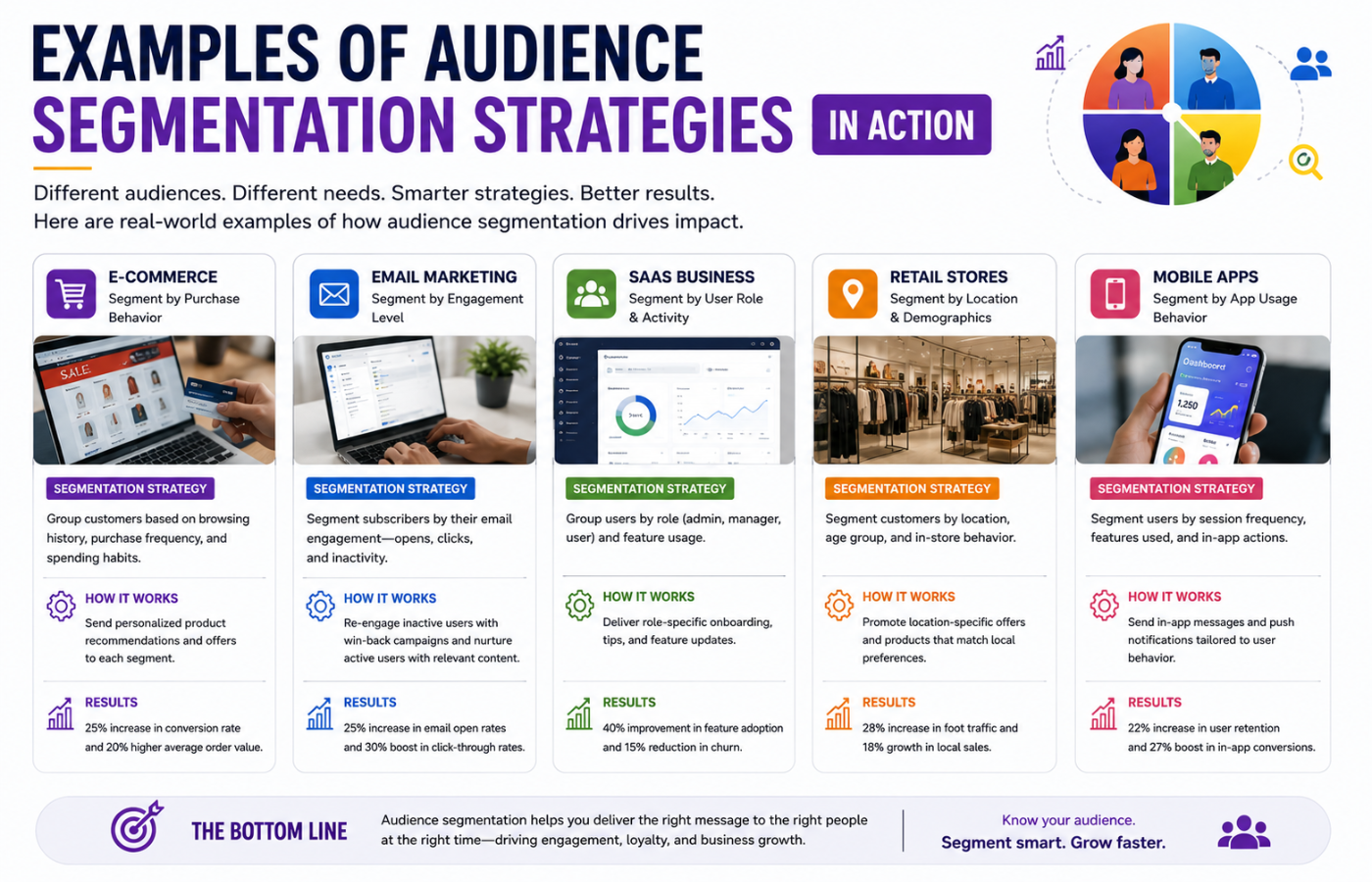
An online fashion retailer implemented behavioral segmentation and identified three key groups: frequent buyers, one-time purchasers, and cart abandoners. Frequent buyers received VIP perks and early access. One-time purchasers received personalised style guides. Cart abandoners received reminder emails with free-shipping offers. The result: repeat purchases rose sharply, cart abandonment dropped, and customer lifetime value grew across all segments .
Example 2: SaaS Company
A B2B software company used firmographic segmentation to separate startups from enterprise clients. Startups received self-serve onboarding content and scalable pricing options, while enterprises received white-glove implementation support and custom contracts. This reduced churn among startups and increased upsell opportunities with enterprises .
Example 3: Fitness App
A fitness app used psychographic and behavioral segmentation to target two distinct groups: casual exercisers and fitness enthusiasts. Casual exercisers received encouragement and simple routines, while fitness enthusiasts were targeted with advanced workouts and performance-tracking features. Each group received messaging that matched their specific motivation and commitment level .
Example 4: Netflix
Netflix uses behavioral segmentation to power its content recommendation engine. By analysing viewing habits, Netflix serves up relevant recommendations on-platform and via email, reducing churn and keeping subscribers engaged .
How to Build Your Audience Segmentation Strategy
Step 1: Set Specific Segmentation Goals
Define what you want to achieve. Vague goals lead to vague results. Connect segmentation to business objectives: if you need more revenue, focus on high-value customer segments; if you want better retention, segment by engagement levels .
Step 2: Gather and Unify Customer Data
Good segmentation requires good data from multiple sources: website analytics, CRM, email engagement, support tickets. Unifying this data creates complete customer profiles .
Step 3: Select Your Segmentation Criteria
Choose criteria that matter for your business. B2B companies might prioritise company size and industry. B2C brands often focus on behaviour and demographics. Start with 3-5 high-impact segments rather than 50 micro-segments nobody maintains .
Step 4: Create and Validate Segments
Build your segments and test them before full rollout. Use pilot campaigns to validate that segments behave differently. If two segments respond the same way, they’re not distinct enough .
Step 5: Activate Across All Channels
Segmentation only works when used consistently across email, website, ads, and sales outreach. Every touchpoint should reflect segment insights .
Step 6: Test, Refine, and Repeat
Track performance by segment. Monitor metrics like open rates, click-throughs, and conversions. Refine your segments as customer behaviour evolves .
Best Practices for Audience Segmentation Strategy
-
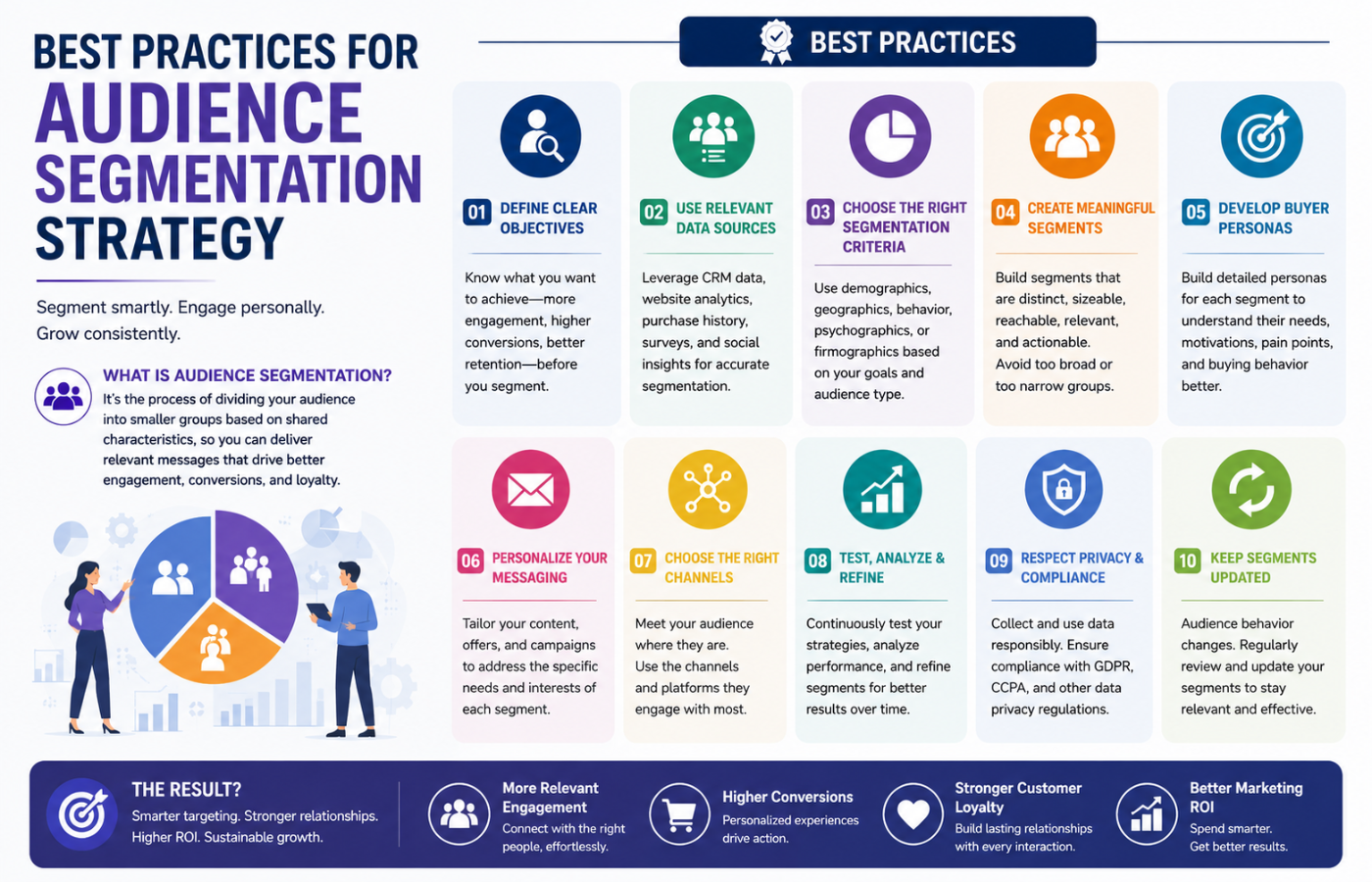
Start simple: Begin with a few meaningful segments and expand over time .
-
Combine segmentation types: Layering demographics + behavior + psychographics creates richer, more actionable segments .
-
Use dynamic, not static segments: Segments should update automatically as customer behaviour changes .
-
Maintain records: Document your segments and performance to build repeatable processes .
-
Continue exploring: Consumer preferences evolve. Regularly identify new segments and refresh your approach .
Common Mistakes to Avoid
-
Segmenting on demographics alone: Demographics tell you who someone is; behaviour tells you what they need right now. Combine both .
-
Building too many segments: Start with a handful of high-impact segments and grow from there .
-
Creating segments but never updating them: Segments must evolve with customer behaviour .
-
Treating all leads the same: A power user and a dormant trial user need completely different messages .
-
Missing the moment: Segmentation without automation is just a list. Act on segments at the right time .
Conclusion
An effective audience segmentation strategy transforms generic marketing into personalised, high-impact conversations. By understanding who your customers are, what they do, and why they act, you can deliver the right message to the right person at exactly the right moment. As consumer behaviour continues to evolve with the rise of AI shopping assistants, precise segmentation has become even more important for delivering relevant recommendations and personalised experiences. The result is higher engagement, stronger conversions, and more efficient marketing spend. Whether you’re an e-commerce retailer, a SaaS company, or a service provider, segmentation is the engine that turns data into growth.
Want an audience segmentation strategy that identifies your highest-value customers, predicts churn, and delivers personalised marketing at scale?
Get in touch with Orbitix today.