








SEO Marketing for Law Firms: Turning Website Traffic Into Clients
Why Generic SEO Fails for Law Firms
Most SEO agencies apply the same playbook to dentists, plumbers, and lawyers alike. They target high-volume keywords, write generic blog posts, and report on rankings that never turn into consultations. But legal marketing has unique constraints: ethical advertising rules (state bar regulations), fierce competition for premium keywords (often $50–$200+ per click on PPC), and a client journey driven by fear, urgency, and the need for authority. A criminal defence firm cannot use the same tone as a family law practice. A medical malpractice lawyer needs different trust signals than a real estate attorney. Generic SEO ignores these nuances — and leaves money on the table.
How SEO Marketing for Law Firms Converts Traffic Into Clients
Effective SEO marketing for law firms focuses on the entire client journey, not just rankings. Here is how to turn anonymous visitors into paying clients:
1. Practice Area Pages That Answer Legal Questions (Not Just List Services)
Most law firms have a page called “Personal Injury” with a paragraph about experience and a phone number. That is not enough. High-converting practice area pages include:
-
Clear explanations of legal concepts in plain English (not Latin or legalese)
-
Step-by-step breakdowns of the legal process (“What happens after I call?”)
-
Common client questions answered (FAQs with schema markup)
-
Case results or settlements (anonymised and compliant with bar rules)
-
Specific location targeting (“Car accident lawyer in [city]”)
-
Clear, above-the-fold calls-to-action (phone, contact form, chat)
2. Content That Answers “Should I Hire a Lawyer?”
Most potential clients do not know if they need an attorney. They search for questions like:
-
“How much is my car accident claim worth?”
-
“Can I be fired for reporting harassment?”
-
“What is the statute of limitations for medical malpractice in [state]?”
SEO marketing for law firms creates content that answers these questions honestly and helpfully. When a visitor realises their situation is complex enough to need professional help, your firm is positioned as the obvious choice. This is called “pre-education” content, and it converts better than any billboard ever will.
3. Local SEO for Law Firms (Google Maps Dominance)
Most legal clients choose a lawyer within a few miles of their home or workplace. Dominating local search requires:
-
Optimised Google Business Profile with practice areas, hours, photos of your office and team, and regular posts
-
Location-specific practice area pages (e.g., “Divorce Attorney in [Neighborhood Name]”)
-
Local citations on legal directories (Justia, Avvo, FindLaw, Super Lawyers)
-
Reviews from actual clients (ethically requested, never incentivised in violation of bar rules)
-
Local backlinks from bar associations, courthouses, legal aid organisations, and community groups
4. Trust Signals That Convert Skeptical Visitors
Legal clients are naturally cautious. Your website must answer their unspoken question: “Can I trust this lawyer with my future?”
Essential trust signals include:
-
Attorney bios with real personality (education, years of experience, but also why they practice law)
-
Client testimonials and video reviews (with permission and compliant with confidentiality rules)
-
Case results page (anonymised summaries of settlements or verdicts)
-
Professional affiliations (state bar, AAJ, local trial lawyer associations)
-
Awards and recognitions (Super Lawyers, Best Lawyers, Rising Stars)
-
Physical office photos (real people, real desks — not stock photography)
-
Accessibility options (clients with disabilities should navigate easily)
5. Technical SEO for Legal Websites
Law firm websites often suffer from technical problems that block clients before they convert:
-
Mobile optimisation (over 60% of “lawyer near me” searches happen on phones)
-
Page speed (a one-second delay drops conversions by 20% — that is lost clients)
-
Clear navigation (potential clients should find your phone number within 2 seconds)
-
Secure forms (SSL certificates and privacy policies build confidence)
-
Schema markup (Attorney schema, LocalBusiness schema, Review schema, FAQ schema)
6. Ethical Lead Capture (Compliant With Bar Rules)
Unlike e-commerce, legal marketing has strict ethical boundaries. SEO marketing for law firms must respect:
-
No guaranteed outcomes (cannot promise results)
-
No solicitation (cannot contact potential clients first in most jurisdictions)
-
Clear disclaimers (past results do not guarantee future outcomes)
-
Accessible intake forms (low friction, but compliant with client-attorney privilege)
Effective lead capture uses low-commitment options: “Get a case evaluation,” “Ask a question,” or “Call now for a confidential conversation.”
The Legal Client Journey: From Search to Signed Agreement
| Stage | Client Mindset | SEO Marketing Tactic |
|---|---|---|
| Crisis | “I was just fired / arrested / in an accident. What do I do?” | Immediate, urgent content (“What to do after a car accident” + phone number prominent) |
| Research | “Do I need a lawyer? How much will this cost?” | Educational blog posts, FAQs, explainer videos, cost guides |
| Comparison | “Which lawyer is best for my specific situation?” | Practice area depth, case results, testimonials, attorney bios |
| Decision | “How do I hire this lawyer?” | Simple contact form, click-to-call, same-day response promise, free consultation offer |
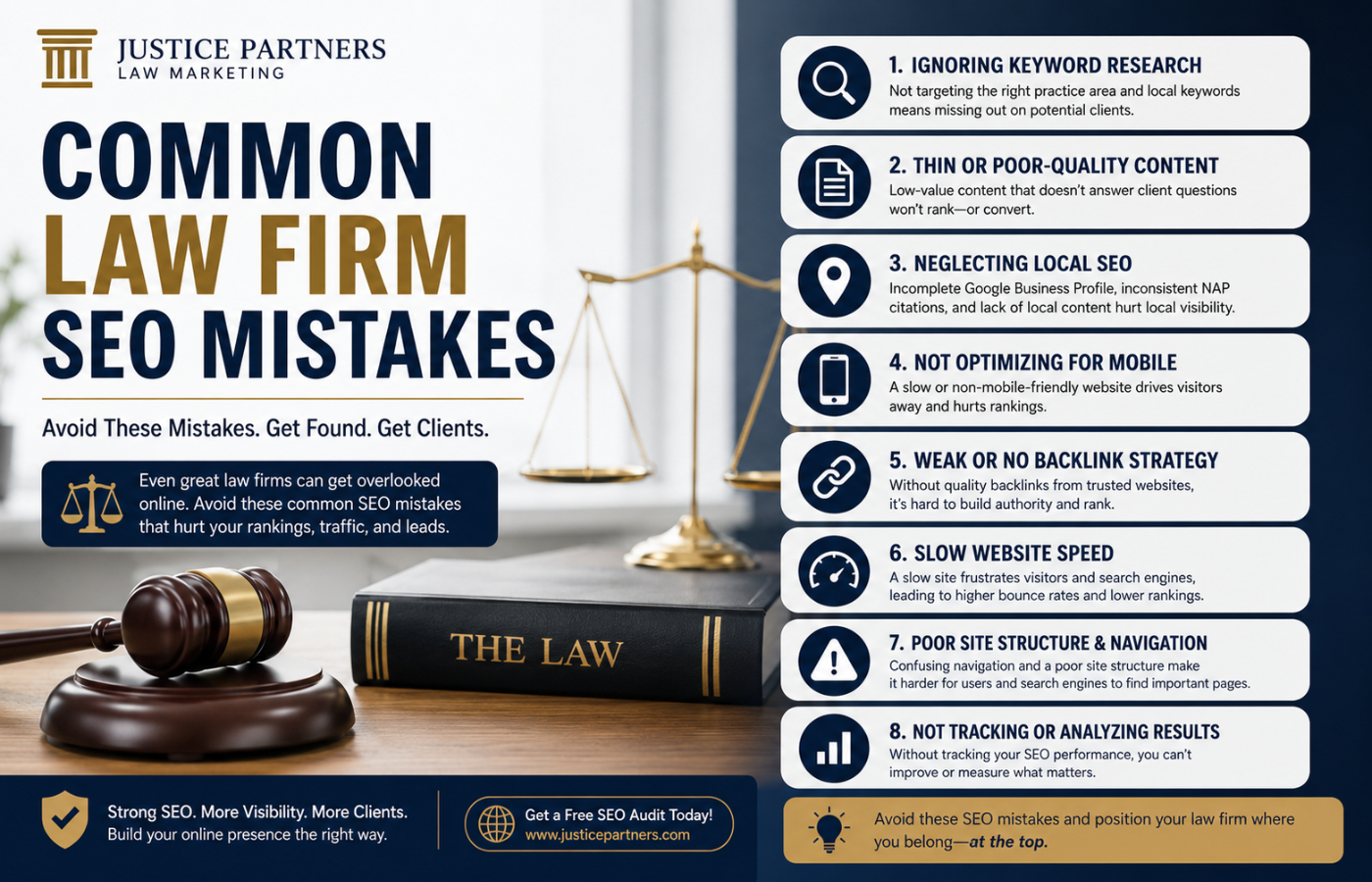
Common Law Firm SEO Mistakes
-
Practising “brochure SEO” (a beautiful site with no helpful content = no traffic)
-
Targeting keywords clients never use (real clients search “can I sue for discrimination,” not “hostile work environment tortious interference”)
-
Hiding the phone number (above the fold, every page, sticky on mobile)
-
Ignoring reviews (potential clients read them. Respond to every single one.)
-
No local landing pages (serving multiple cities from one homepage = serving none well)
-
Outdated or inaccurate bar information (if your “admitted 2005” says 2005, update it)
Measuring Success: Beyond Rankings
Traditional SEO reports show keyword positions. Law firms need metrics that tie to clients:
-
Phone calls from organic search (track with call rail or similar)
-
Contact form submissions (qualified leads, not spam)
-
Consultations booked (the only metric that ultimately matters)
-
Cost per lead vs. cost per client (compare to PPC and traditional advertising)
-
Practice area breakdown (which services drive the most client inquiries?)
Conclusion: Traffic Is Not the Goal — Clients Are
Want legal SEO that fills your consultation calendar with the right clients — not just more website traffic?
Get in touch with Orbitix today.