







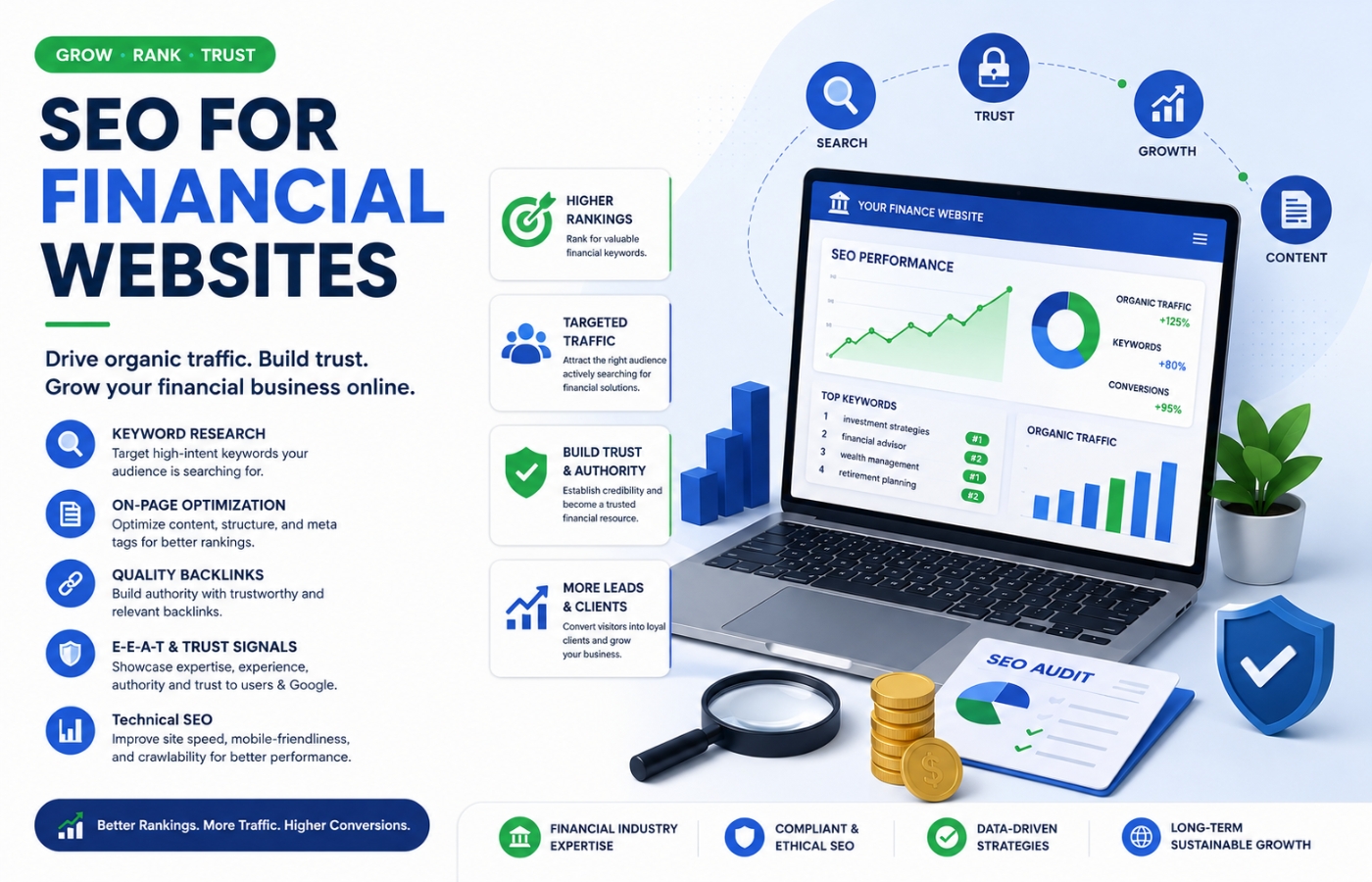
SEO for Financial Websites: Tips to Improve E-E-A-T and Credibility
When it comes to SEO for financial websites, there’s no room for shortcuts or black-hat tactics—because Google holds finance sites to a higher standard than almost any other industry. Whether you’re an independent financial advisor, a mortgage broker, an accounting firm, or a fintech startup, your ability to rank depends less on keyword density and more on something Google calls E-E-A-T: Experience, Expertise, Authoritativeness, and Trustworthiness. As highlighted in many successful B2B SEO case study examples, businesses that prioritize credibility, expert-driven content, and user trust tend to achieve stronger search visibility and sustainable long-term growth.
In the world of personal finance, bad advice can cost people their savings, their homes, or their retirement. Google knows this. That’s why financial websites face rigorous manual reviews, algorithm scrutiny, and a higher bar for featured snippets. Below, we break down exactly how to build credibility-first SEO that earns both search rankings and client confidence.
Why E-E-A-T Is Non-Negotiable for Financial SEO
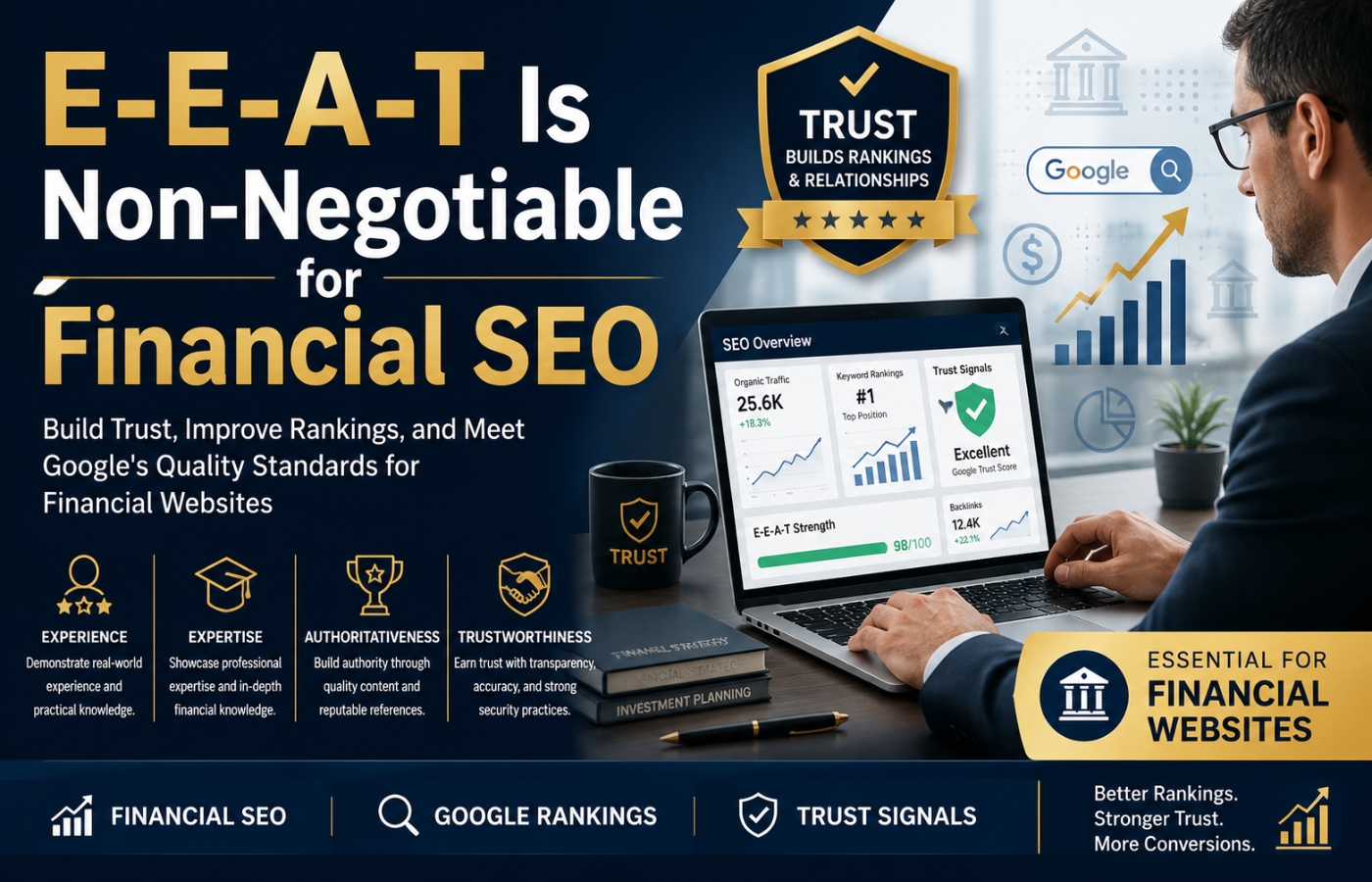
Before diving into tactics, understand this: SEO for financial websites lives or dies by E-E-A-T. Google’s Search Quality Rater Guidelines explicitly list “YMYL” (Your Money or Your Life) topics—and finance is at the very top. If your site lacks demonstrable expertise and trust signals, no amount of backlinks or technical optimization will push you past page two.
E-E-A-T breaks down into four pillars:
| Pillar | What It Means for Financial Websites |
|---|---|
| Experience | First-hand knowledge (e.g., a tax advisor who has filed 1,000+ returns) |
| Expertise | Formal qualifications (CFP, CPA, CFA, regulated by FCA or SEC) |
| Authoritativeness | Recognition from other trusted finance sites and industry bodies |
| Trustworthiness | Transparent pricing, secure forms, clear disclaimers, and accurate information |
7 Credibility-Building Tactics for Financial SEO
1. Create Author Bio Pages With Full Credentials
The single most important trust signal on any financial website is the author behind the content. Never publish anonymous or generic “staff writer” bylines.
Each author page must include:
-
Full name and headshot
-
Professional credentials (CFA, CFP, CPA, ChFC, etc.)
-
Regulatory registration (e.g., “Registered with the FCA” or “Series 65 licensed”)
-
Years of experience and areas of specialisation
-
Links to LinkedIn, professional profiles, or published research
Example: *“John Martinez, CFP® – 14 years of retirement planning experience. FCA-registered. No disciplinary history.”*
2. Publish Original Research and Case Studies
Google can spot generic, rephrased content. Financial websites that rank consistently produce original data:
-
“We analysed 500 mortgage applications from 2024—here’s what we found”
-
“Case study: How we saved a client £45,000 in unnecessary fees”
-
“Quarterly market commentary from our in-house analysts”
Original research earns natural backlinks from other finance sites, which feeds directly into Authoritativeness.
3. Maintain a “Verified” Disclaimers and Compliance Footer
Financial content is heavily regulated. Every page—especially those discussing returns, forecasts, or tax implications—must include:
-
A clear disclaimer stating that information is for educational purposes only
-
Disclosure of any conflicts of interest (affiliate links, sponsored content)
-
Your regulatory status (e.g., “Not FCA-regulated” if applicable, or registration numbers)
-
Last updated date for time-sensitive content (e.g., tax law changes)
Missing disclaimers signal low trust to both Google and users.
4. Earn Backlinks From .gov, .edu, and Industry Bodies
Not all backlinks are equal. For SEO for financial websites, a single link from a .gov domain (like IRS or HMRC) or a recognised industry body (e.g., CFA Institute, FCA, FINRA) carries more weight than 100 generic directory links.
Strategies to earn high-authority links:
-
Offer free calculators or tools (e.g., “Retirement Savings Calculator”)
-
Get quoted as an expert on journalist request sites like HARO (Help a Reporter Out)
-
Sponsor local financial literacy events (universities often link to sponsors)
-
Write guest posts for established finance publications (Forbes Finance, Investopedia)
5. Structure Content for Featured Snippets (Carefully)
Financial keywords often trigger “People also ask” boxes and featured snippets. But be precise—incorrect answers can trigger manual penalties.
To win snippets:
-
Answer specific questions directly: “What is the compound annual growth rate (CAGR) formula?” → Then provide the formula in a clear code block or bullet point.
-
Use tables for comparison content (e.g., “Fixed vs. adjustable-rate mortgages”)
-
Add FAQ schema markup to question-and-answer pairs
Never oversimplify a complex financial topic just to fit a snippet format. Accuracy always trumps brevity.
6. Showcase Third-Party Trust Seals and Reviews
Trust is visible. Display the following prominently (footer or sidebar):
-
SSL certificate badge (especially on contact and application forms)
-
Better Business Bureau (BBB) accreditation
-
Trustpilot or Google Reviews widget (minimum 4.0 stars)
-
Logos of professional memberships (NAPFA, FPA, CISI)
Each trust seal should link to the verification page (e.g., https://www.bbb.org/us/...). This gives Google a verifiable trust signal.
7. Regular Content Audits for Accuracy
Outdated financial advice is dangerous. Set a quarterly content audit schedule:
-
Update statistics (inflation rates, interest rates, tax brackets)
-
Remove or redirect discontinued products (e.g., “Best mutual funds of 2022”)
-
Add “Updated [Month Year]” badges at the top of evergreen articles
Google’s algorithm detects freshness signals. A 2020 article with a 2025 update badge outperforms a neglected 2023 post.
Red Flags That Destroy Financial SEO Credibility
| Red Flag | Why It Kills Rankings |
|---|---|
| Anonymous authors | No accountability = no expertise |
| Promises of “guaranteed returns” | Violates compliance and trust guidelines |
| Broken disclaimers or missing regulatory info | Signals legal risk to Google |
| Pop-ups on first click | Destroys user experience on YMYL pages |
| Copied product disclosures | Duplicate content + low effort |
Final Thought: SEO Is a Byproduct of Credibility
Many financial firms chase rankings by stuffing keywords into meta descriptions or buying cheap backlinks. That approach doesn’t just fail—it can get your site manually penalised or de-indexed.
The truth is, SEO for financial websites is not a separate strategy. It’s the natural result of building a genuinely helpful, accurate, and trustworthy resource. If you’ve ever wondered what constitutes a good website, the answer lies in delivering valuable content, demonstrating expertise, and creating a reliable user experience. When your content answers real client questions, showcases licensed experts, and proves its accuracy with original data, Google will reward you—and more importantly, so will your future clients.
Start with one page today: rewrite an old blog post with a full author bio, add a clear disclaimer, and update one statistic. Then measure your organic click-through rate over the next 30 days. You’ll see the difference credibility makes.
Want to improve your financial website’s credibility and rank higher in Google?
Get in touch with Orbitix today.