







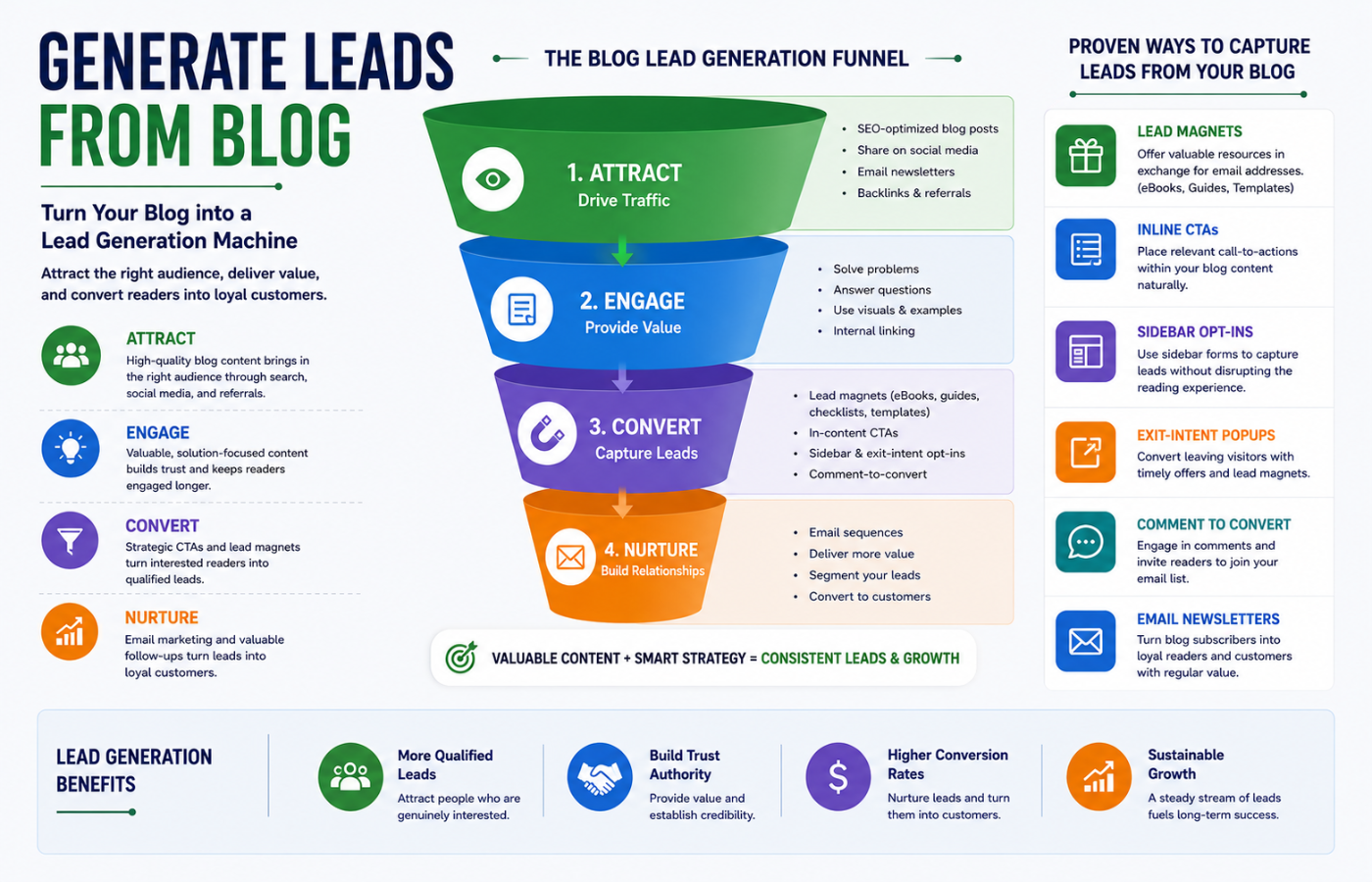
How to Generate More Leads from Your Blog: Proven Strategies That Work
Why Most Blogs Don’t Generate Leads
The average business blog publishes content but sees little return. Why? Because they treat their blog as a publication rather than a lead generation engine. They write about what they find interesting, not what their potential customers are searching for. They have no clear next step for readers. The result is traffic without conversions.
Proven Strategies to Generate Leads from Blog Content
Effective methods to generate leads from blog posts start before you write the first word and continue long after publication.
1. Create Content That Attracts High-Intent Readers
Not all traffic is equal. A visitor reading “how to bake a cake” has very different intent from someone searching “best project management software for small teams.” The latter is far more likely to convert. To generate leads from your blog, you need to attract readers who are actively looking for solutions your business provides.
What to do:
-
Research keywords with commercial intent (e.g., “best,” “vs,” “review,” “pricing”)
-
Target bottom-of-funnel topics (comparisons, alternatives, buying guides)
-
Address specific problems your product or service solves
-
Use long-tail keywords that indicate readiness to purchase
2. Use Strategic Calls-to-Action (CTAs)
Every blog post should have a clear next step for the reader. Generic CTAs like “Contact Us” are far less effective than context-specific ones.
| Page Type | Best CTA Type | Example |
|---|---|---|
| Awareness-stage post | Newsletter signup | “Get weekly marketing tips” |
| Consideration-stage post | Lead magnet | “Download our complete guide to [topic]” |
| Decision-stage post | Demo or consultation | “Book a free consultation” |
| Evergreen content | Resource library | “Access more resources like this” |
Place CTAs strategically:
-
Above the fold (for highly engaged readers)
-
Within the content (contextually relevant)
-
At the end of the post (after they’ve consumed value)
-
In the sidebar (sticky on scroll)
-
As exit-intent popups (last chance to convert)
3. Offer High-Value Lead Magnets
A lead magnet is an incentive offered in exchange for contact information. The most effective lead magnets are specific, actionable, and immediately useful.
Types of lead magnets that work:
-
E-books and guides (comprehensive resources on a specific topic)
-
Checklists and cheat sheets (quick reference tools)
-
Templates and swipe files (ready-to-use assets)
-
Webinars and video training (live or recorded)
-
Free trials or consultations (low-risk entry points)
-
Quizzes and assessments (interactive and engaging)
Best practice: Align your lead magnet with the topic of the blog post. A post about “email marketing best practices” can offer a “complete email marketing checklist.”
4. Optimise Your Landing Pages
When a visitor clicks your CTA, they should land on a page designed to convert—not a generic homepage or contact page.
Landing page essentials:
-
One clear offer (no distractions)
-
Compelling headline matching the CTA text
-
Benefits-focused copy (not features)
-
Social proof (testimonials, case studies, trust badges)
-
Minimal form fields (name + email is usually enough)
-
Strong visual hierarchy (draws attention to the CTA)
-
Mobile-optimised design
5. Implement Exit-Intent and Scroll-Triggered Popups
Not every visitor will convert on their first visit. Exit-intent popups appear when a user is about to leave your site, giving you one last chance to capture their information. Scroll-triggered popups appear after a reader has engaged with a certain percentage of your content (e.g., 70% of the page).
Best practices for popups:
-
Offer genuine value (not just “subscribe to our newsletter”)
-
Make it easy to close (avoid frustration)
-
Use clear, benefit-driven copy
-
Test timing and triggers for optimal results
6. Create “Content Upgrades”
A content upgrade is a bonus resource that expands on a specific blog post—a checklist, template, or guide that adds value beyond what’s in the post.
Example:
-
Blog post: “10 Ways to Improve Your Ad Copy”
-
Content upgrade: “Ad Copy Swipe File with 50 High-Converting Examples”
-
CTA: “Get the swipe file for free”
Content upgrades are highly effective because they offer something directly relevant to what the reader is already interested in.
7. Add Lead Capture in Your Blog Sidebar
Your blog’s sidebar is prime real estate for lead generation. Include opt-in forms that promote your lead magnets, email newsletter, or free resources.
What to include in your sidebar:
-
Email signup form with a clear value proposition
-
Promotion of your best lead magnet
-
Popular or featured content (keeps visitors engaged)
-
Trust signals (testimonials, credentials)
8. Use Live Chat and Chatbots
Website visitors often have questions before they’re ready to convert. Live chat or intelligent chatbots can answer those questions in real-time, reducing friction and capturing leads.
How it generates leads:
-
Chat can capture contact information when visitors aren’t ready to fill out a form
-
Chatbots can qualify leads before passing them to sales
-
Live chat provides immediate assistance, increasing trust
9. Repurpose Content into Lead-Generating Formats
Not all leads come from your blog itself. Repurpose your blog posts into other formats to reach new audiences and capture leads elsewhere.
Repurposing ideas:
-
Turn blog posts into email newsletters (with CTAs to your lead magnets)
-
Create video summaries for YouTube (link back to the full post or lead magnet)
-
Extract key takeaways for social media posts (drive traffic back)
-
Compile related posts into an e-book (new lead magnet)
-
Present blog insights as a webinar (capture registrations)
10. Use Content Upgrades in Your Email Newsletter
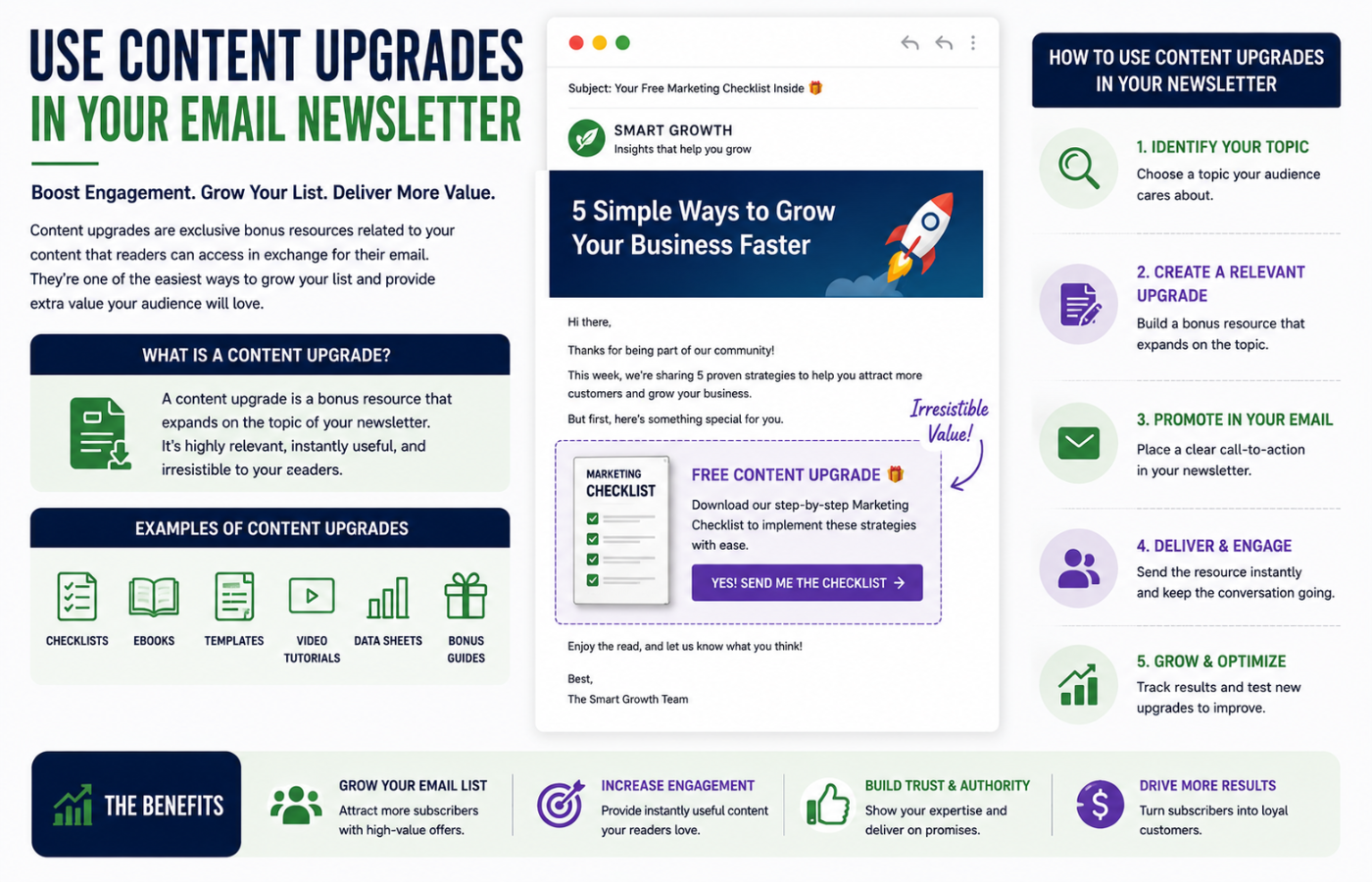
Your existing email subscribers are already interested in what you have to say. Use your newsletter to promote new content upgrades and drive downloads. This also helps re-engage subscribers who may have been inactive.
The Lead Generation Content Funnel
| Stage | Reader Mindset | Content Type | Lead Capture |
|---|---|---|---|
| Awareness | “I have a problem” | Educational blog posts | Email signup |
| Consideration | “What are my options?” | Comparisons, guides | Lead magnet (checklist, guide) |
| Decision | “Which solution is best?” | Reviews, case studies | Demo, consultation, free trial |
| Retention | “How do I use this better?” | Tutorials, updates | Webinar, upgrade, referral |
Measuring Lead Generation Success
Track these metrics monthly:
-
Conversion rate by blog post (which posts drive the most leads)
-
Lead magnet download rate (how many visitors opt in)
-
Cost per lead from blog content (investment vs. returns)
-
Lead quality score (which content brings the best-fit prospects)
-
Time from lead capture to sales conversion (lead nurturing effectiveness)
-
Content performance by stage (awareness vs. consideration vs. decision content)
Common Mistakes to Avoid
| Mistake | Why It Hurts | Fix |
|---|---|---|
| No clear CTA | Readers leave without taking action | Add context-specific CTAs to every post |
| Low-value lead magnets | Visitors don’t want what you’re offering | Create specific, actionable resources |
| Long forms | Visitors abandon | Minimise form fields (name + email) |
| Generic CTAs | “Contact us” doesn’t motivate action | Use action-oriented copy (“Get the guide”) |
| No email follow-up | You don’t nurture captured leads | Create email sequences for each lead magnet |
| No tracking | You don’t know what works | Use UTM parameters and analytics |
Conclusion
Want a blog that generates leads, not just traffic—with content that converts readers into qualified prospects?
Get in touch with Orbitix today.