







From Listings to Leads: Local SEO Tips for Real Estate Professional
Local SEO for real estate agents is the difference between waiting by the phone and having qualified buyers and sellers reach out to you first. Just as local SEO for plumbers helps plumbing businesses connect with homeowners searching for immediate services in their area, real estate professionals can use local search optimization to attract motivated buyers and sellers. In today’s competitive housing market, homebuyers no longer flip through newspaper listings or rely solely on referrals. They pull out their smartphones and search “Realtor near me,” “homes for sale in [neighborhood],” or “best real estate agent in [city].” If your online presence is not optimized for local search, you are invisible to the very people actively looking for your services. Mastering local SEO for real estate agents transforms your website and Google Business Profile into a 24/7 lead generation engine — turning passive listings into active conversations. In this comprehensive guide, we will share actionable local SEO tips designed specifically for real estate professionals ready to dominate their market.
Why Real Estate Agents Must Prioritize Local SEO

The real estate industry has always been local. You do not sell homes in Miami if you work in Seattle. But many agents still rely on outdated marketing methods: cold calling, door knocking, and hoping for referrals. While those tactics still have a place, they cannot compete with the power of local search.
Local SEO for real estate agents ensures that when a potential client searches for a home or an agent in your service area, your name appears at the top — not your competitor’s. Unlike paid ads that stop the moment your budget runs out, local SEO delivers compounding results. A well-optimized Google Business Profile, location-specific landing pages, and positive reviews continue to bring leads month after month, year after year.
This guide will walk you through every essential local SEO tactic — from claiming your Google Business Profile to generating neighborhood-specific content and earning backlinks from local sources.
Why Local SEO for Real Estate Agents Turns Listings Into Leads
At its core, local SEO for real estate agents is about connecting your online presence with the geographic areas you serve. When done correctly, it ensures that your name appears for searches like “homes for sale in [neighborhood]” or “best real estate agent near me.” Below, we break down the specific strategies that move you from invisible to indispensable.
1. Claim and Optimize Your Google Business Profile (GBP)
Your Google Business Profile is the single most important asset for local SEO for real estate agents. It controls how you appear in Google Maps and the Local Pack (the top three map results).
Complete every section of your GBP:
| Section | Best Practice for Real Estate |
|---|---|
| Business name | Use your legal real estate business name. Do not add keywords (“Best Realtor”) — that violates Google’s guidelines. |
| Category | Primary: “Real estate agent.” Secondary: “Real estate consultant,” “Property management,” “Real estate appraiser” (if applicable). |
| Address | Your physical office address. If you work from home, you can hide your address and set a service area. |
| Service area | List all cities, zip codes, or neighborhoods you serve. Be accurate — do not claim areas you do not cover. |
| Phone number | Use a local area code (not a toll-free 800 number). |
| Website | Link to your homepage or a dedicated “contact” page. |
| Hours | Include office hours and specify if you offer evening/weekend showings. |
| Description | 750 characters. Include your service area, specialties (e.g., “first-time homebuyers,” “luxury properties”), and a call to action. |
Photos matter enormously for real estate: Listings with photos receive 42% more requests for directions and 35% more website clicks. Upload:
-
Professional headshot of you
-
Exterior and interior of your office
-
Photos of recent sold homes (with permission)
-
Neighborhood landmarks (parks, schools, shopping centers)
-
You with clients at closings
Pro tip: Add new photos weekly — Google rewards active listings.
2. Generate and Manage Client Reviews
Reviews are a top-three ranking factor for local SEO. They also build the social proof that convinces hesitant buyers and sellers to choose you.
How to get more Google reviews:
-
Ask every satisfied client at closing. Provide a direct link to your GBP review form.
-
Send a follow-up email 24–48 hours after closing with a personalized request.
-
Add a “Review us on Google” link to your email signature and website footer.
-
Create a simple flyer with a QR code that links to your review page — hand it out at open houses.
How to respond to reviews:
-
Positive reviews: Thank the client and mention something specific (e.g., “So glad you loved the backyard in your new Oak Hill home!”).
-
Negative reviews: Respond professionally within 24 hours. Apologize, acknowledge the issue, and take the conversation offline to resolve it. Never argue publicly.
Review stats for real estate: Agents with 20+ reviews and a 4.5+ star average receive 2–3 times more leads than agents with fewer than 5 reviews.
3. Create Neighborhood-Specific Landing Pages
Generic “homes for sale” pages will not rank for local searches. You need dedicated pages for each neighborhood, subdivision, or zip code you serve.
Example URL structure:
-
yoursite.com/neighborhoods/oak-hill-homes-for-sale -
yoursite.com/zip-codes/78701-real-estate -
yoursite.com/communities/lake-travis
What to include on each neighborhood page:
| Element | Why It Matters |
|---|---|
| Neighborhood name in H1 and URL | Directly targets local search queries |
| School ratings (elementary, middle, high) | A top priority for families |
| Average home prices and market trends | Demonstrates expertise |
| Commute times to downtown/employers | Practical information for buyers |
| Local amenities (parks, grocery stores, coffee shops) | Adds depth and local flavor |
| 5–10 active listings in that neighborhood | Keeps page fresh and useful |
| Client testimonials from that specific neighborhood | Social proof with local relevance |
| Embedded Google Map of the neighborhood | Visual confirmation of location |
Content length: Aim for 1,000–1,500 words per neighborhood page. Thin pages (under 500 words) rarely rank.
Pro tip: Update these pages monthly with new listings and recent sales. Google favors fresh content.
4. Optimize for “Near Me” and Voice Search
Over 50% of “near me” searches result in a same-day visit or call. For real estate, that might mean a buyer driving through a neighborhood and searching “Realtor near me” or “open house near me.”
How to optimize for “near me” searches:
-
Naturally include phrases like “serving [city] and surrounding areas” on your homepage and contact page.
-
Mention nearby landmarks: “We help buyers find homes near Barton Creek Mall and the Domain.”
-
Ensure your GBP has accurate service area settings.
Voice search optimization: Voice queries are longer and more conversational. Target question-based keywords:
-
“Who is the best real estate agent in [neighborhood]?”
-
“What are home prices like in [zip code]?”
-
“How do I find a Realtor who specializes in first-time homebuyers?”
Create an FAQ page or FAQ sections on your neighborhood pages to answer these questions directly.
5. Leverage Local Schema Markup
Schema markup is code that helps search engines understand your content. For real estate agents, specific schema types can generate rich results in search.
Essential schema for real estate:
| Schema Type | What It Does | Example |
|---|---|---|
| LocalBusiness | Displays your name, address, phone, and hours | Shows up in knowledge panel |
| RealEstateAgent | Specifically identifies you as a real estate professional | Can trigger agent-specific rich results |
| Product (for listings) | Each home listing becomes a “product” with price, address, bedrooms, baths | May show listing details directly in search |
| Review schema | Displays star ratings in search results | Increases CTR by 30%+ |
Implementation: Use a WordPress plugin like Rank Math or Yoast SEO with schema add-ons. Alternatively, use Google’s Structured Data Markup Helper and add the JSON-LD code manually.
Test your schema: Use Google’s Rich Results Test tool before publishing.
6. Build Local Citations and Ensure NAP Consistency
Citations are mentions of your Name, Address, and Phone Number (NAP) on other websites — directories, local chambers of commerce, real estate portals, and social media.
The golden rule: Your NAP must be absolutely identical everywhere. Even a small variation — “Suite 200” vs. “Ste 200” — confuses Google.
Where to build citations for real estate agents:
-
Google Business Profile (most important)
-
Realtor.com (claim your profile)
-
Zillow (agent profile)
-
Trulia
-
Redfin
-
Yelp
-
Bing Places
-
Apple Maps Connect
-
Local Chamber of Commerce
-
Better Business Bureau (if applicable)
-
Nextdoor (claim your business page)
Tools to manage citations: BrightLocal, Moz Local, or Yext. These tools audit existing citations and distribute your NAP to dozens of directories.
7. Create Local Content (Blogging for Real Estate)
A blog is one of the most underutilized tools in real estate SEO. It allows you to target long-tail keywords that your main service pages cannot.
Blog post ideas for real estate agents:
-
“10 Things to Know Before Buying a Home in [Neighborhood]”
-
“The Best Schools in [City]: A Guide for Families”
-
“How to Win a Bidding War in a Competitive Market”
-
“5 Upcoming Developments That Will Increase Property Values in [Area]”
-
“A Weekend Guide to [Neighborhood] for Potential Homebuyers”
-
“Interview with a Local Home Inspector: Red Flags to Watch For”
-
“Seasonal Home Maintenance Checklist for [City] Homeowners”
Blogging best practices:
-
Aim for 1,000–1,500 words per post
-
Include internal links to your neighborhood pages and contact page
-
Embed a map or photos of the area
-
End with a clear call-to-action (“Thinking of buying in [Neighborhood]? Call me today.”)
-
Publish consistently (1–2 posts per week)
Result: Each blog post becomes a new entry point for search engines, bringing in buyers and sellers who are still in the research phase.
8. Earn Local Backlinks
Backlinks (links from other websites to yours) are a major Google ranking factor. For local SEO for real estate agents, the most valuable backlinks come from other local businesses and organizations.
Where to earn local backlinks:
-
Local news websites (sponsor a charity event or share a market update)
-
Local blogs (offer a guest post about home buying tips)
-
Chamber of Commerce (member directory listing)
-
Local mortgage lenders, home inspectors, and title companies (cross-link to each other)
-
Local schools or PTAs (sponsor a fundraiser in exchange for a link)
-
Neighborhood associations or HOAs
Outreach email template:
Subject: Local partnership idea for [Neighborhood]
Hi [Name],
I’m a local Realtor specializing in [Neighborhood]. I noticed you have a resource page for homeowners. I recently published a guide called “5 Things Every [Neighborhood] Homebuyer Should Know.” Would you consider adding a link to it on your page? Happy to share your business with my clients as well.
Best,
[Your Name]
9. Optimize Your Website for Mobile and Speed
Nearly 70% of real estate searches happen on mobile devices. Buyers search while driving through neighborhoods, waiting at open houses, or scrolling during lunch breaks. If your website is slow or hard to use on a phone, they will bounce to another agent.
Mobile optimization checklist:
-
Responsive design (adapts to any screen size)
-
Click-to-call phone number (tap to dial)
-
Large, easy-to-tap buttons (minimum 48px)
-
Readable font sizes (16px+ for body text)
-
Fast load time (under 2.5 seconds for Largest Contentful Paint)
-
No pop-ups that cover the listing search
Speed optimization:
-
Compress images (use WebP format)
-
Enable caching
-
Use a Content Delivery Network (CDN)
-
Choose fast, reliable hosting (avoid cheap shared hosting)
Tool: Test your site with Google PageSpeed Insights. Aim for a score of 90+ on mobile.
10. Use Internal Linking to Distribute Authority
Internal links are hyperlinks from one page on your website to another. They help Google discover your content and pass “link juice” from high-authority pages to newer ones.
Internal linking strategy for real estate:
-
From your homepage, link to your top 5 neighborhood pages.
-
From each neighborhood page, link to active listings in that area.
-
From each blog post, link to relevant neighborhood pages and your contact page.
-
Create a “Resources” or “Buyer’s Guide” page that links to all your informational content.
Example: A blog post titled “How to Buy a Home in Austin” should link to your “Austin Neighborhoods” page, your “Mortgage Calculator” page, and your “Contact Me” page.
Measuring Success: Key Metrics for Real Estate Local SEO
Track these KPIs to know if your efforts are working:
| Metric | What It Measures | Target |
|---|---|---|
| GBP views and searches | How often your listing appears | Month-over-month growth |
| GBP calls and direction requests | High-intent leads | 20+ per month |
| Organic traffic to neighborhood pages | Buyers researching specific areas | 30% increase quarterly |
| Keyword rankings for “[neighborhood] homes for sale” | Local visibility | Top 5 for 10+ neighborhoods |
| Review count and average rating | Trust and algorithm ranking | 4.5+ stars; 5+ new reviews/month |
| Backlinks from local domains | Local authority | 2–5 new links per month |
| Contact form submissions from organic search | Actual leads | Depends on market size |
Free tools: Google Analytics, Google Search Console, Google Business Profile Insights. Paid tools: SEMrush, BrightLocal, or Moz Local.
Common Local SEO Mistakes Real Estate Agents Make
Using a Franchise or Brokerage Page Instead of Your Own
Your brokerage may have a page for you, but you need your own website and GBP. Otherwise, you are invisible when someone searches your name.
Fix: Create your own professional website with your name in the domain (e.g., yourname.com).
No Neighborhood Pages
A single “homes for sale” page cannot rank for dozens of neighborhoods.
Fix: Create a dedicated page for each neighborhood you serve. Start with your top 5 highest-volume areas.
Ignoring Google Posts
Google Posts (updates on your GBP) expire after 7 days. Many agents never use them.
Fix: Post weekly — new listings, open house announcements, market updates, or client testimonials.
Inconsistent NAP
Your address and phone number differ between your website, GBP, and Zillow profile.
Fix: Audit your NAP across 20+ directories. Correct every inconsistency.
No Calls-to-Action (CTAs)
Visitors read your content but have no idea how to hire you.
Fix: Every page should have a clear CTA: “Search Listings,” “Contact Me,” “Get a Home Valuation,” or “Schedule a Showing.”
Real-World Example: How One Agent Dominated Her Market with Local SEO
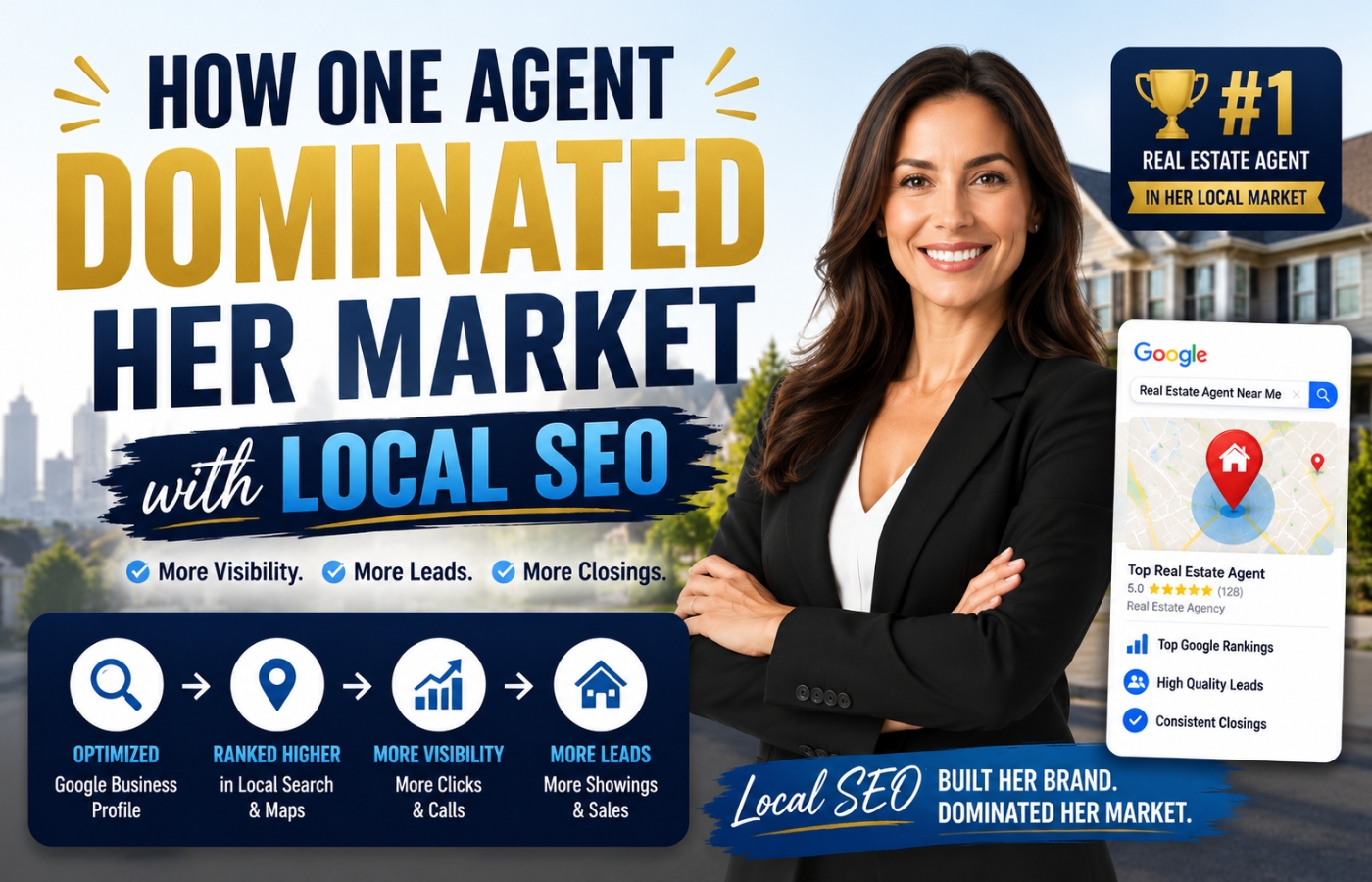
The agent: Sarah, a solo real estate agent in Nashville, Tennessee. She had a basic website, a GBP listing with no photos, and only 6 reviews. She was ranking on page 3 for most local keywords.
The strategy (6 months):
-
Fully optimized GBP (added 25 photos, weekly posts, responded to all reviews)
-
Created 12 neighborhood pages (Green Hills, 12 South, East Nashville, etc.), each with 1,200+ words, school data, and active listings
-
Published 2 blog posts per week (local market updates, buyer tips, neighborhood guides)
-
Earned 8 local backlinks (from the Chamber of Commerce, a mortgage broker, and a local home improvement blog)
-
Generated 22 new Google reviews (asked every client at closing)
-
Added LocalBusiness and RealEstateAgent schema markup
The results:
-
Local Pack ranking for “Nashville Realtor”: #9 → #2
-
Organic traffic: +340%
-
Leads from website: 4 per month → 18 per month
-
Closed transactions from organic leads: 2 in year one → 11 in year two
Cost: Approximately $3,000 (freelance content writer, citation management tool, and her time). **Additional commission revenue:** Estimated $300,000+.
Conclusion: Start Turning Listings Into Leads Today
You have the listings. You have the expertise. But without local SEO for real estate agents, potential buyers and sellers may never find you. The strategies in this guide — from optimizing your Google Business Profile and creating neighborhood pages to earning reviews and building local backlinks — are proven, actionable, and within reach of any agent willing to invest time and effort. Much like local SEO for restaurants helps dining establishments attract nearby customers and increase reservations, effective local SEO enables real estate agents to connect with motivated buyers and sellers in their target markets.
Start small. Claim your GBP fully this week. Add 10 photos. Ask two past clients for reviews. Then, create one neighborhood page. Then another. Over 90 days, you will see movement. Over six months, you will see leads. Over a year, you will transform your business.
The buyers and sellers in your market are searching right now. Make sure they find you.
Want more qualified real estate leads and attract more buyers and sellers?
Get in touch with Orbitix today.