







Financial Services SEO Company: How to Choose the Right Partner
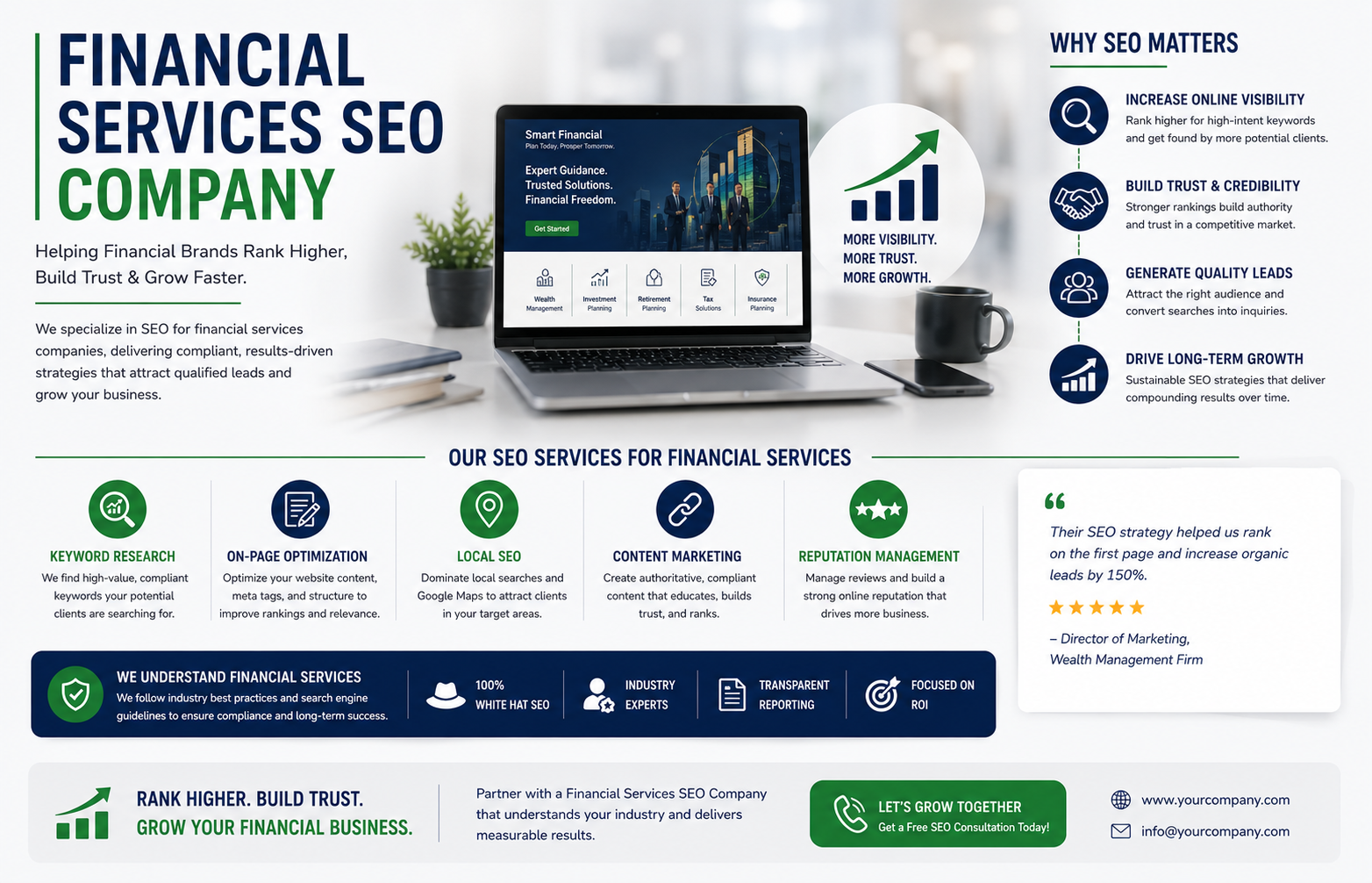
Choosing the right financial services SEO company can be the difference between a steady stream of qualified leads and a website that generates traffic but never converts. Financial services firms operate in one of the most competitive, highly regulated, and trust-dependent digital markets. A specialist financial services SEO company understands the strict compliance requirements, Google’s YMYL (Your Money or Your Life) standards, and the complex buyer journeys that generalist agencies often miss. Many firms also benefit from SEO Consultant Services, which provide tailored strategies, technical guidance, and ongoing optimization to improve search visibility and attract qualified prospects. This guide breaks down exactly what to look for when selecting your SEO partner.
Why Financial Services SEO Demands a Specialist
Finance sits in a category Google takes particularly seriously: Your Money or Your Life (YMYL). Content that influences financial decisions is held to a higher standard in search, and the financial services SEO companies that understand this—along with the regulatory landscape that surrounds it—will consistently outperform those that don’t .
A specialist agency builds E-E-A-T (Experience, Expertise, Authoritativeness, Trustworthiness) into its strategy from the start, ensuring authors have verifiable credentials and content demonstrates genuine expertise . Generalist agencies are often not equipped to think in these terms and likely won’t understand that, in finance, the credibility of the source is as important as the optimisation itself .
What to Look for in a Financial Services SEO Company
Here are the critical criteria for evaluating financial services SEO companies:
1. Regulatory Compliance Built Into Strategy
The finance industry operates under strict regulations including FCA rules in the UK, and SEC and FINRA requirements in the US. A specialist agency builds regulatory awareness into their workflow from the outset, scanning every landing page for potential compliance issues before publication . A generalist, by contrast, is likely to approach content creation without this framework, leaving your compliance team to pick up the pieces .
What to ask: “How do you integrate compliance reviews into your content workflow?”
2. Deep E-E-A-T Understanding
Google’s E-E-A-T framework applies to all websites, but it carries particular weight in finance. When someone is searching for advice on managing their pension or choosing an investment product, Google wants to serve them content from sources that can prove they know what they’re talking about .
What to look for: Credentialed authors (CFP, CFA, CPA), transparent sourcing (IRS.gov, SEC.gov), and clear author bios with verifiable expertise .
3. High-Intent Keyword Focus, Not Just Traffic
Broad SEO can drive traffic, but in financial services, traffic without intent is largely worthless. Someone searching for ‘investment options’ is at a very different stage to someone searching for ‘pension drawdown advice for NHS consultants’ . A specialist understands which terms signal genuine buying intent and how to map those terms to the right content types.
What to look for: Long-tail, product-specific terms that indicate decision-readiness, e.g., “best employee benefits insurance for SMEs” over “insurance quotes” .
4. Compliance-Aware Content Creation
Financial content requires careful compliance with securities laws, banking regulations, and industry-specific requirements. The best agencies work with compliance teams to ensure all content meets regulatory requirements while remaining engaging and optimized for search .
What to look for: Proper disclaimers about investment risks, accurate representation of financial products, and regulatory language integrated naturally—not hidden in footers .
5. Local SEO Expertise
Community banks, credit unions, and local financial advisors benefit significantly from local SEO. A specialist optimises Google Business Profiles, creates location-specific content, and ensures consistent citations across local directories .
What to look for: Hyper-local landing pages, GBP management, and local intent keywords like “financial planner near me” .
6. Technical SEO & Security
Financial websites require secure infrastructure (HTTPS), high performance, and mobile optimisation. A specialist ensures these technical requirements while maintaining security and compliance .
What to look for: Core Web Vitals optimisation, mobile-first indexing readiness, and bulletproof security protocols .
7. Authority Building Through Quality Links
Building quality backlinks in financial services requires credibility and relationships. Specialists leverage relationships with financial media publications, industry analysts, and authoritative financial websites .
What to look for: Digital PR strategies, original research that earns coverage, and links from .gov and .edu domains .
8. Schema Markup Implementation
Structured data helps search engines and AI models understand financial content with precision. Specialists implement FinancialProduct, Article, and LocalBusiness schemas to improve visibility in both traditional search and AI answers .
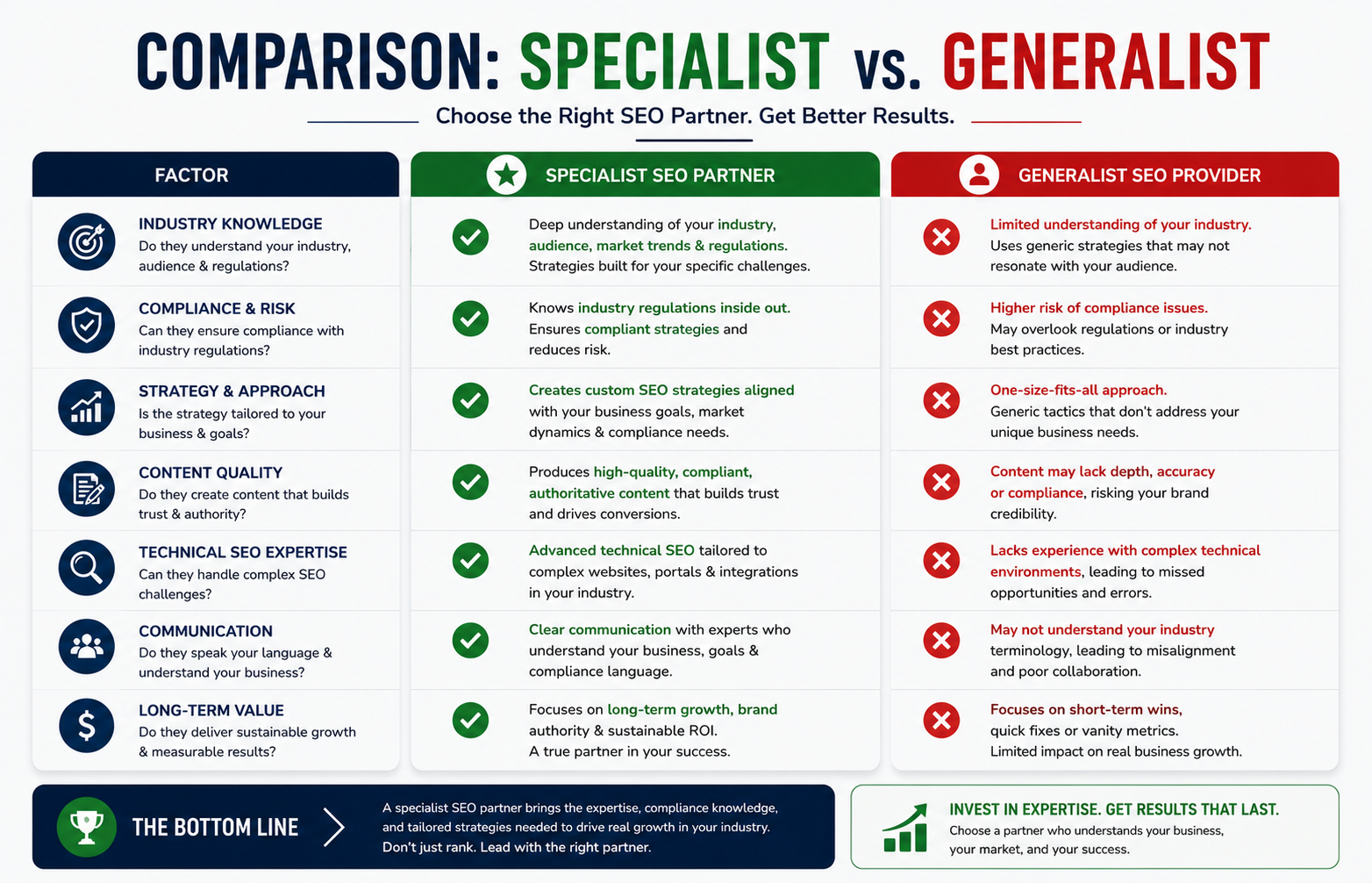
Comparison: Specialist vs. Generalist
| Factor | Finance Specialist | Generalist |
|---|---|---|
| Regulatory compliance | Built into strategy from day one | Often an afterthought |
| E-E-A-T content | Central to approach for YMYL topics | May not understand YMYL requirements |
| Keyword strategy | High-intent, niche financial terms | Broad terms with lower conversion rates |
| Learning curve | Minimal: deep expertise from the start | Significant: steep ramp-up required |
| Content quality | Compliant, technically accurate | Risk of inaccurate or non-compliant copy |
Common Mistakes to Avoid
| Mistake | Why It Hurts |
|---|---|
| Choosing the cheapest option | Often lacks compliance expertise and ends up costing more in penalties or wasted spend |
| No compliance review workflow | Content may violate regulations, creating liability |
| Targeting broad, generic keywords | Attracts unqualified traffic that never converts |
| No E-E-A-T signals | Google doesn’t trust your content for YMYL topics |
Measuring Financial SEO Success
Track these KPIs:
-
Qualified leads from organic search, not just traffic
-
Conversion rates on product and service pages
-
Cost per acquisition (CPA) from organic channels
-
Brand citations in AI search answers (GEO/AEO metrics)
Conclusion
In financial services, the stakes are higher, the regulations are stricter, and the trust required is greater. The right financial services SEO company combines technical SEO expertise, SEO Content Writing, compliance knowledge, and deep industry understanding to help your firm thrive in organic search. A generalist may be cheaper, but the risk of compliance breaches, wasted spend, and missed opportunities far outweighs any upfront savings.
Want financial services SEO that delivers qualified leads, maintains compliance, and builds trust with both Google and your clients — from day one?
Get in touch with Orbitix today.