







Enterprise SEO Services: Best Practices for Managing Large Websites
Enterprise SEO services are fundamentally different from traditional SEO. While a small business website might have a few dozen pages, enterprise websites often span tens of thousands — or even millions — of pages across multiple domains, subdomains, countries, and languages. Managing SEO at this scale requires automated tools, cross-functional collaboration, and a strategic framework that prioritizes technical health, content governance, and performance measurement. Whether optimizing a global eCommerce platform or targeting niche local markets through strategies such as Dentist SEO in Brighton, businesses need a scalable approach to maximize online visibility. Without the right framework, enterprise websites can suffer from crawl inefficiencies, duplicate content, index bloat, and missed revenue opportunities. In this comprehensive guide, we will explore the best practices that enterprise SEO services use to manage large websites effectively and drive sustainable organic growth.
Why Enterprise SEO Requires a Different Playbook
If you have ever managed SEO for a small business, you know the basics: optimize meta tags, build backlinks, write quality content, and monitor rankings. For niche industries, such as businesses investing in SEO Services for Electricians, these strategies can often deliver solid results. But when you scale up to an enterprise organization — think e-commerce giants, global media publishers, franchise networks, or multinational corporations — those tactics break down.
Enterprise SEO services must address challenges that simply do not exist for smaller sites:
-
Thousands of product pages with thin or duplicate content
-
Multiple CMS platforms across different business units
-
International targeting (hreflang) for dozens of languages
-
Crawl budget management (Google will not crawl every page)
-
Coordination between development, marketing, product, and IT teams
-
Reporting at the portfolio level (not just per page or per keyword)
This guide will walk you through the proven frameworks, tools, and processes that enterprise SEO teams use to manage complexity and deliver measurable ROI.
What Enterprise SEO Services Include That Standard SEO Doesn’t
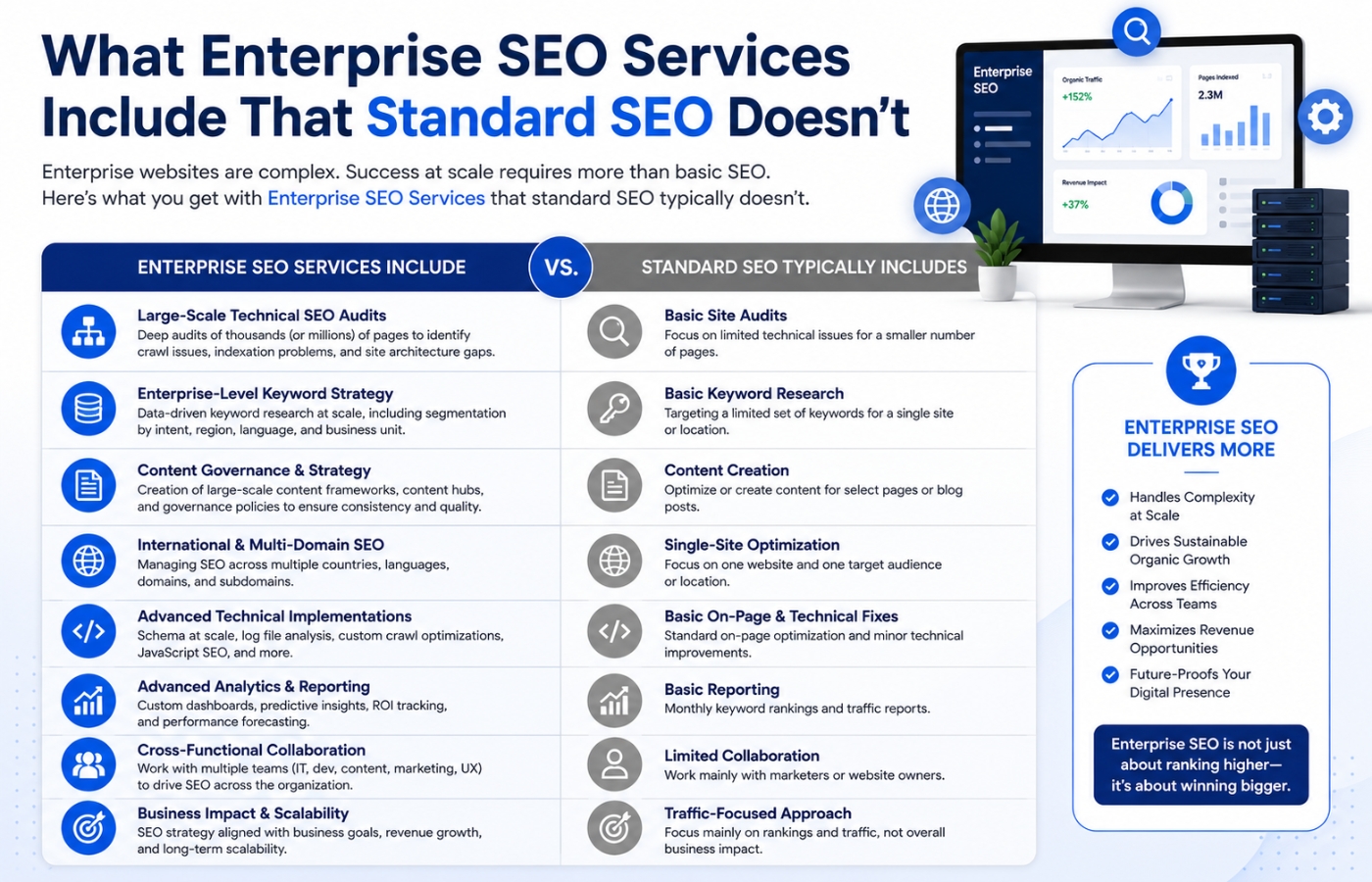
When you invest in enterprise SEO services, you are not just paying for keyword research and link building. You are paying for a systematic approach to managing massive digital ecosystems. Below are the core components that distinguish enterprise SEO from small-business SEO.
1. Technical SEO at Scale: Crawl Budget and Indexation Management
For large websites, crawl budget is a critical concept. Google allocates a limited number of URLs to crawl on your site within a given timeframe. If your site has 5 million pages but Google only crawls 500,000 per day, many pages will never be indexed or updated.
Crawl budget best practices:
-
Log file analysis: Use server log files to see exactly which pages Googlebot is crawling (and how often). Tools like Screaming Frog Log File Analyzer or OnCrawl can help.
-
Parameter handling: Use Google Search Console’s URL Parameters tool to tell Google which query strings create duplicate or irrelevant content.
-
XML sitemap segmentation: Break your sitemap into multiple files (e.g., sitemap-products.xml, sitemap-blog.xml, sitemap-locations.xml) and limit each to 50,000 URLs.
-
Robots.txt optimization: Block crawling of low-value pages (internal search results, faceted navigation, admin pages) to preserve crawl budget for important content.
-
Canonicalization: Use canonical tags to consolidate duplicate or near-duplicate pages (e.g., product pages with different color parameters).
Real-world example: An e-commerce enterprise with 2 million product pages discovered that 80% of their crawl budget was wasted on faceted navigation URLs (e.g., /shoes?color=red&size=10&sort=price). After implementing robots.txt blocks and parameter handling, indexation of their core product pages increased by 300%.
2. Automated Auditing and Monitoring
Manual SEO audits are impossible at enterprise scale. You need automated tools that continuously monitor your site for issues and alert you before they impact rankings.
Essential tools for enterprise SEO services:
| Tool | Primary Use Case |
|---|---|
| DeepCrawl (now Lumar) | Enterprise-wide crawls, change detection, log analysis |
| OnCrawl | Technical SEO analytics with data science integration |
| Botify | Crawl budget optimization and log file analysis |
| Screaming Frog (with CLI) | Large-scale crawling (up to millions of URLs) |
| SEMrush Site Audit (Enterprise plan) | Scalable issue tracking |
| Google Search Console API | Automated performance data extraction |
What to monitor continuously:
-
404 errors and broken links
-
Orphan pages (no internal links pointing to them)
-
Pages with thin content (under 300 words)
-
Duplicate title tags and meta descriptions
-
Slow-loading pages (Core Web Vitals failures)
-
Indexation spikes or drops
Set up automated weekly or daily reports that prioritize issues by severity (e.g., “critical” issues affect revenue pages).
3. Structured Data at Scale
Schema markup is powerful, but implementing it on 100,000 pages manually is impossible. Enterprise SEO services use template-level schema injection and dynamic variable substitution.
Common enterprise schema implementations:
-
Product schema (price, availability, reviews, SKU) – for e-commerce
-
Organization schema – for brand-level information
-
LocalBusiness schema – for multi-location businesses (franchises, dealerships, store locators)
-
Article schema – for media and blog content
-
BreadcrumbList schema – for all navigation hierarchies
-
FAQ schema – for knowledge base and support pages
Implementation methods:
-
CMS template modification (add schema variables to product or page templates)
-
Google Tag Manager (inject JSON-LD dynamically based on data layer variables)
-
Middleware or API-based schema generation
Pro tip: Use Google’s Rich Results Test tool to validate a sample of pages, but also set up automated testing via the Google Search Console API to detect schema errors across your entire site.
4. International SEO and Hreflang Management
For global enterprises, managing SEO across multiple countries and languages is a major challenge. Hreflang tags tell Google which language or regional URL to serve to which user.
Hreflang best practices for enterprise:
-
Use hreflang in your XML sitemap (rather than HTML
<head>tags) for easier management at scale. -
Ensure every language/country version has a self-referential hreflang tag.
-
Include
x-defaultfor pages that are not language-specific (e.g., a global homepage). -
Never use hreflang with noindex pages.
-
Monitor hreflang errors in Google Search Console (under “International Targeting”).
Common enterprise mistake: Implementing hreflang incorrectly, causing Google to ignore all tags. Example: A site with English (US), English (UK), and French (FR) must have bidirectional tags. Page A links to Page B, and Page B links back to Page A.
Tool recommendation: Use Hreflang Generator Tools (like Aleyda Solis’s Hreflang Generator) or enterprise platforms like SISTRIX for validation.
5. Content Governance and Avoiding Duplicate Content
Large websites are notorious for duplicate content — often unintentionally. Common sources include:
-
Print-friendly versions of pages
-
Session IDs and tracking parameters
-
Pagination (page 1, page 2, page 3)
-
Sort and filter options (e.g.,
?sort=price_asc) -
HTTP vs. HTTPS, www vs. non-www
-
Syndicated content (press releases, manufacturer descriptions)
Enterprise solutions:
-
Canonical tags: Designate the master version of each page.
-
Parameter handling: Use Google Search Console to set rules for specific parameters.
-
Content templates: For e-commerce, write unique product descriptions instead of using manufacturer default text. At minimum, use “canned content” with unique customer reviews, Q&A, or video.
-
Noindex low-value pages: Pages like internal search results, calendar archives, and tag pages should be
noindex, follow.
Case study: A large retailer had 85% of their indexed pages consisting of duplicate product descriptions copied from suppliers. After rewriting just 10% of their top-selling products with unique content and adding canonical tags, organic traffic to those product pages increased by 40% within three months.
6. Log File Analysis for Crawl Optimization
Log files contain records of every request made to your server, including requests from search engine bots. For enterprise SEO services, log analysis reveals:
-
Which pages Googlebot crawls most frequently
-
Which pages are rarely or never crawled
-
Crawl frequency changes over time
-
Crawl budget wasted on low-value pages
-
Server response codes (200, 404, 301, 500) for bots
How to use log data:
-
Export 1–4 weeks of raw server logs.
-
Filter for Googlebot user agent.
-
Analyze which URL patterns receive the most crawl requests.
-
Compare crawl frequency to page importance (e.g., revenue pages should be crawled daily; blog archives weekly is fine).
-
Use robots.txt or meta robots to block bots from low-value sections.
-
Monitor after changes to ensure crawl budget reallocates to important pages.
Tool: Botify, OnCrawl, or Splunk (for custom log analysis).
Without log analysis, enterprise SEO is flying blind. You cannot manage what you do not measure.
7. Enterprise Link Building at Scale
Link building for a small business might mean 10–20 high-quality backlinks per month. For an enterprise, you need systems and processes that generate links at scale without sacrificing quality.
Scalable link acquisition strategies:
-
Digital PR: Create newsworthy data studies, surveys, or original research that journalists naturally want to cite.
-
Broken link building at scale: Use tools like Ahrefs or Majestic to find broken links on industry resource pages, then suggest your content as a replacement.
-
Unlinked brand mentions: Track mentions of your brand that are not hyperlinked (using Google Alerts or Mention.com). Reach out and ask for a link.
-
Skyscraper content + outreach: Create the best resource on a topic, then email everyone who linked to inferior resources.
-
Partnerships and sponsorships: Sponsor industry conferences, local events, or charitable organizations in exchange for a link.
-
Resource page harvesting: Find “helpful resources” or “useful links” pages in your niche using search operators like
intitle:"resources" + "your industry".
Enterprise link management tools:
-
Ahrefs (Enterprise plan)
-
Majestic (bulk backlink analysis)
-
Pitchbox (outreach automation)
-
BuzzStream (relationship management)
Important note: Enterprise sites must avoid private blog networks (PBNs) and other black-hat tactics. Google penalizes aggressive link schemes, and the revenue impact for an enterprise can be catastrophic.
8. Performance Measurement and Enterprise Dashboards
At the enterprise level, you cannot rely on manual spreadsheets or basic Google Analytics reports. You need custom dashboards that aggregate data across:
-
Multiple domains and subdomains
-
Multiple countries and languages
-
Different business units (e.g., product, blog, support, careers)
-
Custom KPIs tailored to each page type
Enterprise SEO dashboards should include:
| KPI Category | Example Metrics |
|---|---|
| Visibility | Average ranking position for top 1,000 keywords |
| Traffic | Organic sessions, new users, landing page performance |
| Engagement | Bounce rate, average session duration, pages per session |
| Conversions | Revenue from organic search, goal completions, Ecommerce conversion rate |
| Technical health | Crawl errors, Core Web Vitals pass rate, indexation ratio |
| International | Hreflang coverage, traffic by country/language |
Tools for enterprise reporting:
-
Google Looker Studio (formerly Data Studio) + Supermetrics
-
Tableau or Power BI (for custom data integration)
-
Search Console API + Python scripts
-
SEMrush .Trends or Ahrefs Rank Tracker (for portfolio tracking)
Automation best practice: Schedule automated email reports to stakeholders weekly, but build an executive dashboard that refreshes daily.
9. Cross-Functional Workflows and Stakeholder Management
Enterprise SEO is rarely a solo effort. You must collaborate with:
-
Development/Engineering: For technical fixes, schema implementation, and site migrations
-
Product teams: For URL structure, faceted navigation, and new feature launches
-
Content teams: For keyword targeting, content briefs, and internal linking
-
PR/Marketing: For digital PR campaigns and linkable assets
-
IT/Infrastructure: For server log access and crawling optimizations
-
Legal/Compliance: For international regulations (GDPR, CCPA) that impact SEO
Enterprise workflow best practices:
-
Create an SEO ticket system integrated with your development team’s project management tool (Jira, Asana, Trello).
-
Hold weekly SEO sync meetings with each stakeholder group.
-
Document all SEO processes and playbooks (e.g., “How to launch a new product category page”).
-
Use change detection tools (like ContentKing or Lumar) to alert you when pages change unexpectedly.
Common failure mode: An enterprise site loses rankings after a CMS update because the SEO team was not notified of the change. Prevention requires embedded workflows, not just quarterly audits.
10. Site Migrations, Redesigns, and Platform Changes
Large websites undergo constant change: rebrands, CMS migrations (e.g., moving from AEM to WordPress), domain changes, or major redesigns. Each of these events carries massive SEO risk.
Enterprise migration checklist:
-
Before migration: Full crawl of the existing site (all URLs, metadata, internal links).
-
URL mapping: Create a spreadsheet mapping every old URL to its new URL (or marking as removed).
-
Redirect planning: Implement 301 redirects for every changed URL. No 302s, no chains.
-
Staging environment testing: Use password protection or noindex tags to prevent staging pages from being indexed.
-
Launch checklist: Update robots.txt, submit new sitemap, verify new property in Google Search Console, monitor crawl stats.
-
Post-launch monitoring: Run a full crawl within 24 hours, check for 404 errors, monitor indexation and rankings for 30–60 days.
Pro tip: For enterprise migrations, hire an external SEO auditor to review your plan. A single mistake (e.g., losing redirects for 10,000 product pages) can cost millions in lost revenue.
Enterprise SEO Tools Stack (Recommended)
| Category | Recommended Tools |
|---|---|
| Crawling & Auditing | Lumar (DeepCrawl), Botify, OnCrawl, Screaming Frog |
| Keyword Research | SEMrush, Ahrefs, Moz Pro (Enterprise) |
| Rank Tracking | SEMrush, STAT Search Analytics, AccuRanker |
| Backlink Analysis | Ahrefs, Majestic, LinkResearchTools (LRT) |
| Log File Analysis | Botify, OnCrawl, Splunk |
| International SEO | SISTRIX, Hreflang Builder Tool |
| Dashboard & Reporting | Google Looker Studio + Supermetrics, Tableau |
| Change Detection | ContentKing, Lumar |
| Site Speed Monitoring | SpeedCurve, Calibre, Google CrUX API |
Budget for enterprise tools typically ranges from $500 to $5,000+ per month. The ROI justifies the cost when you manage millions in organic revenue.
Common Enterprise SEO Mistakes
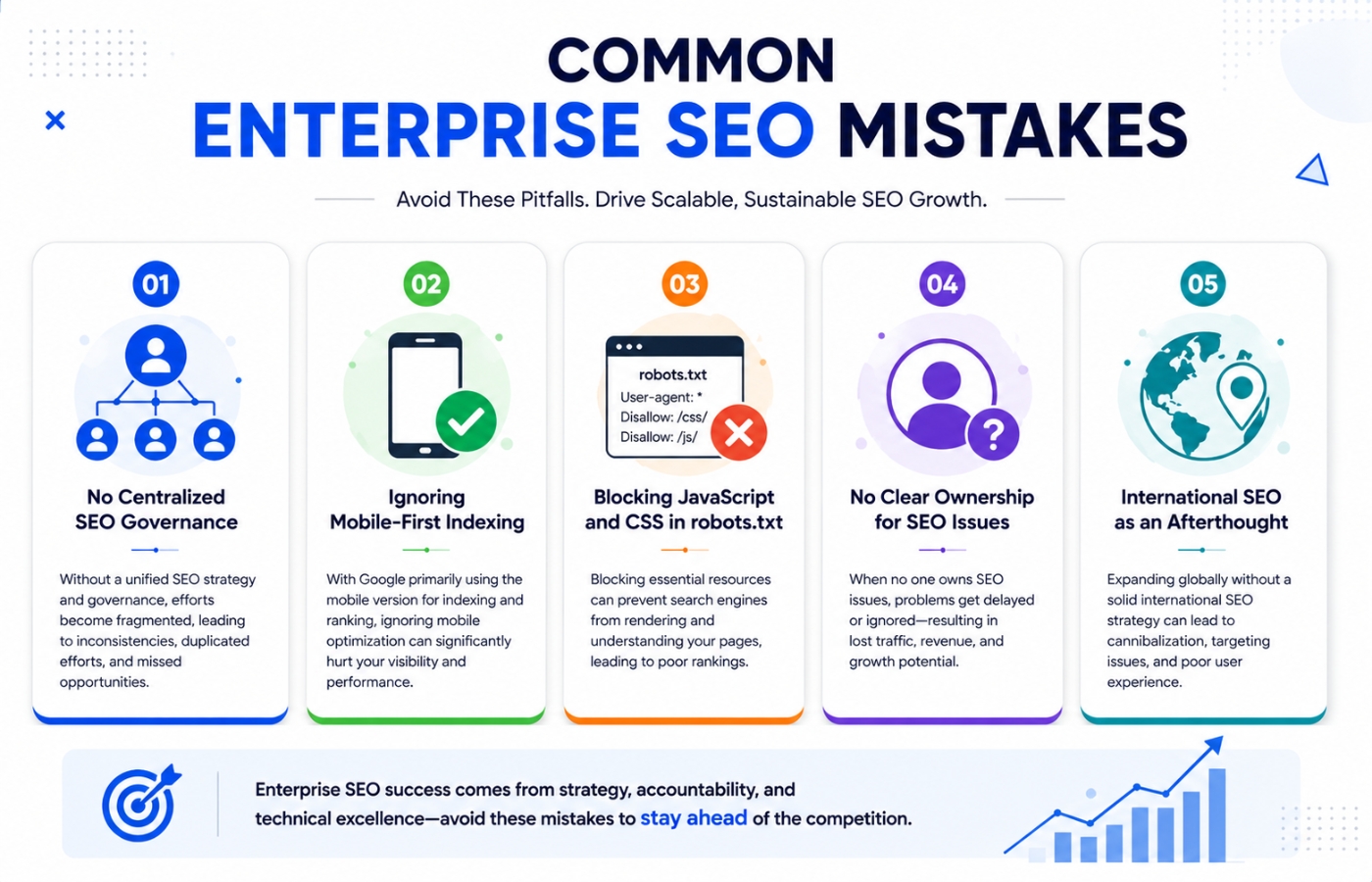
No Centralized SEO Governance
Each business unit does its own thing, resulting in inconsistent URL structures, duplicate content, and conflicting canonical tags.
Fix: Create an SEO Center of Excellence with documented standards.
Ignoring Mobile-First Indexing
Enterprise sites often have separate mobile subdomains (m.example.com) or mobile apps that are not crawlable.
Fix: Use responsive design or dynamic serving with proper Vary: User-Agent headers.
Blocking JavaScript and CSS in robots.txt
Google needs these resources to render pages correctly.
Fix: Allow Googlebot access to all JS/CSS files.
No Clear Ownership for SEO Issues
Everyone assumes someone else will fix the broken schema or 404 errors.
Fix: Assign an SEO product owner with authority to prioritize technical tasks in the development backlog.
International SEO as an Afterthought
Launching a new country site without hreflang or proper local keyword research.
Fix: Include international SEO in the project discovery phase.
Real-World Example: Enterprise SEO Turnaround
The Company: A global hotel chain with 1,200+ properties, a booking engine with 5 million+ room-and-date combinations, and 15 country-specific websites.
The Problem: Organic traffic had flatlined for 18 months. Core Web Vitals failed on 80% of pages. Hreflang tags were completely broken. Duplicate content across country sites was rampant.
The Solution (Enterprise SEO Services):
-
Conducted a full log file analysis and discovered Google was wasting 60% of crawl budget on faceted search URLs.
-
Implemented robots.txt blocks and parameter handling to redirect crawl budget to booking pages.
-
Rewrote hreflang implementation (moving from HTML head to XML sitemaps) and fixed 12,000+ errors.
-
Optimized images and implemented lazy loading, improving LCP from 4.2 seconds to 1.8 seconds.
-
Created a content governance policy requiring unique descriptions for top 500 properties (with templates for the rest).
The Results (12 months):
-
Organic traffic: +140%
-
Organic revenue: +$22 million annually
-
Hreflang error rate: 45% → 2%
-
Core Web Vitals pass rate: 20% → 89%
-
Crawl efficiency: 60% waste → 15% waste
Total investment: $300,000 (tools, agency fees, internal resources). ROI: 73x in year one.
Conclusion: Scale SEO or Get Left Behind
Managing a large website requires more than basic SEO knowledge. It requires enterprise SEO services — a disciplined combination of automated tools, cross-functional workflows, technical rigor, and strategic prioritization. The principles are the same as small-site SEO (great content, fast pages, clean code), but the execution is exponentially more complex.
Start with your crawl budget and indexation. Then move to international targeting, schema at scale, and automated monitoring. Build dashboards that executives understand. And never stop testing.
Your enterprise website is one of your most valuable assets. Treat its SEO with the seriousness it deserves.
Want more qualified organic traffic and attract more customers through enterprise-level SEO?
Get in touch with Orbitix today.