







How to Create an SEO Content Hub That Drives Organic Traffic
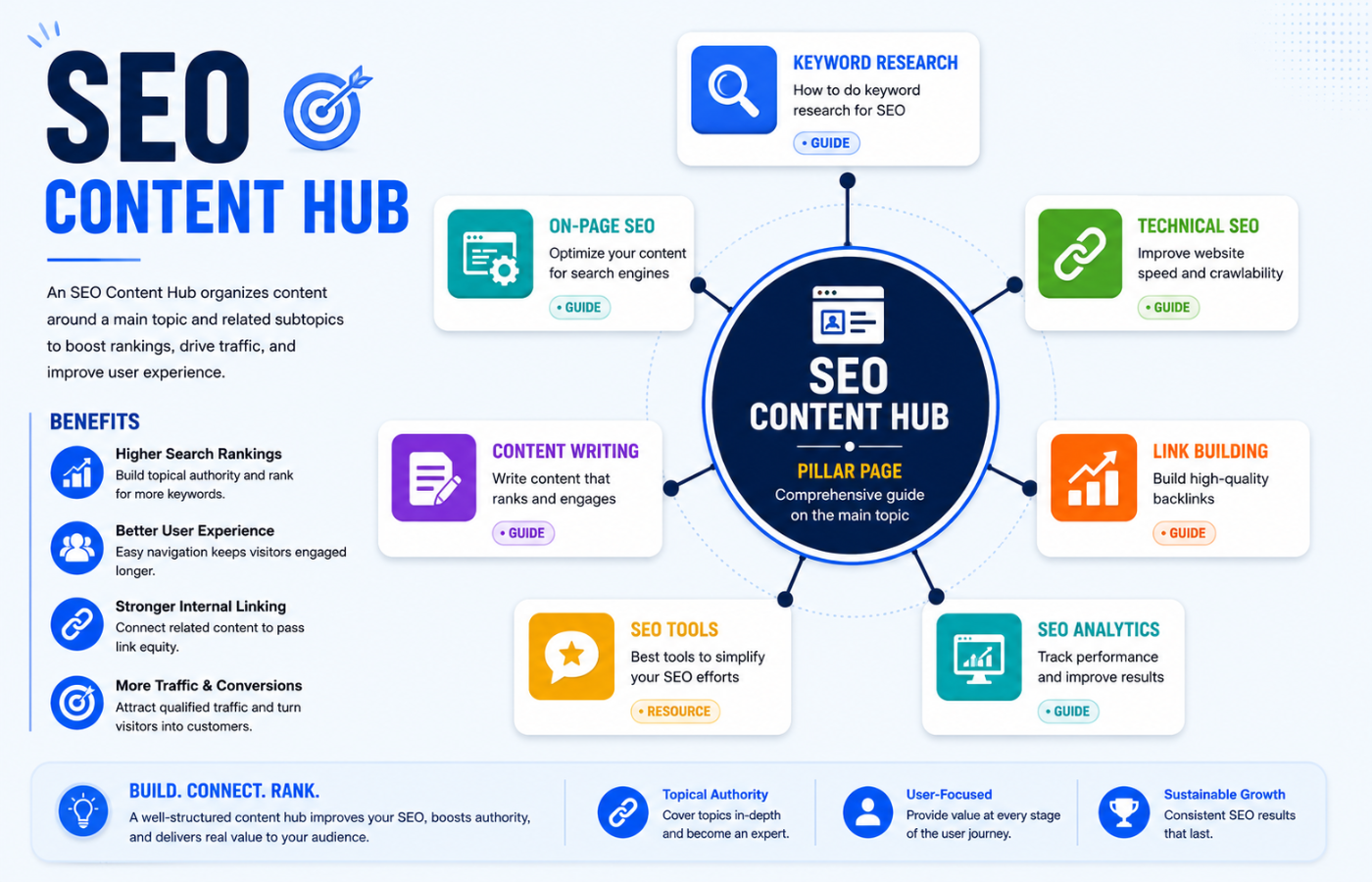
An SEO content hub is one of the most effective ways to build topical authority, improve search rankings, and turn your website into a go-to resource for your industry. Combined with high-quality SEO content writing, this approach helps create valuable, search-friendly content that meets user intent and strengthens your site’s authority. Unlike traditional blogging—where content gets buried over time—an SEO content hub uses a structured, topic-driven approach that signals to search engines that you cover a subject thoroughly and authoritatively. When executed correctly, a content hub can catapult a site from ranking for a handful of keywords to hundreds or even thousands. This guide walks you through exactly how to build one that drives sustainable organic traffic.
What Is an SEO Content Hub?
A content hub is a curated collection of interrelated content, all centered around a specific topic. Think of it as a digital book: the pillar page acts as the main authority page (introducing the broad topic), while 10-15 cluster pages function as chapters that cover specific subtopics in depth. A strong internal linking structure ties everything together, helping both users and search engines navigate the content.
Content hubs can take several forms: the classic hub-and-spoke model, a content library (organising multiple topics), a topic gateway (deep coverage of one subject), or a content database (searchable archive).
Why Content Hubs Drive Organic Traffic
1. Build Topical Authority – A well-structured hub demonstrates experience, expertise, authoritativeness, and trustworthiness (E-E-A-T) across the entire topic. Google rewards sites that provide comprehensive, connected coverage on a subject.
2. Rank for Multiple Keywords – The pillar page targets broad, high-volume terms, while cluster pages rank for long-tail keywords with higher conversion potential. This gives you visibility across the entire user journey.
3. Improve Engagement – Internal links guide readers through related content, increasing time on site, reducing bounce rates, and sending positive engagement signals to Google.
4. Keep Content Evergreen – Content hubs are organised by topic, not date. This means valuable content doesn’t get buried like blog posts do. Pages become powerhouses as they age, accumulate backlinks, and get updated regularly.
5. Prepare for AI Search – AI answer engines like ChatGPT, Perplexity, and Google AI Overviews favour sites with deep, organised coverage and clear relationships between entities.
How to Build an SEO Content Hub Step by Step
Step 1: Choose Your Core Topic
Your pillar topic should be broad enough to support 10-15 subtopics, narrow enough to keep content focused, and relevant to your business. Run keyword research to check search volume and difficulty. Look for a topic with enough query variations to build a full cluster.
Step 2: Identify Subtopics
Break your core topic into specific, long-tail subtopics that address different angles, questions, or audience segments. Use tools like Ubersuggest, AnswerThePublic, or Keyword Explorer to generate ideas. Avoid keyword cannibalisation by assigning each cluster page a unique focus.
Step 3: Audit Existing Content
Before creating new content, search your website for existing articles or pages that fit your hub’s topic. Repurpose relevant pieces—even if they need editing, it saves time and effort.
Step 4: Create the Pillar Page First (or Early)
Your pillar page should provide a comprehensive overview, linking out to each cluster page using descriptive anchor text. Make it user-friendly with a table of contents, clear navigation, and visual elements. Some strategies work better by launching cluster pages first to build momentum before publishing the pillar.
Step 5: Build Supporting Cluster Content
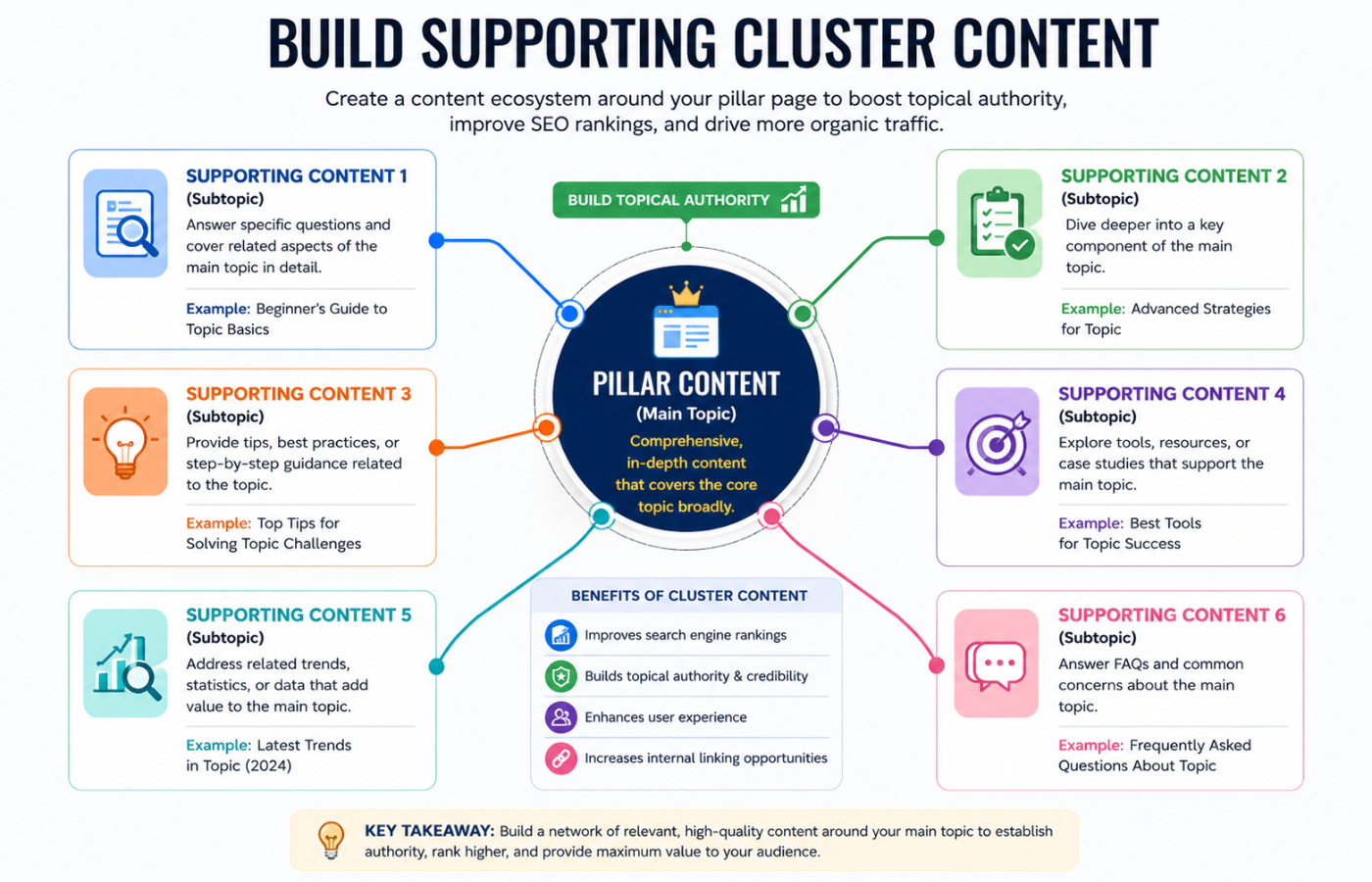
Write in-depth articles for each subtopic, ensuring every page links back to the pillar using keyword-rich anchor text. Where helpful, link related cluster pages to each other, creating a dense internal link graph.
Step 6: Implement Internal Linking
Effective internal linking is the key to making a content hub work. Ensure:
-
The pillar page links to every cluster page
-
Each cluster page links back to the pillar
-
Related cluster pages link to each other where relevant
Use descriptive anchor text that includes keywords—this reinforces semantic relationships for search engines and helps users navigate intelligently.
Step 7: Add Structured Data
Implement schema markup like Article, BreadcrumbList, FAQ, or relevant entity schema on both pillar and cluster pages to reinforce topical relationships and increase the chances of rich results and AI citations.
Step 8: Publish and Promote
You don’t need to publish everything at once. Start with the pillar page and add subtopics on a weekly or monthly schedule. Share your hub on social media, in email newsletters, and through outreach to relevant industry sites.
Step 9: Measure and Optimise
Track:
-
Organic traffic growth (keyword rankings, page views)
-
Engagement (time on page, bounce rate, click-throughs)
-
Leads or conversions from hub content
-
Backlink acquisition
Review performance quarterly, refresh outdated content, add new cluster pages as topics emerge, and retire low-performing pages.
Common Mistakes to Avoid
| Mistake | Fix |
|---|---|
| Duplicate content across location/subtopic pages | Write unique, locally specific copy for each page |
| No clear internal linking structure | Implement consistent hub→spoke and spoke→hub links |
| Publishing the pillar with thin content | Ensure the pillar covers the broad topic with sufficient depth |
| Forgetting to update the hub | Schedule quarterly reviews to keep content fresh |
| No CTAs or lead capture | Add relevant, non-gated CTAs to guide users to the next step |
Conclusion
An SEO content hub is one of the smartest investments you can make in organic growth and a strong Inbound Marketing Strategy. By structuring content around topics, not random keywords, you build authority, improve user experience, and become the go-to resource in your niche. The model works because it aligns with how modern search engines—and AI answer engines—interpret meaning and relationships.
Start small: pick one core topic, map out your cluster, and publish consistently. Within months, you can go from ranking for a handful of keywords to dominating your category.
Want an SEO content hub that builds authority, ranks for hundreds of keywords, and generates leads—without guesswork or wasted content?
Get in touch with Orbitix today.