






Email Marketing for Beginners: The Complete Step-by-Step Guide
Email marketing for beginners can feel overwhelming, but it remains one of the most effective digital marketing channels available—delivering an average ROI of £36 for every £1 spent. As businesses adapt to SEO Strategies 2026, combining strong email campaigns with modern search optimisation is becoming essential for long-term digital growth. Whether you’re a small business owner, a solopreneur, or a marketing novice, email marketing for beginners starts with understanding the fundamentals: building a quality list, crafting messages that resonate, and nurturing relationships that convert. This step-by-step guide will walk you through everything you need to know, from choosing the right platform to analysing your first campaign’s performance.
Why Email Marketing Still Matters in 2026
Despite the rise of social media and AI-powered search, email remains the most direct and personal channel to reach your audience. With over 4.3 billion email users worldwide, your potential customers are already in their inboxes—often multiple times a day. Unlike social platforms where algorithms control visibility, email delivers your message directly to the people who have invited you in. For beginners, this means you own your audience relationship, not a platform.
Email Marketing for Beginners: Your Step-by-Step Playbook
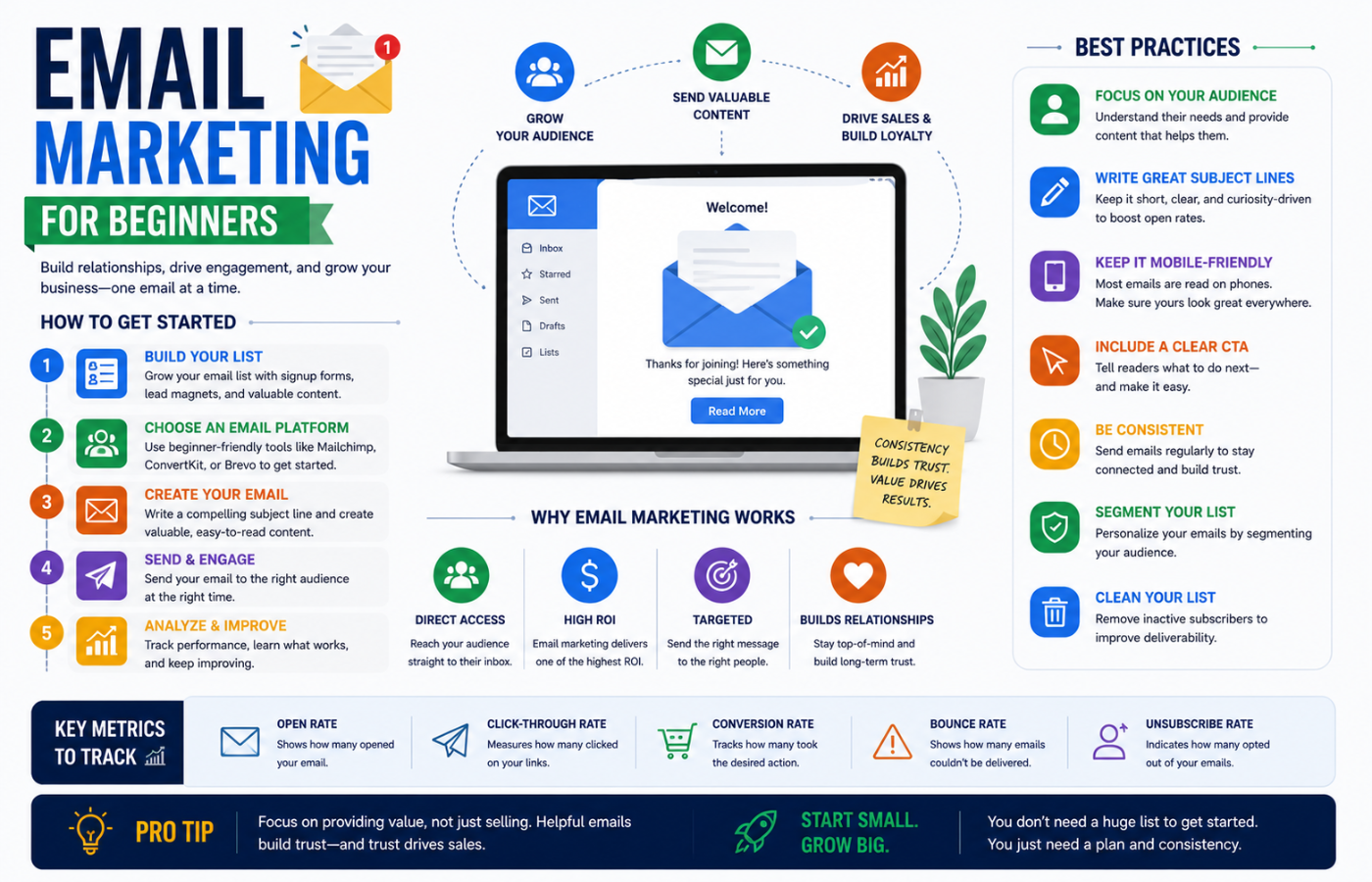
Here’s how to launch your first campaign with confidence using these email marketing for beginners best practices.
Step 1: Choose the Right Email Marketing Platform
Your platform is the foundation of your email program. For beginners, look for:
-
Ease of use: Drag-and-drop editors and pre-built templates
-
Free or low-cost plans: Most platforms offer free tiers for up to 500-1,000 subscribers
-
Deliverability: High inbox placement rates (not spam folders)
-
Automation capabilities: Welcome sequences, abandoned cart emails
-
Analytics: Open rates, click-through rates, and conversion tracking
Recommended platforms for beginners:
-
Mailchimp: Best for beginners with free plan up to 500 contacts
-
MailerLite: Affordable, clean interface, strong automation
-
ConvertKit: Designed for creators and bloggers
-
Brevo (formerly Sendinblue): Great for transactional emails and SMS
Step 2: Build Your Email List the Right Way
Your list is your most valuable asset. Never buy email lists—this damages deliverability and violates GDPR/anti-spam laws. Instead:
Organic list-building methods:
-
Website signup forms: Place opt-in forms prominently on your homepage, blog sidebar, and as exit-intent popups
-
Lead magnets: Offer a free resource (e-book, checklist, template, discount code) in exchange for an email address
-
Social media promotion: Direct followers to a landing page
-
In-person events: Collect emails at trade shows, workshops, or storefronts
-
Referral programs: Encourage existing subscribers to share with friends
Best practice: Use double opt-in (confirmation email) to verify subscribers genuinely want to hear from you. This dramatically improves deliverability and engagement.
Step 3: Segment Your Audience From Day One
Even as a beginner, you can start segmenting your list. Segmentation means grouping subscribers by shared characteristics so you can send relevant content.
Simple segmentation criteria for beginners:
-
New vs existing subscribers: Send a welcome series to new leads, regular newsletters to existing ones
-
Lead magnet interest: Group subscribers by the free resource they downloaded (e.g., “SEO Checklist” vs “Social Media Template”)
-
Purchase history: If you sell products, segment by what they’ve bought
-
Engagement level: Active openers vs inactive subscribers
Why this matters: Segmented campaigns generate 760% more revenue than non-segmented ones. Even basic segmentation improves results dramatically.
Step 4: Design Your First Email Campaign
Your first campaign sets the tone for your relationship with subscribers.
Essential email types for beginners:
-
Welcome email: Sent immediately after signup—sets expectations and introduces your brand
-
Newsletter: Regular updates with valuable content (weekly or monthly)
-
Promotional emails: Product launches, sales, or special offers
-
Re-engagement email: Win back inactive subscribers
Best practices for your first email:
-
Subject line: Keep under 50 characters, create curiosity or urgency
-
Personalisation: Use the subscriber’s name in the greeting
-
Clear call-to-action (CTA): One primary action per email
-
Mobile optimisation: Over 60% of emails are opened on mobile
-
Value-first approach: Lead with helpful content, not a sales pitch
-
Unsubscribe link: Legally required and builds trust
Step 5: Write Copy That Connects
Your email copy should feel like a conversation, not a sales letter.
The 4-1-1 Rule for email content:
-
4 helpful, educational emails (value, tips, insights)
-
1 soft promotional email (introducing a product or service)
-
1 hard promotional email (direct sales offer)
This ratio builds trust before you ever ask for the sale.
Headline and opening line tips:
-
Start with a question or relatable statement
-
Address a specific pain point
-
Use the word “you” more than “we” or “I”
Step 6: Add Visual Appeal
Your emails don’t need to be design masterpieces. Clean, simple layouts often perform better.
Visual best practices:
-
Brand colours and logo: Build recognition
-
Images: Relevant, high-quality photos (compress for faster loading)
-
White space: Don’t clutter—guide the reader’s eye
-
Consistent font: Readable, web-safe (Arial, Georgia, Helvetica)
-
Alt text for images: Ensures readability even when images are blocked
Step 7: Test Before Sending
Never send an email without testing.
What to test:
-
Subject lines: A/B test two versions (doctors vs surgeons approach)
-
Send time: Try different days and times
-
CTA placement: Button vs text link, top vs bottom
-
Content length: Short vs long-form copy
Essential pre-send checklist:
-
Test on desktop and mobile
-
Click every link to ensure it works
-
Check for spelling and grammar errors
-
Preview in different email clients (Gmail, Outlook, Apple Mail)
-
Verify unsubscribe link is functional
-
Ensure your “From” name is recognisable
Step 8: Send and Analyse Your First Campaign
After sending, the real learning begins.
Key metrics to track:
| Metric | What It Measures | Good Benchmark |
|---|---|---|
| Open Rate | Percentage who opened your email | 20-30% average across industries |
| Click-Through Rate (CTR) | Percentage who clicked a link | 2-5% average |
| Conversion Rate | Percentage who completed the desired action (e.g., purchase) | 1-3% average |
| Bounce Rate | Undeliverable emails | Under 2% |
| Unsubscribe Rate | People who left your list | Under 0.5% |
| Spam Complaint Rate | Users marking as spam | Under 0.1% |
Remember: These are benchmarks. Your numbers will vary by industry, list quality, and offer.
Step 9: Build Automated Email Sequences
Once you’ve sent a few manual campaigns, explore automation. Set up sequences that run on autopilot:
-
Welcome sequence: 3-5 emails introducing your brand, sharing value, and asking for engagement
-
Abandoned cart sequence: Remind shoppers to complete their purchase
-
Re-engagement sequence: Win back inactive subscribers
-
Birthday/anniversary sequence: Personalised greetings with offers
Pro tip: Start with a simple welcome sequence—it’s the highest-impact automation for beginners.
Common Email Marketing Mistakes for Beginners to Avoid
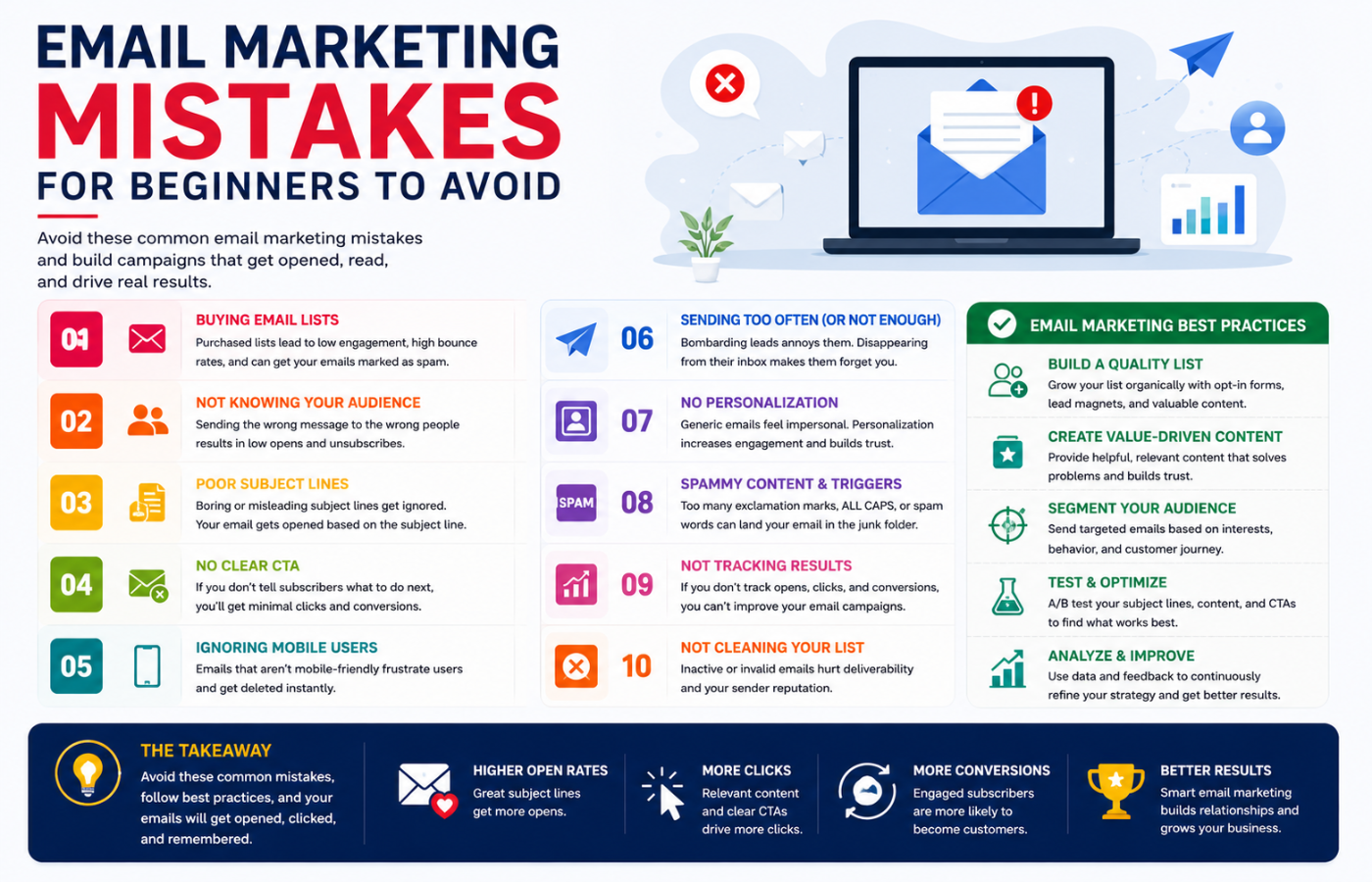
| Mistake | Why It Hurts | Fix |
|---|---|---|
| Buying email lists | Low engagement, spam complaints, legal trouble | Build organically with lead magnets |
| No clear goal per email | Subscribers don’t know what to do | Define one CTA per email |
| Sending too frequently | Subscriber fatigue and unsubscribes | Start weekly or bi-weekly and adjust |
| Sending too rarely | Subscribers forget who you are | Maintain consistent schedule |
| Ignoring mobile design | Lost engagement from mobile users | Test on multiple devices |
| No welcome email | Missed opportunity to set expectations | Automate a welcome sequence |
| Not analysing results | No improvement over time | Review metrics monthly |
Conclusion
Email marketing for beginners doesn’t have to be complicated. Start with the right platform, build your list organically, create valuable content, and analyse your results to improve incrementally. While channels like email remain highly effective, combining them with Social-First Ranking Strategies can strengthen your overall digital marketing approach by expanding your reach and engagement. The beauty of email is that it compounds—each campaign teaches you something about your audience, and over time, your strategy becomes more refined and effective.
Want email marketing that actually converts—with step-by-step guidance on list-building, automation, and campaign optimisation for beginners?
Get in touch with Orbitix today.