






Comprehensive Guide to Copywriting: Tips & Trends 2026
What Is Copywriting?
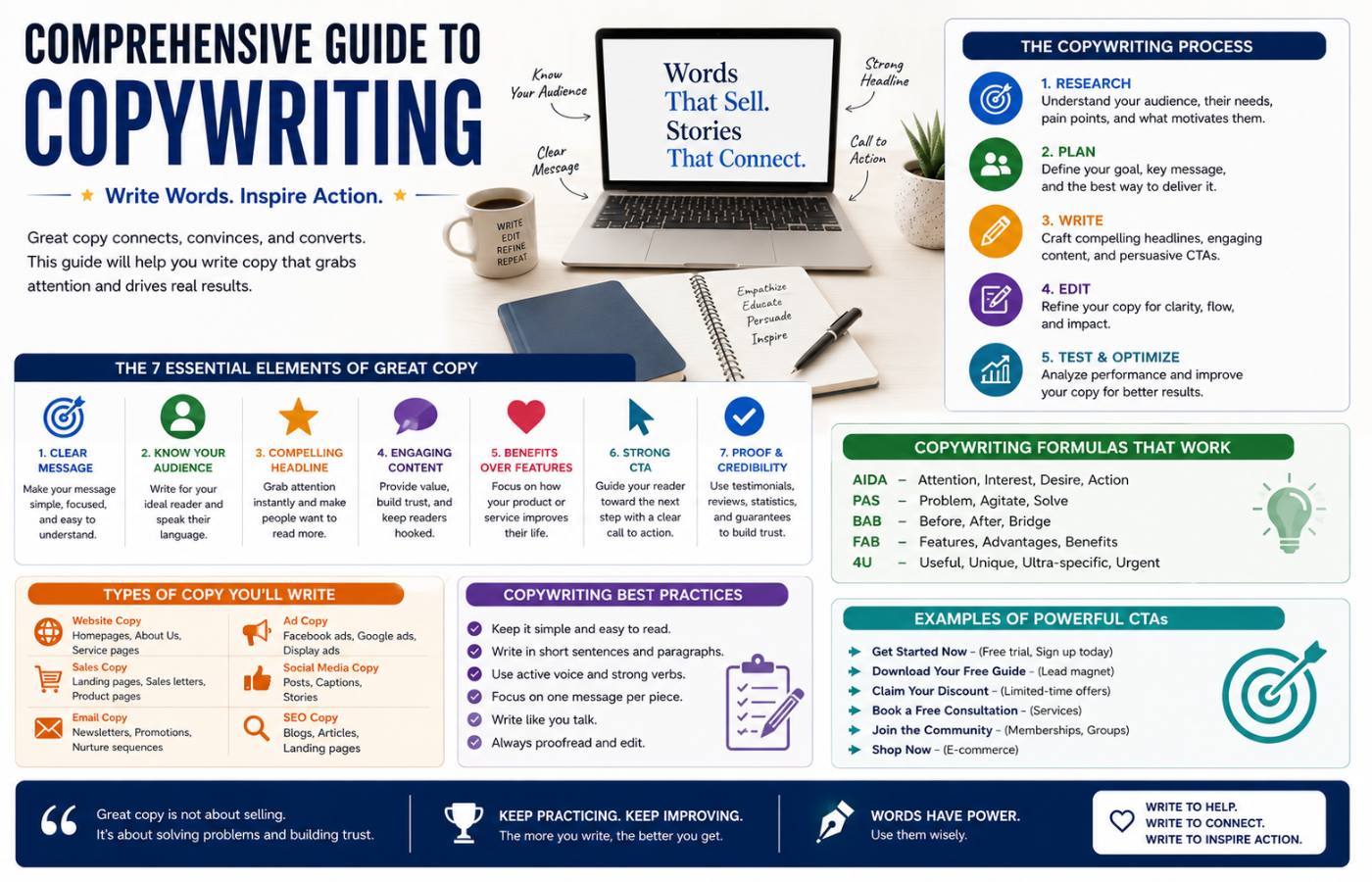
Copywriting is the practice of writing persuasive text to get readers to take a specific action, such as signing up for a newsletter or making a purchase. It includes everything from ads and landing pages to emails and product descriptions.
Good copy communicates your value clearly and motivates the reader to act. Features, benefits, pricing, and social proof all serve the message, but copy is what determines how those elements land with the reader.
Key distinction: Copywriting is different from content marketing. Content writing builds awareness over time through blogs, guides, and educational resources. Copywriting is more direct — its job is to get the reader to take a specific action, right now.
Why Copywriting Still Matters in 2026
AI can generate copy at scale, so do you even need a human copywriter anymore? The short answer is yes.
Trust is the differentiator. According to Accenture’s Life Trends report, 62 percent of consumers say trust is an important factor when choosing to engage with a brand. At the same time, AI-generated content is flooding every channel. Data from CivicScience shows 36 percent of consumers can spot AI in a brand’s marketing and won’t do business with them when they do.
Emotional connection drives results. Analysis of over 1,400 advertising case studies finds that purely emotional campaigns outperform those using rational content alone, generating almost double the profitability.
Copywriting has always been about understanding what motivates your audience and building a message that moves them to act. AI can draft and iterate quickly, but it can’t replace the strategic thinking that makes copy convert.
Types of Copywriting You Need to Know
Effective comprehensive guide to copywriting covers the different types of copy you’ll encounter:
Brand Copywriting
Defines how a brand displays its values and personality, creating an emotional connection with customers. It shows up in landing pages, ads, and anywhere a brand interacts with its audience.
SEO Copywriting
Writing content that ranks well in search engines and provides value to the reader is one of the most effective SEO Strategies for long-term growth. In 2026, this means creating copy that satisfies search intent and earns citations in AI Overviews.
Social Media Copywriting
Grabbing users’ attention as they scroll and converting it. Each platform has its own rules — copy that works on LinkedIn won’t land the same way on TikTok.
Email Copywriting
One of the most direct forms of copy, landing in someone’s personal inbox. Email marketing generates $36 for every $1 spent on average.
Direct Response Copy
Drives immediate engagement, like putting an item in a cart or completing a purchase.
The 2026 Copywriting Trends
1. Human Insight + AI Integration
While AI will continue to get faster, its ability to generate copy may degenerate as it feeds and re-feeds on its own output. Human input and insight will become more necessary. Copywriters who can write real, compelling copy brimming with a strong point of view and personality will be more in demand.
The opportunity: Copywriters who build systems with AI to automate repeatable processes will have an ever-increasing advantage.
2. The Sea of Sameness
85% of marketers use AI for content creation, and when brands across the world use the same few basic LLMs, marketing copy starts to converge on the same bland tone. Consumers are starting to notice the “AI-slop” — over-employed rhetorical tricks, empty optimism, and a homogeneous tone.
The solution: Brands that invest in proper content infrastructure — systems that can maintain brand voice whilst scaling across channels — will stand out.
3. Specificity Over Generics
In a GenAI-driven world, clarity and original insight stand out because they feel grounded, credible, and difficult to replicate. Go beyond generic claims and anchor your copy in real examples, data, and outcomes.
4. AI as a Brainstorming Partner, Not a Replacement
The most successful copywriters use AI as an assistant, not a replacement. They brainstorm with AI, let the ideas fly, and then write the copy themselves. Use AI to test your writing: “What’s the weakest claim in here?” or “Where does this sound like every other brand?”
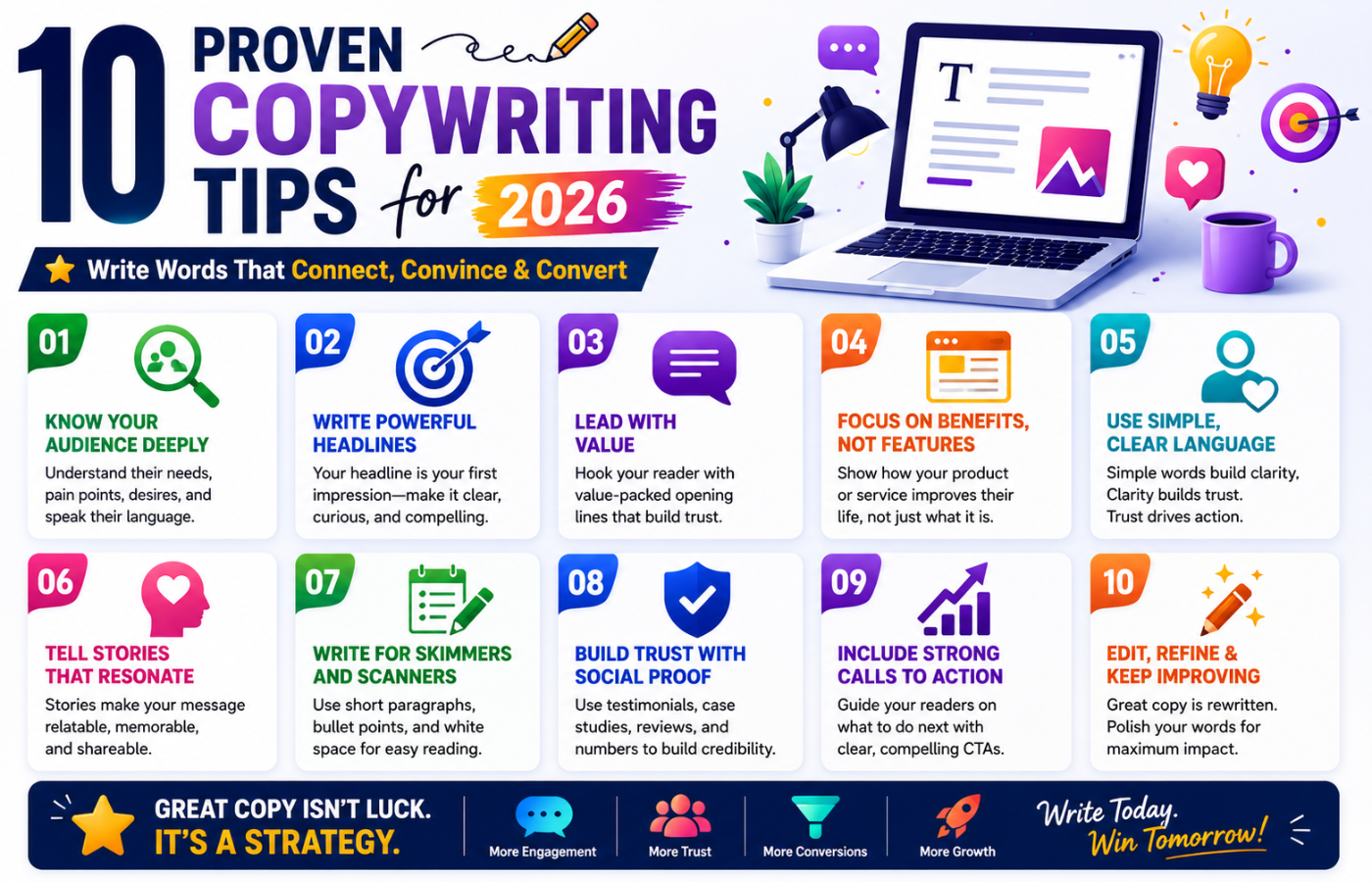
10 Proven Copywriting Tips for 2026
1. Start With Your Customer, Not Your Product
Good copy starts with a deep understanding of your audience’s pain points. It goes deeper than just listing your product’s features. Write directly to the buyer about what their experience will be once they move forward.
2. Focus on Benefits, Not Features
Instead of writing about the technicalities of a car’s design, a car company could focus on how smooth and quiet the ride will be. Write about the customer’s experience in using the product, not your experience in designing it.
3. Write Clear, Concise Copy
Brevity is your friend. Don’t write long, chunky paragraphs that are tough to get through. Use clear, simple language that is easy and quick to comprehend.
4. Craft Compelling Headlines
You only have a few seconds to capture a reader’s attention. The headline must immediately grab their attention, speak to a need they may have, and convey that they are the correct audience for that product.
5. Appeal to Emotions
People make decisions based on emotions. Consider the emotional impact you’re looking to evoke — happiness, hopefulness, or even anger — then use emotional words in your copy.
6. Tell a Story
We crave stories. Using a narrative — or the implication of a narrative — in your copy helps create emotional connection and makes the audience more invested in the outcome.
7. Know Where Your Copy Lives
Write within the constraints and context of its place. The context will let you know how much space you have and what else your audience is looking at.
8. Always Include a Strong Call to Action
The goal of copywriting is to get the reader to take action. The CTA should have strong, direct language that persuades the reader to take action.
9. Edit and Cut… Then Do It Again
Your first draft probably isn’t your best version. Write the first draft, put it away, then read it from the perspective of your target customer. Cut unnecessary words and rewrite elements that don’t work.
10. Back Up Your Claims With Data
Go beyond generic claims and anchor your copy in real examples, data, and outcomes. Copy that demonstrates genuine expertise and cites original data is more likely to show up in AI visibility.
Common Copywriting Mistakes to Avoid
| Mistake | Why It Hurts | Fix |
|---|---|---|
| Writing too complex | Readers tune out | Use simple, clear language |
| Ignoring user intent | Low conversions | Match content to what users actually want |
| Weak headlines | Nobody reads further | Lead with a strong hook |
| Keyword stuffing | Looks spammy, penalised | Write naturally for humans |
| No emotional appeal | Feels robotic | Connect with readers’ emotions |
Tools for Copywriters in 2026
AI writing tools can sharpen your output when you use them strategically. Without applying your own judgment, though, they can flatten it.
-
Anyword: Data-driven AI copywriting platform with predictive performance scores
-
Grammarly: Catching spelling and grammar mistakes and flagging tone mismatches
-
Wordtune: AI-powered rewriting tool that helps you refine your message
-
Ahrefs & Semrush: SEO research and optimization
-
Hemingway Editor: Readability improvement
Conclusion: The Future of Copywriting
Copywriting in 2026 is no longer just writing — it is about performance. Good copy helps content rank better in search engines, get more engagement, and generate more conversions.
The key trends shaping copywriting’s future include:
-
AI search and voice search — content must be structured for AI systems
-
Personalisation and conversational search — adapting voice across dozens of segments
-
Human insight and authenticity — standing out in the sea of sameness
But one thing will stay the same: clear and helpful writing will always perform best — no matter how technology evolves.
Want copywriting that converts in 2026 — with strategies that blend AI efficiency and human insight to build trust, drive action, and stand out from the competition?
Get in touch with Orbitix today.