




GEO vs SEO: How AI Search Is Changing Digital Marketing
Why the Shift Matters
AI search is fundamentally different. Google responds with ranked lists of links; generative engines provide direct, synthesized answers with citations . This shift has profound implications for digital marketing strategy.
GEO vs SEO: Key Differences You Need to Know
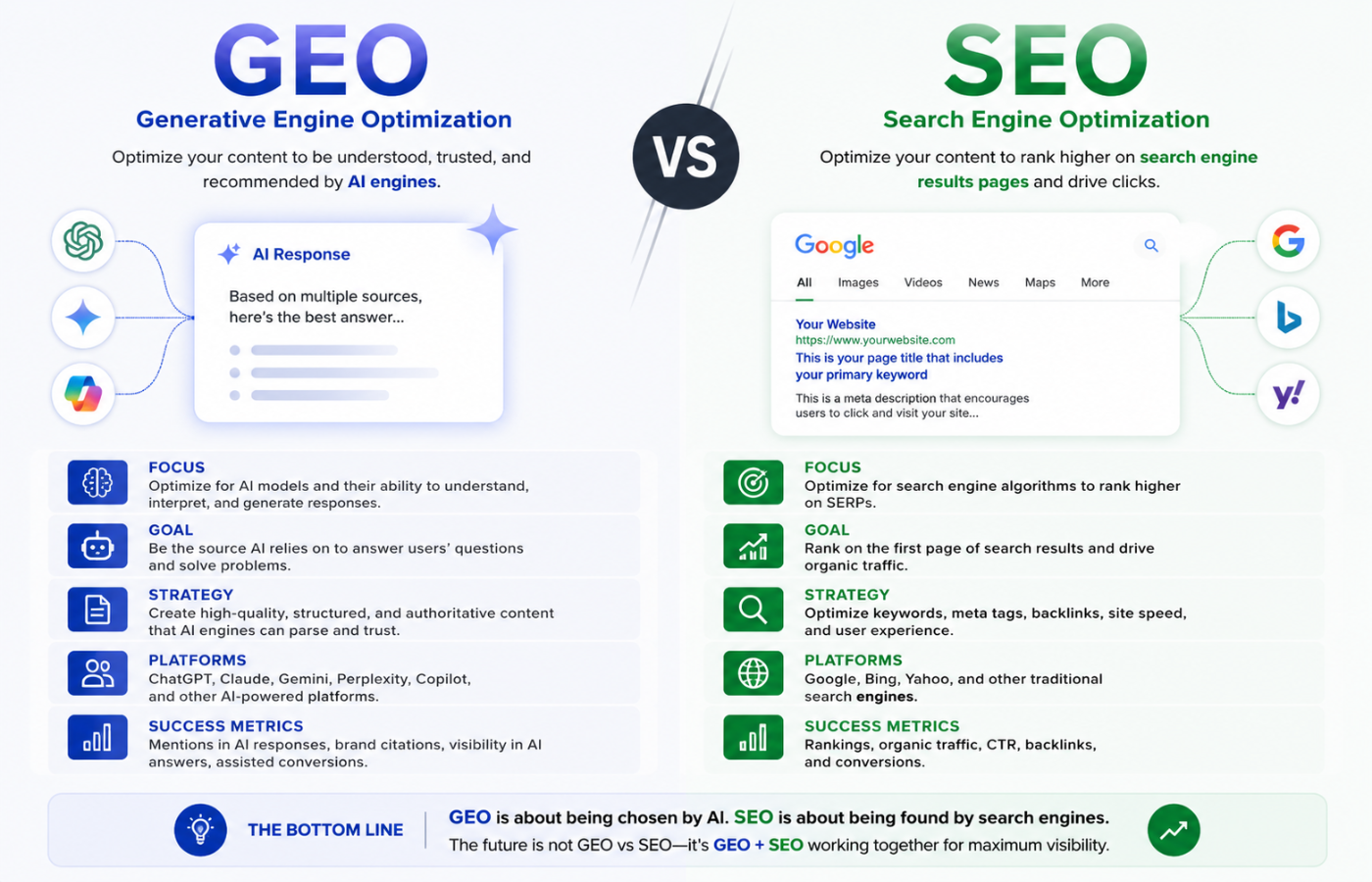
Here are the critical differences when comparing GEO vs SEO:
Target Platforms
-
SEO: Traditional search engines like Google, Bing, Yahoo
-
GEO: Generative AI tools like ChatGPT, Perplexity, Claude, Google Gemini and AI Overviews
Primary Goal
-
SEO: Rank in search results and drive clicks to your website
-
GEO: Get cited as a source within AI-generated answers
Content Style
-
SEO: Persuasive brand voice, keyword-optimised, conversion-focused
-
GEO: Neutral factual tone, reference-material style, structured for machine extraction
Preferred Content Formats
-
SEO: Long-form articles, product pages, rich media, interactive elements
-
GEO: Listicles, comparison tables, step-by-step guides, FAQ blocks, definition-first paragraphs
Authority Signals
-
SEO: Backlinks, Domain Authority, page-level metrics
-
GEO: Unlinked brand mentions across the web, Wikipedia presence, Reddit references, entity authority
Freshness Requirements
-
SEO: Annual refreshes adequate; rankings persist for months
-
GEO: Quarterly refreshes required; citations decay within ~13 weeks without updates
Measurement
-
SEO: Google Search Console, GA4, Semrush, Ahrefs (mature metrics)
-
GEO: Citation frequency, Share of Model, AI-referred traffic (emerging tools)
The Overlap: Shared Fundamentals
While the GEO vs SEO debate highlights differences, they share critical foundations :
-
Technical performance: Fast load times and mobile responsiveness matter to both
-
Content structure: Clear H1/H2/H3 hierarchy and schema markup serve both disciplines
-
Third-party authority: Mentions in high-authority sites boost both AI citations and Google rankings
-
E-E-A-T: Experience, Expertise, Authoritativeness, and Trustworthiness signals benefit both
A Critical Reality Check
The overlap between top Google-ranking pages and AI-cited sources has dropped from 70% to under 20% and continues falling . Ranking well in Google is no longer a reliable proxy for appearing in AI-generated answers.
Which Matters More in 2026?

By traffic volume, SEO still dominates — Google sends approximately 190 times more traffic than all AI platforms combined . However, AI-referred traffic grew 527% year-over-year in early 2025 and converts at 4.4–5 times the rate of traditional organic search . Gartner projects a 25% decline in organic search traffic to commercial sites by 2026 .
The Budget-Split Framework
-
Early-stage brands: 70% GEO, 30% SEO — AI citation windows are faster (3–5 days vs 3–6 months)
-
Mid-market brands: 40–50% of existing SEO budget shifted to GEO work
-
Enterprise brands: Start with 15–25% GEO allocation, scale as results come in
Conclusion: SEO and GEO Are Not Substitutes
When considering GEO vs SEO, the answer is not one or the other — it’s both. SEO remains the volume engine that drives the majority of organic traffic, whether users discover your business through Google Maps or organic SEO results. GEO is the emerging layer that captures high-intent customers discovering brands through AI platforms. Brands that invest in both — while adapting content structure, freshness cycles, and measurement infrastructure for each — will win in the AI-driven search era.
Want to dominate both traditional search and AI platforms — with a strategy that balances SEO fundamentals and GEO tactics for maximum visibility?
Get in touch with Orbitix today.