








Keyword Research Techniques to Improve Your SEO Performance
Why Most Keyword Research Fails
Most businesses target keywords that are too broad, too competitive, or completely irrelevant to their actual customers. They chase search volume instead of search intent. The result? Traffic that never converts. The best keyword research techniques prioritise relevance and commercial intent over vanity metrics.
7 Essential Keyword Research Techniques That Drive Results
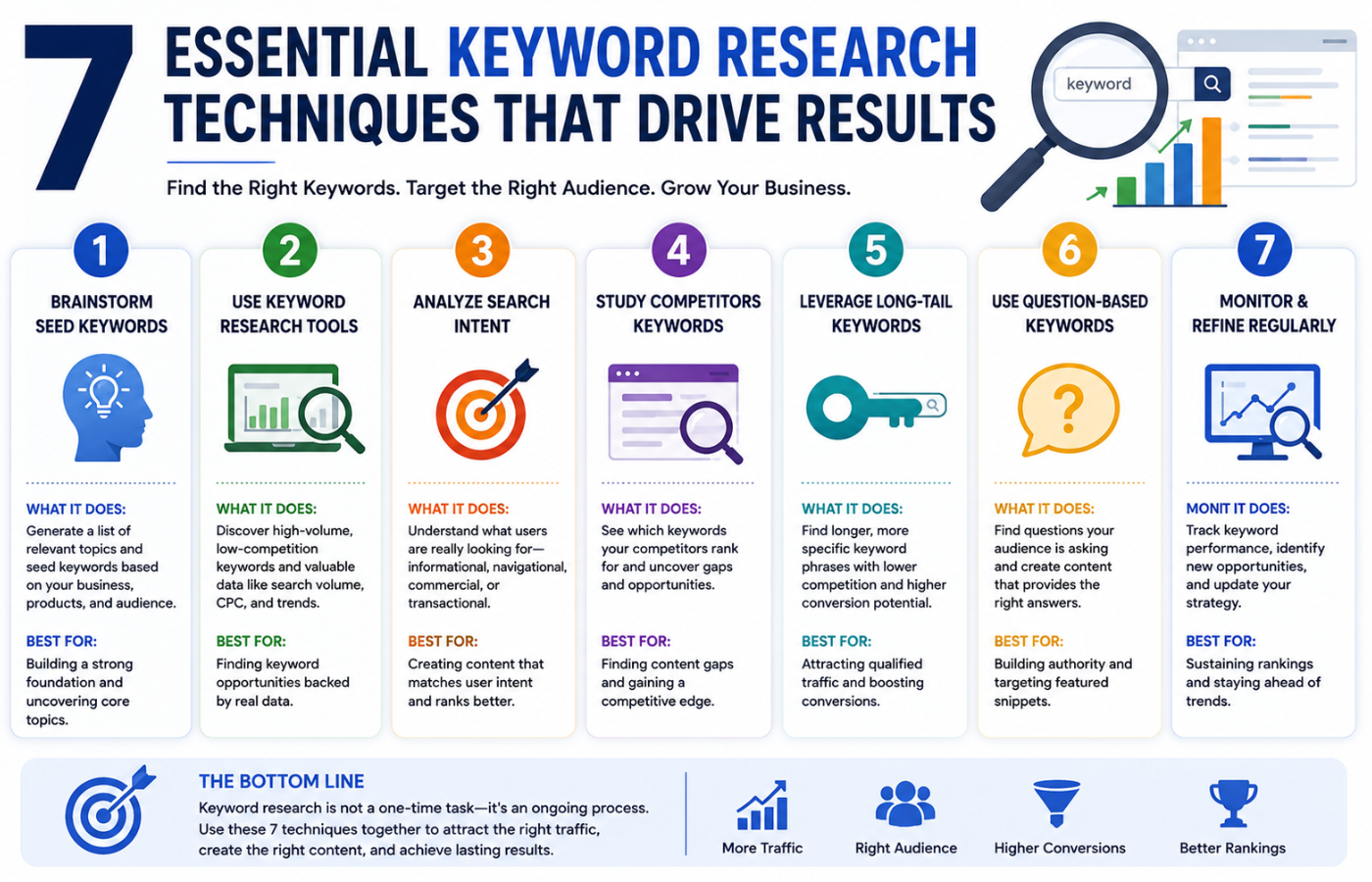
Here are seven proven keyword research techniques that will transform your SEO performance:
1. Start With Your Customer’s Problems, Not Your Products
Instead of asking “What do we sell?” ask “What problems do our customers have?” Your keywords should reflect the questions people ask before they even know your product exists.
Example:
-
Bad: “Project management software”
-
Good: “How to track team tasks without meetings”
-
Better: “Best project management tools for remote design teams”
Tools: AnswerThePublic, Reddit, Quora, customer service emails.
2. Analyse Your Competitors’ Keywords
Your competitors have already done some of the work. Use SEO tools to see which keywords they rank for and where they have content gaps.
Tools: Semrush, Ahrefs, Moz (competitor analysis features).
What to look for:
-
Keywords they rank for that you do not
-
Keywords they rank poorly for (opportunity to outrank them)
-
Keywords they have not covered at all (content gap)
3. Use Google Autocomplete and Related Searches
Google reveals what real people are searching for. Type a seed keyword into Google and watch autocomplete suggestions. Then scroll to the bottom of the search results page for “Related searches.”
Example for “plumber”:
-
Autocomplete: “plumber near me,” “plumber emergency,” “plumber cost”
-
Related searches: “plumber call-out fee,” “plumber for boiler,” “plumber available now”
4. Leverage Long-Tail Keyword Research
Long-tail keywords (3-5+ words) have lower search volume but much higher conversion rates. A person searching “best waterproof walking boots for wide feet” is far closer to buying than someone searching “boots.”
Why long-tail works:
-
Less competition
-
Clearer intent
-
Higher conversion rates
How to find them: Use “People also ask” boxes, Google Suggest, and tools like Ubersuggest.
5. Group Keywords by Search Intent
Not all searches are equal. Group keywords by user intent:
| Intent Type | Example | Content Focus |
|---|---|---|
| Informational | “What is project management?” | Blog posts, guides, FAQs |
| Navigational | “Asana login” | Brand pages, login portals |
| Commercial | “Asana vs Trello” | Comparison guides, case studies |
| Transactional | “Buy project management software” | Product pages, pricing, free trials |
6. Identify “Topic Clusters” Not Just Single Keywords
One keyword per page is outdated. Modern SEO uses topic clusters: one pillar page covering a broad topic, linked to multiple cluster pages covering specific subtopics.
Example:
-
Pillar: “Complete Guide to Email Marketing”
-
Clusters: “Email automation tools,” “How to write subject lines,” “Welcome email templates,” “Abandoned cart recovery”
7. Use Data From Your Own Customers
Your best keyword source is already in your CRM, email inbox, and customer support tickets.
Where to look:
-
Customer questions in support tickets
-
Phrases used in sales calls (record and transcribe)
-
Search queries in your site’s internal search
-
Comments on your blog and social media
The Keyword Research Workflow
| Step | Action | Tools |
|---|---|---|
| 1 | Brainstorm seed keywords | Customer interviews, team brainstorming |
| 2 | Expand with autocomplete/related | Google, AnswerThePublic |
| 3 | Analyse competitor keywords | Semrush, Ahrefs |
| 4 | Check search volume and difficulty | Keyword research tools (free/paid) |
| 5 | Map keywords to content types | Spreadsheet or content calendar |
| 6 | Prioritise by intent and ROI | Score by commercial value + difficulty |
Common Keyword Research Mistakes
| Mistake | Why It Hurts | Fix |
|---|---|---|
| Ignoring search intent | High traffic, zero conversions | Match content type to intent |
| Targeting only high-volume keywords | Too competitive, impossible to rank | Mix head terms with long-tail |
| No keyword grouping | Pages cannibalise each other | Assign one primary keyword per page |
| Forgetting local keywords | Missing local customers | Add city/neighbourhood to keywords |
| Set and forget | Keywords change | Update keyword research quarterly |
Tools for Keyword Research
| Tool | Best For | Free Version |
|---|---|---|
| Google Keyword Planner | Search volume, cost data | Yes (with Google Ads) |
| Google Autocomplete | Real-time suggestions | Free |
| AnswerThePublic | Question-based keywords | Free (limited) |
| Ubersuggest | Keyword ideas + difficulty | Free (limited) |
| Semrush | Competitor keyword analysis | Free trial |
| Ahrefs | Deep keyword data | Free trial |
| Moz Keyword Explorer | Keyword difficulty scores | Free (limited) |
Measuring Keyword Research Success
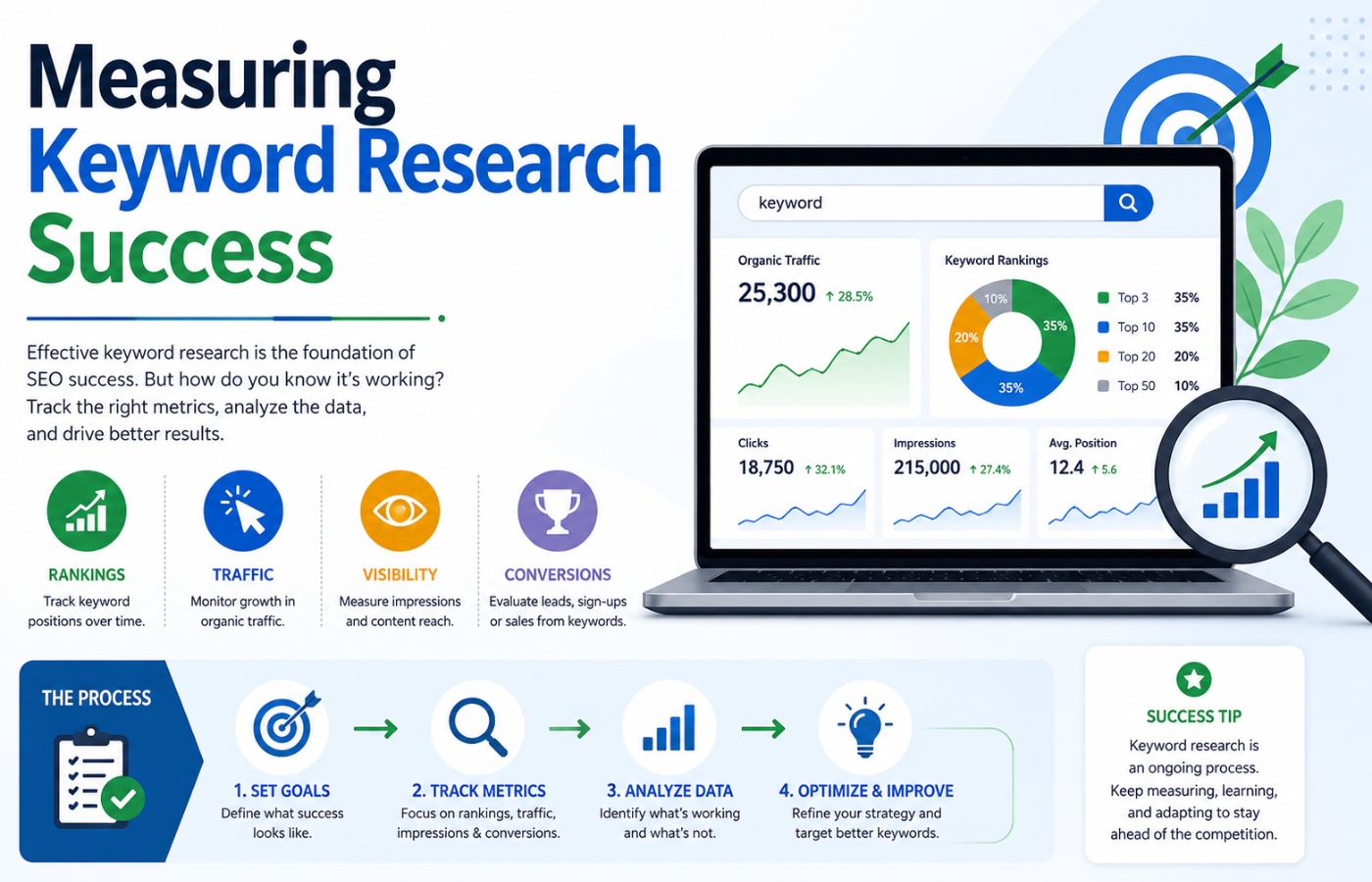
Track these metrics monthly:
-
Click-through rate (CTR) for target keywords
-
Average position for priority keywords
-
Organic traffic from new keyword clusters
-
Conversion rate by keyword group (which keywords drive leads?)
-
Keyword coverage (how many of your top 100 keywords are you ranking for?)
Conclusion: Research Drives Results
Want keyword research that uncovers exactly what your customers are searching for — so you can create content that ranks and converts?
Get in touch with Orbitix today.