






How Long Does Dental SEO Marketing Take to Show Results?
Dental SEO marketing is one of the most effective ways to attract new patients searching for dentists near them, but it comes with a question every practice owner asks: “How long until I see results?” Unlike paid ads that generate traffic the moment you swipe a credit card, dental SEO marketing is a long-term investment that builds compounding visibility over time. Whether you’re focusing on a local campaign such as dentist SEO in Brighton or targeting a broader service area, the honest answer is that most dental practices begin seeing measurable improvements between 3 to 6 months, with significant patient growth typically occurring between 6 to 12 months. Understanding this timeline helps you set realistic expectations, avoid expensive shortcuts, and stay committed to a strategy that ultimately delivers the highest ROI of any marketing channel.
Why Dental SEO Takes Time (And Why That’s a Good Thing)
Search engines like Google are not trying to frustrate dentists. They take time to reward new SEO efforts because their primary goal is protecting searchers. If a brand-new dental website could rank #1 overnight, anyone could manipulate the system. Google’s slow, methodical evaluation process — crawling new content, assessing backlinks, monitoring user behaviour, and building trust — is precisely what makes dental SEO marketing so valuable once you achieve it. Unlike ads that stop the moment you stop paying, SEO results accumulate and compound.
The Realistic Timeline for Dental SEO Marketing Results
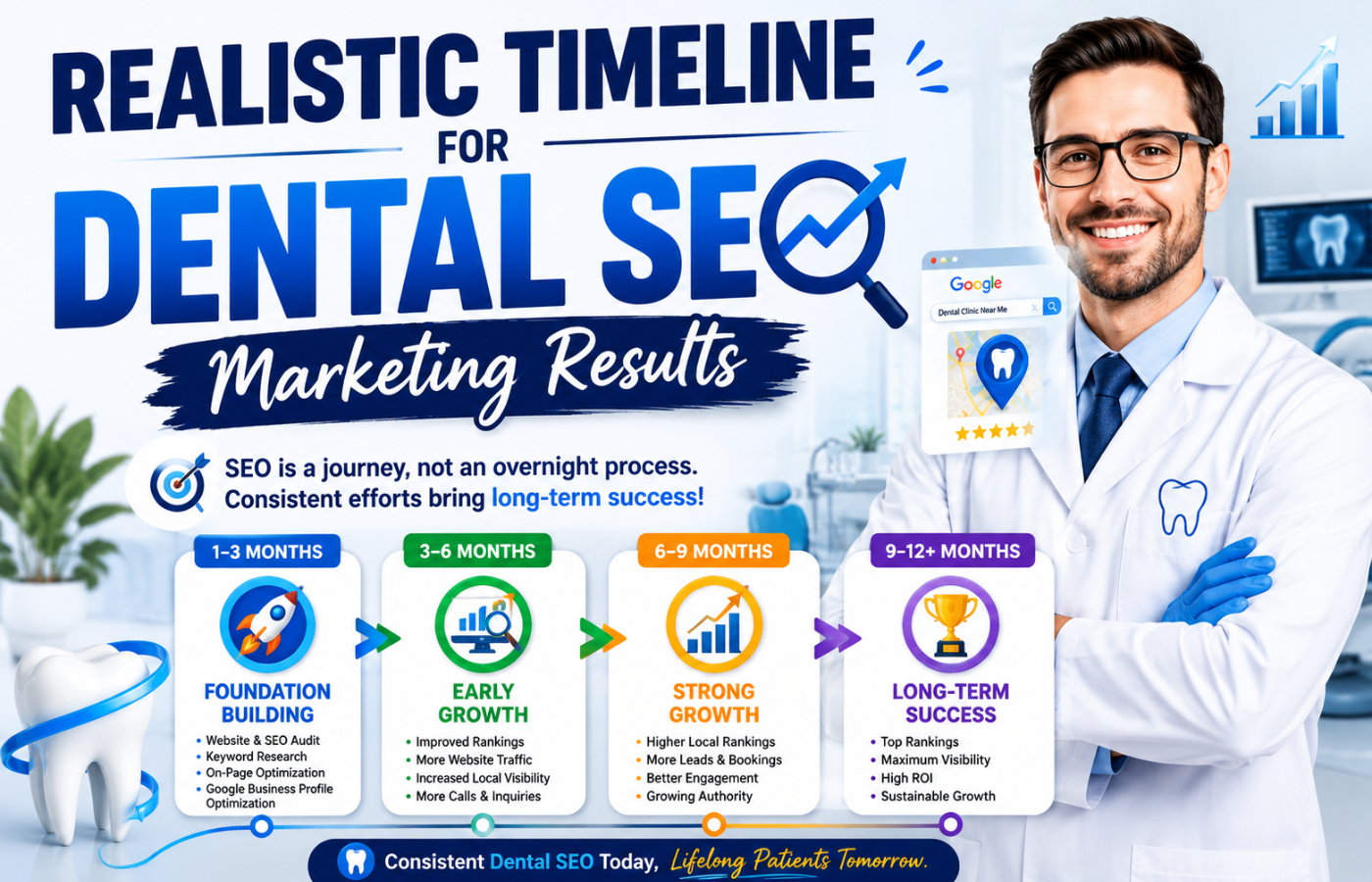
Every dental practice is different, but most follow this predictable timeline when executing professional dental SEO marketing:
Months 1-3: The Foundation Phase (No Significant Results Yet)
What is happening behind the scenes:
-
Technical SEO audit and fixes (site speed, mobile usability, indexing issues)
-
Google Business Profile (GBP) optimisation (categories, services, photos, posts)
-
Citation cleanup and local directory consistency (NAP across 50+ sites)
-
On-page SEO for key service pages (dental implants, Invisalign, emergency dentist, etc.)
-
Initial content creation (blog posts, service page expansion, location pages)
What you should expect: No significant ranking or patient increases yet. This phase is invisible but essential. Think of it as pouring the concrete foundation before building a house.
Key metric to watch: Indexation of new pages and resolution of technical errors (not traffic or calls).
Months 3-6: Early Signs of Movement
What is happening:
-
Google begins crawling and indexing your optimised pages
-
Initial keyword rankings appear, typically for lower-competition, long-tail terms (e.g., “affordable dental cleaning in [suburb]” rather than “dentist near me”)
-
GBP signals improve (more views, more direction requests, more calls)
-
First patient inquiries from organic search begin trickling in (2-5 per month from new terms)
What you should expect: Small, encouraging wins. Your practice might rank #12 for “Invisalign [city]” instead of #25. These early rankings are proof of concept.
Key metric to watch: Growth in keyword rankings (not necessarily top 3 yet) and increase in GBP discovery searches.
Months 6-9: Meaningful Patient Growth Begins
What is happening:
-
Consistent rankings in positions 4-10 for high-value procedure keywords
-
First “top 3” local pack rankings for neighbourhood-specific searches
-
Blog content begins driving informational traffic (e.g., “do I need a root canal?”)
-
Patient calls and new patient forms increase noticeably (10-20+ per month from SEO)
What you should expect: Your scheduling coordinator will start mentioning “new patients who found us on Google.” This is where dental SEO marketing becomes self-funding.
Key metric to watch: New patient attributions from organic search and GBP.
Months 9-12: Accelerating Returns
What is happening:
-
Multiple top 3 rankings for primary procedure keywords
-
Dominance in local pack for your core service area
-
Patients begin driving from neighbouring towns and suburbs
-
Compounding effect: more traffic → more engagement signals → higher rankings → even more traffic
What you should expect: SEO becomes one of your top 3 patient acquisition channels, often surpassing referrals or traditional advertising.
Key metric to watch: Cost per new patient from SEO compared to PPC or direct mail (typically 70-80% lower).
Months 12-24: Market Dominance
What is happening:
-
Your practice becomes a recognised authority in your geography
-
Featured snippets, “People also ask,” and image pack visibility
-
Patients call from outside your primary radius (willing to drive further for your reputation)
-
Low-competition, high-intent terms (e.g., “same day crown [city]”) drive consistent volume
What you should expect: SEO delivers a predictable, growing stream of new patients month after month with no incremental ad spend.
Key metric to watch: Year-over-year organic patient growth (typically 30-50%+).
Factors That Speed Up or Slow Down Dental SEO Marketing
| Accelerators (Faster Results) | Brakes (Slower Results) |
|---|---|
| New practice in underserved area | Saturated market with 20+ competitor dentists |
| Existing high-quality backlinks | No external links or citations |
| Active, engaged Google Business Profile | Unclaimed or neglected GBP |
| Consistent review generation (5+ per month) | No recent reviews or mixed star ratings |
| Fast, mobile-optimised website | Slow, outdated, non-responsive site |
| Dedicated in-house or agency resource | Sporadic, “when I have time” effort |
What Dental SEO Marketing Is NOT
To set proper expectations, understand what dental SEO does not do:
-
It is not instant. No legitimate provider can guarantee #1 rankings in 30 days. Anyone who promises this is selling something fraudulent.
-
It is not one-time. SEO requires ongoing content, link building, and GBP maintenance. Stops sees rankings slowly decline after 3-6 months.
-
It is not a replacement for a good website. SEO drives traffic; your website converts it. A slow, confusing site will waste your SEO investment.
-
It is not the same as PPC. Pay-per-click delivers immediate volume but stops when you pause spending. SEO builds equity you keep.
Red Flags: Unrealistic Promises to Avoid
If a dental SEO marketing provider says any of the following, run:
-
“We guarantee page one in 30 days or your money back.”
-
“We have a secret Google hack.”
-
“We can submit your site to thousands of search engines.”
-
“We guarantee #1 ranking for ‘dentist near me.'” (No one can guarantee this.)
-
“We don’t need access to your website or Google Business Profile.”
The ROI Calculation: Why Waiting Is Worth It
| Time Period | Typical Monthly SEO Investment | Cumulative Investment | Typical New Patients from SEO (Average Value £500 each) | ROI |
|---|---|---|---|---|
| Months 1-3 | £1,500 – £3,000 | £4,500 – £9,000 | 0-2 | Negative |
| Months 4-6 | £1,500 – £3,000 | £9,000 – £18,000 | 3-8 | Break-even to slightly positive |
| Months 7-12 | £1,500 – £3,000 | £18,000 – £36,000 | 15-30+ | 2x – 5x |
| Months 13-24 | £1,500 – £3,000 | £36,000 – £72,000 | 40-80+ annually | 5x – 10x+ |
Conclusion: Patience Rewarded, Impatience Penalised
Dental SEO marketing is a marathon, not a sprint. Practices that quit after 3 months because “nothing happened” never see the compounding growth that begins around month 6. Conversely, practices that commit to 12–24 months of consistent, professional SEO build an asset that delivers new patients every single month — often at a fraction of the cost of dental ads. This same long-term approach is what makes enterprise SEO services so effective for large organizations, proving that sustainable organic growth comes from ongoing optimization rather than quick fixes. The best time to start was 12 months ago. The second best time is today.
Want a realistic, timeline-driven dental SEO strategy that builds patient volume month after month — with no hype and no impossible promises?
Get in touch with Orbitix today.