





How Bespoke Website Design Helps Brands Stand Out Online
Bespoke website design is the antithesis of template-based, one-size-fits-all web development. In a digital landscape where thousands of businesses use the same off-the-shelf themes from platforms like Wix, Squarespace, or WordPress template marketplaces, standing out is nearly impossible when your website looks exactly like your competitor’s. Bespoke website design involves creating a custom-built website from the ground up — tailored to your brand identity, user journey, technical requirements, and business goals. This approach is particularly valuable for businesses that require advanced functionality, seamless integrations, and scalable eCommerce website development solutions to support online sales and long-term growth. Unlike templates that force you to fit into pre-existing layouts, a bespoke approach ensures that every pixel, every interaction, and every line of code serves your unique audience. In this comprehensive guide, we will explore how bespoke website design elevates brands above the noise, builds trust, and drives measurable business results.
The Problem with Template Websites
Walk through the internet today, and you will notice a pattern. Countless small and medium businesses use the same popular templates from Shopify, WordPress, or Wix. While these platforms are affordable and convenient, they come with significant downsides for brands serious about differentiation.
The hidden costs of template websites:
-
Generic aesthetics: Your brand looks like hundreds of others.
-
Bloated code: Templates include unnecessary scripts that slow down your site.
-
Limited customization: You can only modify what the template allows.
-
Poor scalability: As your business grows, the template cannot grow with you.
-
Security vulnerabilities: Popular templates are frequent targets for hackers.
Bespoke website design solves every single one of these problems. When you invest in a custom-built website, you are not buying a product — you are commissioning a digital asset designed exclusively for your brand. Below, we will explore exactly how bespoke design helps brands command attention, build credibility, and outperform template-dependent competitors.
Why Bespoke Website Design Is a Competitive Advantage
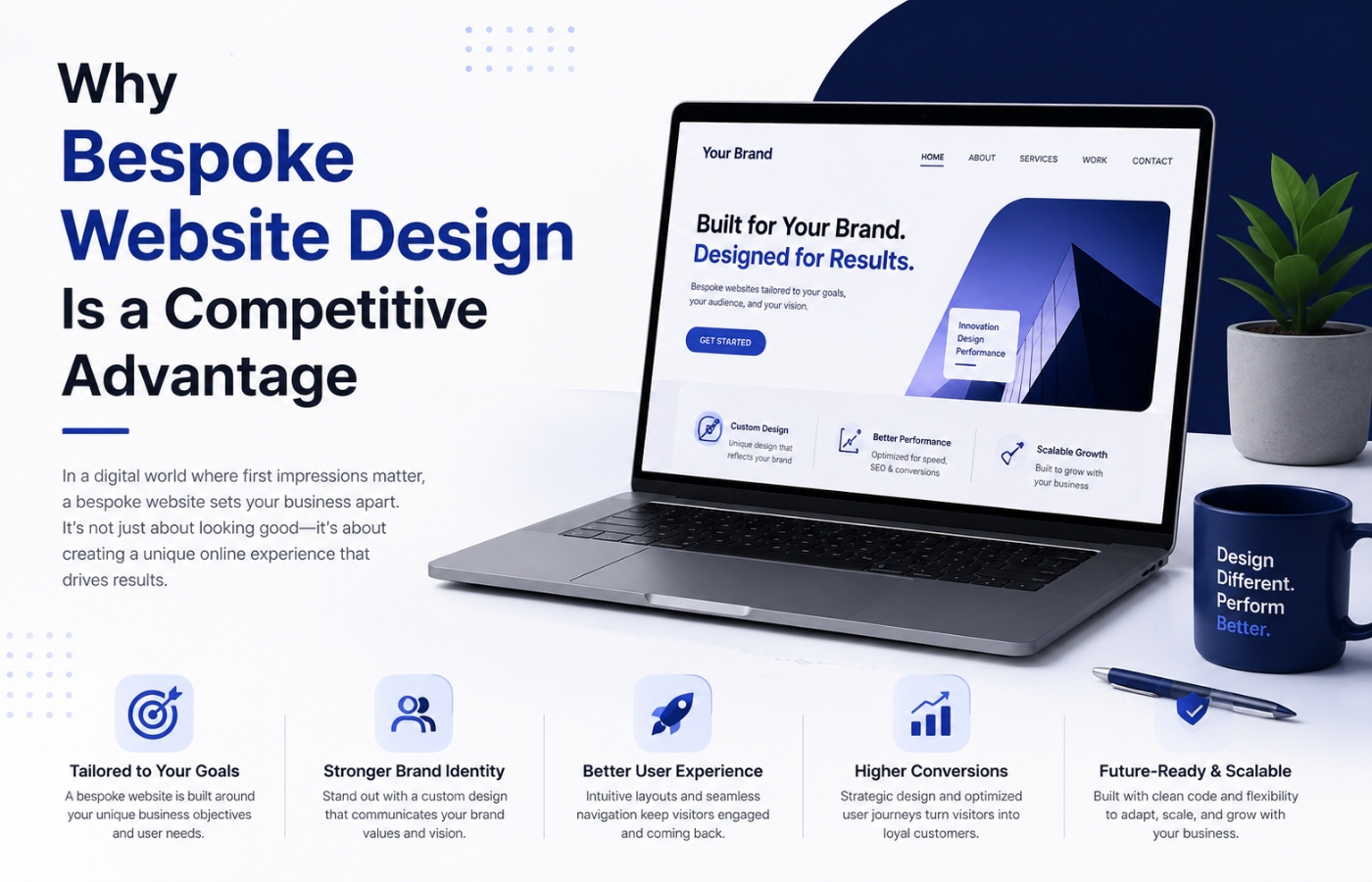
In crowded markets, differentiation is everything. Bespoke website design allows you to break free from the visual monotony of templates and create a digital experience that reflects your brand’s unique personality, values, and value proposition. Below are the specific ways bespoke design helps brands stand out online.
1. Unique Visual Identity That Cannot Be Replicated
When you use a template, any competitor can purchase the same theme and build a website that looks remarkably similar to yours. Colors, layouts, button styles, and even navigation structures become nearly identical.
With bespoke website design, you get:
-
Custom typography: Fonts selected specifically to match your brand voice (not the default options in a template).
-
Tailored color palettes: Not just primary and secondary colors, but a full system of gradients, accents, and hover states.
-
Original iconography and illustrations: No stock icons that every other site uses.
-
Unique spacing and grid systems: Layouts engineered for your specific content hierarchy.
-
Custom animations and micro-interactions: Delightful touches that templates cannot replicate.
Example: A luxury hotel using a template might look identical to a budget motel that purchased the same theme. A bespoke hotel website, however, can incorporate custom room photography, a unique booking interface, and animations that evoke the property’s ambiance — creating a memorable impression that no template can match.
2. Tailored User Experience (UX) for Your Specific Audience
Templates are designed for the “average” business. But your audience is not average. Their needs, pain points, and behaviors are unique to your industry and customer base.
Bespoke UX advantages:
-
Custom user flows: Map out exactly how different user types (new visitors, returning customers, enterprise clients) should navigate your site.
-
Personalized content prioritization: Surface the information that matters most to your specific audience — not what a template designer assumed.
-
Industry-specific interactions: For example, a real estate site might need a custom property search filter; a law firm might need a secure client portal; an e-commerce brand might need a one-click checkout tailored to their products.
-
Accessibility optimization: Build for WCAG 2.1 AA standards from the start, not as an afterthought.
Real-world impact: A bespoke B2B software company website might structure its navigation around “buyer personas” (e.g., “For CTOs,” “For Marketing Directors”) rather than generic “Products” and “Solutions” tabs. This tailored approach increases engagement and conversion rates.
3. Superior Performance and Page Speed
Templates are notorious for bloat. They include hundreds of lines of CSS and JavaScript for features you will never use — sliders, accordions, pop-ups, and gallery styles that remain in the code even when disabled. This bloat destroys page speed.
Bespoke performance benefits:
| Factor | Template | Bespoke |
|---|---|---|
| Code size | Includes unused CSS/JS | Only what you need |
| HTTP requests | High (many external scripts) | Minimized |
| Core Web Vitals | Often fails (LCP, CLS issues) | Engineered to pass |
| Mobile load time | Often 3–5+ seconds | Can achieve <1.5 seconds |
| Hosting flexibility | Limited by platform | Choose any host (optimized for your stack) |
Speed and conversions: Every 1-second delay in page load time reduces conversions by 7% (Amazon study). A bespoke site that loads 2 seconds faster than a template competitor could see conversion rates 14% higher.
Example: A bespoke e-commerce site can strip out unnecessary scripts, implement advanced image optimization (WebP with lazy loading), and use a headless CMS architecture for near-instant page loads — results that are difficult or impossible to achieve with a template.
4. Scalability and Future-Proofing
Your business today is not your business tomorrow. You might add new product lines, expand to new locations, integrate with new software (CRMs, ERPs, marketing automation), or launch a mobile app. Templates are rigid — they fight you at every stage of growth.
Bespoke scalability features:
-
Modular architecture: Add new page types, features, or integrations without rebuilding the entire site.
-
Custom post types and fields: If you need to manage “properties,” “case studies,” “team members,” or “events” as distinct content types, a bespoke solution handles this natively.
-
API-first design: Connect to any third-party service (Salesforce, HubSpot, Stripe, Zapier) without hacky workarounds.
-
Headless CMS options: Separate your content management from your frontend, allowing you to change your frontend technology without losing content.
Example: A bespoke site for a growing franchise can be built with a multi-location architecture from day one. Adding the 20th location requires a simple database entry — not a template hack or a full redesign.
5. Enhanced Security
Popular templates and their associated plugins are prime targets for hackers. When thousands of sites use the same theme, a single vulnerability can be exploited across all of them.
Bespoke security advantages:
-
No public theme fingerprinting: Attackers cannot identify your CMS or theme version.
-
Minimal plugins: Custom functionality reduces the attack surface.
-
Custom security protocols: Implement role-based access, rate limiting, and custom firewall rules.
-
Regular, targeted updates: You control the codebase; patches address only your specific code.
Real-world stat: Over 90% of hacked WordPress sites are running outdated or vulnerable themes/plugins. A bespoke site eliminates this entire category of risk.
6. SEO-Friendly Architecture from the Ground Up
Templates often generate poor HTML structure, messy heading hierarchies, and suboptimal internal linking. Bespoke development allows you to implement SEO best practices natively.
Bespoke SEO advantages:
-
Clean, semantic HTML5: Search engines parse your content easily.
-
Customizable URL structures: Create SEO-optimized URLs that match your keyword strategy.
-
Fine-tuned schema markup: Inject JSON-LD exactly where needed, without plugin bloat.
-
Optimized heading hierarchy: Ensure one H1 per page, logical H2/H3 structure.
-
Advanced structured data: Implement product, local business, FAQ, or article schema tailored to your content.
Example: A bespoke e-commerce site can dynamically generate product schema for thousands of SKUs, include aggregate rating markup, and add brand, sku, offers, and review properties — all without the performance drag of an SEO plugin.
7. Complete Ownership and Portability
With most template-based platforms (Wix, Squarespace, Shopify), you do not truly own your website. You cannot easily export your design and move to another host. Your site is tied to the platform’s ecosystem.
Bespoke ownership benefits:
-
Full code ownership: You own every line of HTML, CSS, JavaScript, and backend code.
-
Hosting freedom: Move to any provider (AWS, Netlify, Vercel, traditional shared hosting).
-
No platform lock-in: You are never forced to accept price increases or feature changes from a third-party platform.
-
Transferable assets: Your design and functionality can be reimplemented in any technology stack.
For brands building long-term digital value, ownership is non-negotiable. Bespoke website design gives you that control.
8. Seamless Third-Party Integrations
Modern businesses rely on dozens of tools: CRMs, email marketing platforms, analytics, booking systems, payment gateways, and more. Templates often offer limited integration options or require expensive plugins that break with every update.
Bespoke integration capabilities:
-
Direct API connections: Integrate exactly what you need, exactly how you need it.
-
Custom webhooks: Trigger actions in external systems based on user behavior.
-
Single sign-on (SSO): Connect to your existing authentication systems.
-
Real-time data sync: Pull inventory, pricing, or availability from external databases.
Example: A bespoke site for a medical practice can integrate directly with their patient scheduling system, insurance verification API, and telehealth platform — creating a seamless experience that no template could achieve.
9. Mobile-First, Not Mobile-Friendly
“Mobile-friendly” means a template site shrinks to fit a smaller screen. “Mobile-first” means the site is designed from the ground up for touch interactions, thumb reach, and mobile context.
Bespoke mobile-first advantages:
-
Touch-optimized interfaces: Button sizes, spacing, and gestures designed for fingers, not cursors.
-
Conditional loading: Serve lighter assets (images, scripts) to mobile users.
-
Mobile-specific content prioritization: Show different information hierarchy on mobile vs. desktop.
-
Advanced responsive patterns: Not just columns stacking, but entirely reorganized layouts.
Google uses mobile-first indexing. A bespoke mobile-first site is not a nice-to-have — it is essential for rankings.
10. Long-Term Cost Efficiency
At first glance, bespoke website design has a higher upfront cost than a template. A custom site might cost $10,000–$50,000+, while a template costs $0–$500 per year. However, total cost of ownership tells a different story.
Cost comparison over 5 years:
| Expense | Template Site | Bespoke Site |
|---|---|---|
| Initial build | $0–$500 | $15,000–$50,000 |
| Monthly platform fees | $20–$300 | $50–$200 (hosting) |
| Premium plugins/themes | $200–$1,000/year | $0 |
| Developer fixes for template conflicts | $1,000–$5,000/year | Minimal ($500–$2,000 maintenance) |
| Redesigns (template sites need every 2–3 years) | $5,000–$15,000 | One build lasts 5+ years |
| Lost revenue from slow speed/poor UX | Hard to quantify but significant | Avoided |
| Total 5-year cost | Often $15,000–$40,000+ (with redesigns) | $20,000–$60,000 |
Bespoke sites often cost less over time because they do not require frequent redesigns, plugin subscriptions, or emergency fixes for template conflicts.
Bespoke vs. Custom vs. Template: Clarifying Terms
| Term | Definition | Best For |
|---|---|---|
| Template | Pre-designed theme with limited customization | Hobby sites, absolute minimum budget |
| Customized template | Template with modified colors and some layout changes | Small businesses with $1k–$3k budget |
| Bespoke website design | Built from scratch, unique code, tailored to brand | Brands serious about differentiation, scalability, and long-term value |
Bespoke website design is not the right choice for every business. But for brands that rely on their website as a primary customer acquisition channel, it is the only choice.
When to Invest in Bespoke Website Design
Consider bespoke design if any of these apply to your brand:
-
You compete in a crowded market where differentiation matters
-
Your website is your primary sales or lead generation channel
-
You have specific user flows or functionality that templates cannot handle
-
You plan to scale significantly (add products, locations, or integrations)
-
Your brand identity is unique and cannot be expressed through templates
-
You value long-term ownership and control over your digital assets
-
Page speed and Core Web Vitals are critical for your SEO strategy
When a template might be sufficient:
-
A personal portfolio or blog
-
A temporary landing page for a short-term campaign
-
An absolute minimum budget (under $3,000) with no growth plans
The Bespoke Website Design Process
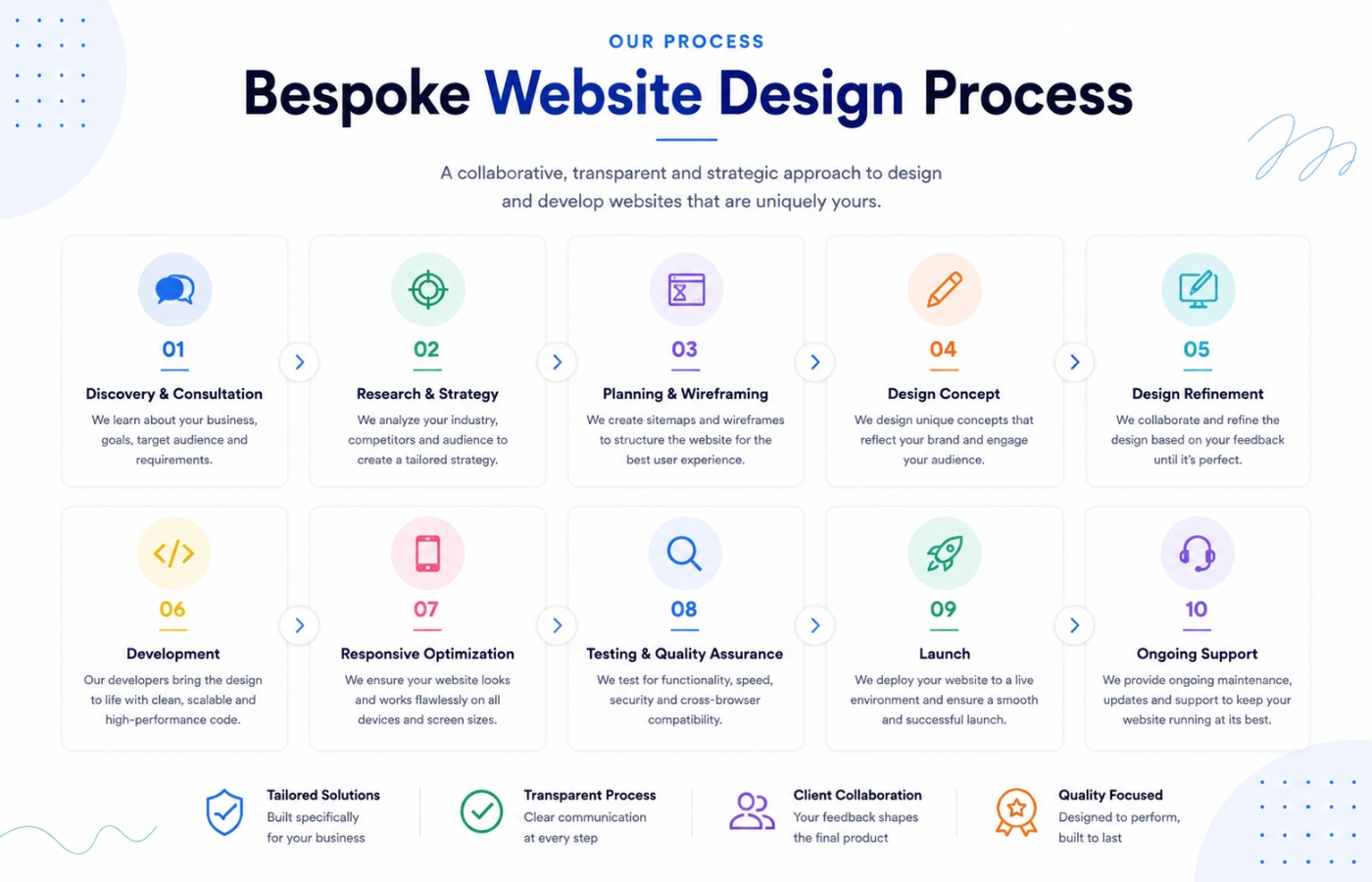
A professional bespoke project typically follows this workflow:
Phase 1: Discovery (1–3 weeks)
-
Stakeholder interviews
-
Competitive analysis
-
User persona development
-
Technical requirements gathering
-
Sitemap and content inventory
Phase 2: Design (3–6 weeks)
-
Wireframes (low-fidelity layouts)
-
Style tiles (typography, color, spacing)
-
High-fidelity mockups (desktop + mobile)
-
Interactive prototype (clickable)
Phase 3: Development (6–12 weeks)
-
Frontend development (HTML, CSS, JavaScript)
-
Backend development (CMS integration, databases, APIs)
-
Third-party integrations (CRM, payment, analytics)
-
Performance optimization
Phase 4: Testing and Launch (2–3 weeks)
-
Cross-browser testing
-
Mobile device testing
-
Accessibility audit (WCAG)
-
Security audit
-
Load testing
-
301 redirects (if migrating from old site)
Phase 5: Post-Launch (ongoing)
-
Training for your team
-
Documentation
-
Maintenance and support
-
Analytics setup and reporting
Total timeline: 3–6 months on average.
Measuring the ROI of Bespoke Website Design
A bespoke site is an investment. Measure its success with these KPIs:
| Metric | Before Bespoke | After Bespoke (Target) |
|---|---|---|
| Page load time (LCP) | 3.5+ seconds | Under 2 seconds |
| Bounce rate | 60–70% | Under 45% |
| Conversion rate | 1–2% | 3–5%+ (depends on industry) |
| Organic traffic | Stagnant or declining | 20%+ year-over-year growth |
| Average session duration | 1–2 minutes | 3–5 minutes |
| Support tickets for site issues | Weekly | Monthly or less |
ROI calculation example:
-
Current monthly revenue from website: $50,000
-
Conversion rate improvement from 2% to 4% (double) = $100,000/month
-
Annual revenue increase: $600,000
-
Bespoke site cost: $40,000
-
ROI in year one: 1,400%
Common Myths About Bespoke Website Design
Bespoke is only for big brands with huge budgets.
Reality: Small and medium businesses increasingly invest in bespoke design because the long-term ROI outweighs the upfront cost. Many agencies offer payment plans.
Bespoke websites are harder to update.
Reality: A well-built bespoke site includes a user-friendly CMS (like a custom WordPress backend or a headless CMS) that is often easier to use than template page builders.
Templates are just as good if you customize them.
Reality: Customizing a template is like remodeling a house you do not own — you are limited by the original structure. Bespoke builds from a blank canvas.
Bespoke takes too long.
Reality: A rushed template site that launches in 2 weeks but needs a redesign in 18 months is not faster — it is inefficient.
Real-World Example: How Bespoke Design Transformed a Local Brand
The brand: “Heritage Roasters,” a regional coffee chain with 8 locations. Their old website was a $500 template from ThemeForest. It was slow (LCP 4.2 seconds), difficult to update, and looked nearly identical to three competitors in their city.
The bespoke solution:
-
Custom design reflecting their brand colors, vintage typography, and photography style
-
Custom store locator with filtering (roasteries, cafes, wholesale pickup)
-
Bespoke e-commerce module for coffee bean subscriptions (not a generic Shopify embed)
-
Mobile-first design with one-click reorder for returning customers
-
Integration with their loyalty program API
The results (12 months after launch):
-
Organic traffic: +210%
-
Mobile conversion rate: 1.2% → 4.8% (300% increase)
-
Average order value: $24 → $41 (custom upsell flows)
-
Support tickets for website issues: 12 per month → 1 per month
-
Revenue from online subscriptions: $0 → $18,000/month
Investment: $35,000 bespoke build + $500/month maintenance. ROI: Recouped within 5 months.
Choosing a Bespoke Website Design Partner
Not all agencies are equal. Ask potential partners:
-
Do they ask about your business goals first (not just colors and fonts)?
-
Do they have experience in your industry?
-
What is their post-launch support and maintenance process?
-
Can they provide case studies and references?
-
Do they handle both design AND development in-house? (Beware of agencies that outsource coding.)
-
What is their approach to SEO and performance?
-
Do you own the code and design files after completion?
Avoid agencies that:
-
Use page builders (Elementor, WPBakery, Divi) and call it “bespoke”
-
Offer a one-month timeline for a complex site (rushed work leads to technical debt)
-
Cannot provide detailed documentation
Conclusion: Stand Out or Blend In
Do you want to blend in with every other business using the same theme? Or do you want to stand out as a brand that cares about every detail of its digital presence?
The choice is yours.
Want a website that truly represents your brand and attracts more customers?
Get in touch with Orbitix today.