







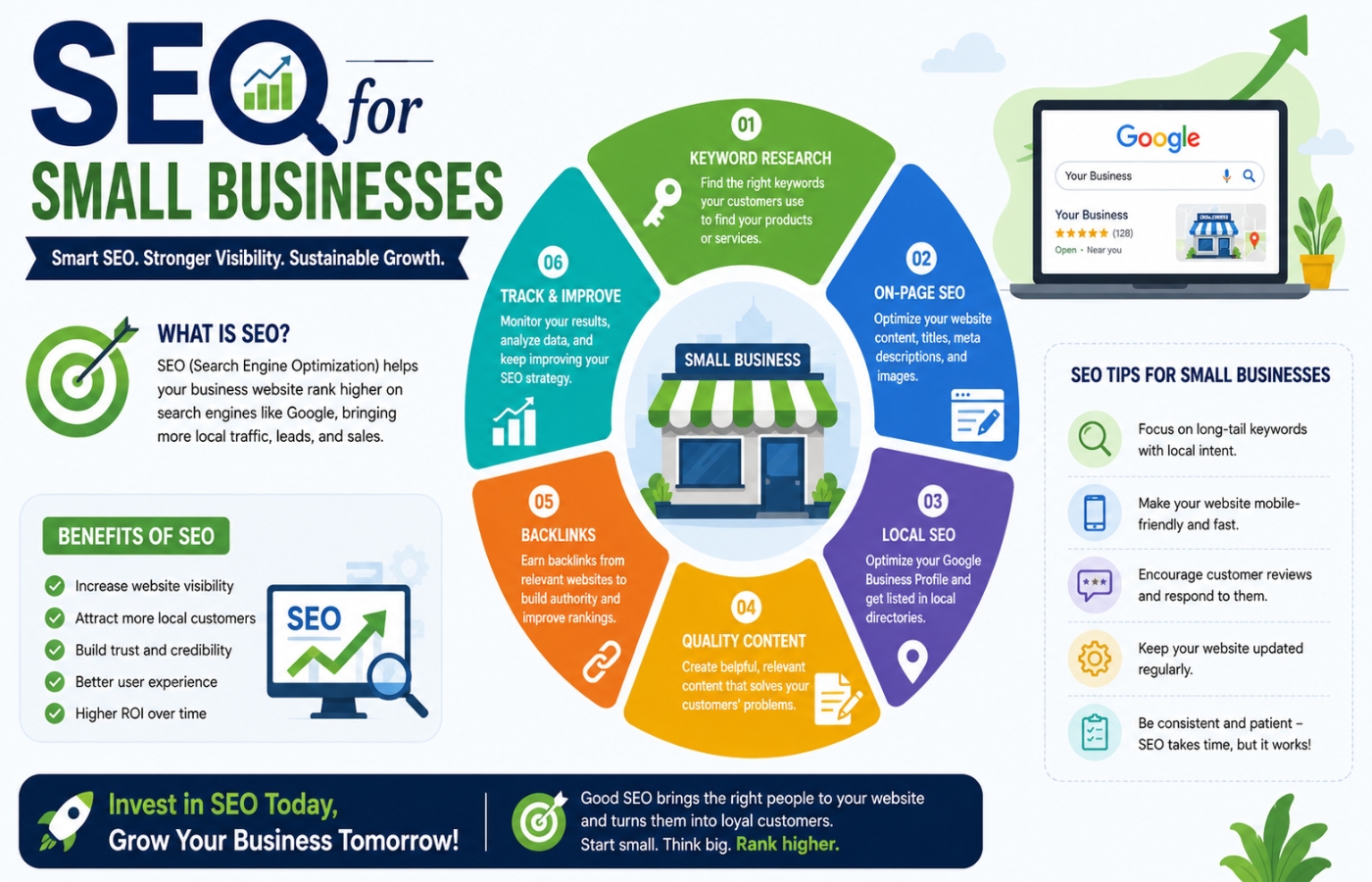
The Role of Content Marketing in SEO for Small Businesses
Why Small Businesses Need Content Marketing for SEO
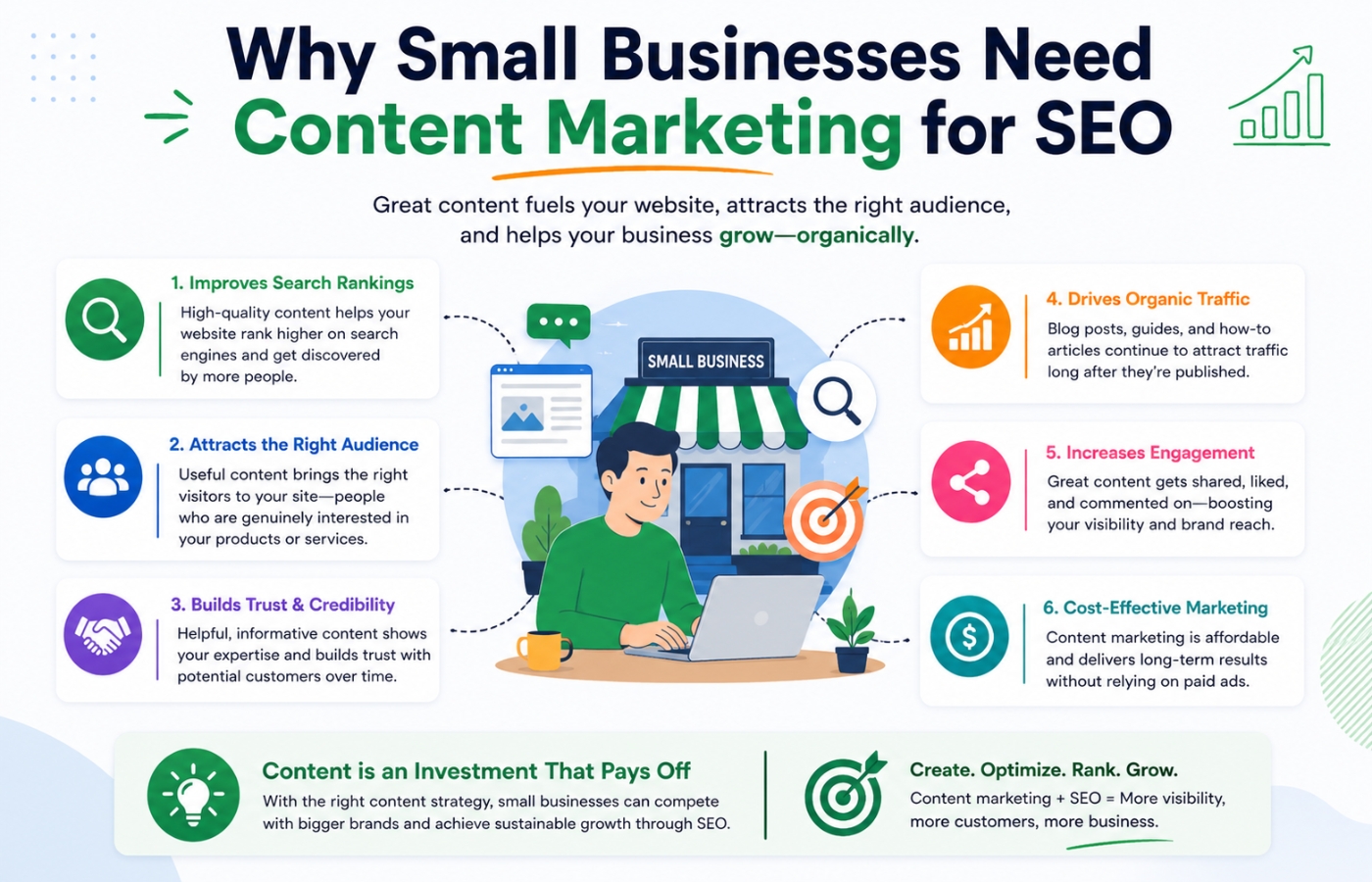
If you run a small business — whether a local bakery, a plumbing company, a law firm, or an e-commerce store — you face a common challenge: bigger competitors have deeper pockets for ads and larger teams for SEO. But search engines do not favor the biggest budget. They favor the best answer. That is where content marketing becomes your secret weapon.
Content marketing is the practice of creating valuable, relevant, and consistent content to attract and retain a clearly defined audience. When combined with SEO for small businesses, content marketing helps you:
-
Rank for long-tail keywords that big competitors ignore
-
Build trust and authority in your local market
-
Generate backlinks naturally (without expensive outreach campaigns)
-
Convert casual visitors into paying customers
This guide will walk you through the critical role content marketing plays in small business SEO — from keyword research and content formats to promotion and measurement.
How Content Marketing Powers SEO for Small Businesses
At its core, SEO for small businesses relies on content to satisfy search intent. Google’s primary job is to deliver the most useful result for a user’s query. That “useful result” is almost always content — a blog post, a product page, a video, a guide, or an FAQ. This is especially important for service-based businesses, including a SEO Company for Window Cleaning, as high-quality content helps attract potential customers and improve visibility in local search results. Without content, you have nothing to optimize. Below, we break down the specific ways content marketing drives SEO success for small businesses.
1. Content Creates Ranking Opportunities for Long-Tail Keywords
Big businesses often target high-volume, competitive keywords like “plumber” or “personal injury lawyer.” Small businesses cannot win those battles directly — but you can win the war by targeting long-tail keywords.
Long-tail keywords are longer, more specific phrases (3–5+ words) with lower search volume but much higher intent. Examples:
| Head Term (High Competition) | Long-Tail Keyword (Low Competition) |
|---|---|
| “coffee shop” | “coffee shop with outdoor seating in Austin” |
| “divorce lawyer” | “how to file for uncontested divorce in Ohio” |
| “running shoes” | “best running shoes for flat feet women” |
| “plumber” | “emergency plumber open Sunday near me” |
How content marketing targets long-tail keywords:
-
Write blog posts answering specific questions (e.g., “How much does a water heater replacement cost in Denver?”)
-
Create location pages for each neighborhood you serve
-
Publish product guides or comparison posts
-
Develop FAQs that mirror voice search queries
Every piece of content you create is a new “door” for search engines to enter your website. For small businesses, 100 long-tail blog posts often generate more traffic than trying to rank for 10 head terms.
2. Content Establishes Expertise, Authority, and Trust (E-E-A-T)
Google’s Search Quality Rater Guidelines emphasize E-E-A-T: Experience, Expertise, Authoritativeness, and Trustworthiness. Small businesses often lack the brand recognition of large competitors, so you must demonstrate E-E-A-T through content.
How content demonstrates E-E-A-T:
-
Experience: Write case studies or “how we solved X problem” posts showing real customer situations.
-
Expertise: Publish detailed guides that go beyond surface-level information. Cite data, include expert quotes, and show your credentials.
-
Authoritativeness: Get mentioned or linked to by other reputable sites. Great content earns backlinks naturally.
-
Trustworthiness: Be transparent about pricing, policies, and customer stories. Include customer testimonials within your content.
Example: A small accounting firm could publish “The Complete Guide to Small Business Tax Deductions (2026 Edition).” This 5,000-word guide covers every deduction, includes examples, and is updated annually. Over time, other small business blogs link to it as a resource. Google sees those backlinks and rewards the firm with higher rankings — not just for tax keywords, but for their core service pages as well.
3. Content Feeds Your Internal Linking Structure
Internal links are hyperlinks from one page on your website to another. They help Google discover new pages and distribute “link equity” (ranking power) across your site. Content marketing creates natural opportunities for internal linking.
Example internal linking strategy:
-
Write a pillar page: “The Ultimate Guide to SEO for Small Businesses” (2,500+ words)
-
Write cluster posts: “How to Do Keyword Research,” “On-Page SEO Checklist,” “Local SEO for Plumbers,” etc.
-
From the pillar page, link to each cluster post.
-
From each cluster post, link back to the pillar page.
This “topic cluster” model tells Google that your pillar page is the authoritative resource on that topic. All cluster posts support it. The result? Your entire silo of content ranks better.
Pro tip for small businesses: Every new blog post should link to at least 2–3 existing posts on your site. And every existing post should be updated periodically to link to newer, relevant content.
4. Content Generates Backlinks (Without Paying for Them)
Backlinks remain one of Google’s top three ranking factors. But for small businesses, buying backlinks is risky (and often against Google’s guidelines). Content marketing offers a white-hat alternative: create content so valuable that other websites naturally want to link to it.
Linkable content formats for small businesses:
| Content Type | Why People Link to It |
|---|---|
| Original research or survey | Unique data that others cite |
| Ultimate guides (5,000+ words) | Comprehensive resource worth bookmarking |
| Infographics | Easy to embed and share |
| Free tools or calculators | Highly useful and shareable |
| Local resource lists | Other local businesses link to them |
| Industry statistics roundups | Journalists and bloggers need stats |
Example: A small landscaping company conducts a survey of 500 local homeowners about their lawn care habits. They publish “The 2026 Austin Lawn Care Report” with charts and key findings. Local news sites, real estate blogs, and home improvement forums link to the data. Those backlinks boost the landscaping company’s authority — helping them rank for “lawn care Austin” even though they have fewer backlinks than national brands.
5. Content Answers Questions (Featured Snippets and Voice Search)
Over 20% of Google searches return featured snippets — the “position zero” answer boxes above the #1 organic result. Small businesses can win these snippets by structuring content to directly answer questions.
How to optimize for featured snippets:
-
Identify question-based keywords (e.g., “how do I start SEO for my small business?”)
-
Create an H2 or H3 that is exactly that question.
-
Write a direct, concise answer (40–60 words) immediately below the heading.
-
Follow with detailed explanation, examples, or steps.
Example:
How often should a small business publish blog content for SEO?
*For most small businesses, publishing 2–4 high-quality blog posts per month is sufficient to see SEO gains. Consistency matters more than frequency. One well-researched, 1,500-word post per week outperforms daily low-effort posts.*
Voice search also favors question-answer formats. When someone asks Siri or Alexa “What is the best SEO strategy for a small business?” Google pulls from content structured like the example above.
6. Content Supports Local SEO Efforts
For local small businesses — plumbers, electricians, dentists, real estate agents — content marketing is essential for ranking in the Local Pack and Google Maps.
Local content ideas:
-
“Why [Your City] Homeowners Trust Us for [Service]”
-
“A Guide to [Local Landmark/Event] – Tips for Visitors”
-
“Interview with [Local Business Owner or Nonprofit Leader]”
-
“Before and After: [Service] Project in [Neighborhood Name]”
-
“Seasonal Maintenance Checklist for [City] Residents”
Each local blog post should:
-
Naturally include your city or neighborhood name
-
Embed a Google Map of your location or service area
-
Link to your Google Business Profile
-
Include a call-to-action (e.g., “Call us for a free estimate in [City]”)
Case study: A small HVAC company in Chicago created 15 neighborhood pages (e.g., “HVAC Repair in Lincoln Park,” “AC Installation in Wicker Park”). Each page included local landmarks, common home types in that area, and customer reviews from that neighborhood. Within 6 months, they ranked in the top 3 for “HVAC repair + neighborhood name” for 12 of those neighborhoods. Organic leads increased by 200%.
7. Content Marketing Is Cost-Effective for Small Budgets
Paid ads (Google Ads, Facebook, etc.) stop generating traffic the moment you stop paying. Content marketing, however, produces compounding returns. A blog post you write today can generate traffic and leads for years.
Cost comparison:
-
Google Ads for “plumber [city]”: $10–$50 per click. 100 clicks = $1,000–$5,000.
-
Content marketing: Cost of writer ($100–$500 per post) + your time. One post can generate 100 clicks per month indefinitely after ranking.
Real ROI example: A small law firm invested $3,000 in 10 detailed blog posts about local family law topics. Six months later, those posts collectively generated 2,500 organic visits per month. At a hypothetical CPC of $20 (cost if they paid for those clicks via ads), that is $50,000 per month in “free” traffic. The content continues to perform for years.
For small businesses with limited marketing budgets, content marketing offers the highest long-term ROI of any channel.
8. Content Fuels Social Media and Email Marketing
SEO and content marketing do not exist in a vacuum. The same content you create for search engines can be repurposed for:
-
Social media: Turn a blog post into 5–10 social posts (quotes, tips, questions).
-
Email newsletters: Share your latest guide or case study with your email list.
-
YouTube: Record a video version of a popular blog post.
-
LinkedIn articles: Republish excerpts on your company page.
This multiplies the value of every piece of content. A single blog post becomes a lead generation asset across multiple channels — all while still powering your SEO for small businesses.
9. Content Supports Each Stage of the Customer Journey
Not everyone who finds your website is ready to buy immediately. Content marketing allows you to serve users at every stage:
| Stage | User Intent | Content Type |
|---|---|---|
| Awareness | “I have a problem” | Blog posts, guides, videos, infographics |
| Consideration | “What are my options?” | Comparison posts, case studies, webinars |
| Decision | “I want to buy/contact” | Product pages, testimonials, free consultations |
Example for a small dental practice:
-
Awareness: “Why Do My Gums Bleed When I Floss?” (blog post)
-
Consideration: “Laser Gum Treatment vs. Traditional Scaling: Pros and Cons” (comparison)
-
Decision: “Schedule Your Gum Evaluation – Free Consultation” (landing page)
Without content, you can only target users at the decision stage. That means missing the vast majority of potential customers who are still researching. Content marketing fills the top and middle of your funnel.
Content Formats That Work Best for Small Business SEO
Not all content is created equal. For SEO for small businesses, these formats consistently deliver the best results:
Blog Posts
The workhorse of content marketing. Aim for 1,000–2,500 words. Target 1–3 related keywords per post.
Service Pages
Each service you offer should have its own page (e.g., “Drain Cleaning,” “Water Heater Repair”). These are often your highest-converting pages.
Location Pages
If you serve multiple cities or neighborhoods, create a unique page for each. Include local testimonials, photos, and specific information.
FAQs
A dedicated FAQ page (or FAQ sections on service pages) captures voice search and featured snippets.
Case Studies / Before & After
Show real results. Include specific metrics (“saved client $5,000 in roof repairs”).
Video Transcripts
If you create videos, publish the full transcript as a blog post. Video transcripts are indexable and often rank for long-tail queries.
Customer Stories / Testimonials
With permission, turn customer success stories into detailed posts. Include photos and specific outcomes.
How to Create a Content Marketing Calendar for Small Business SEO
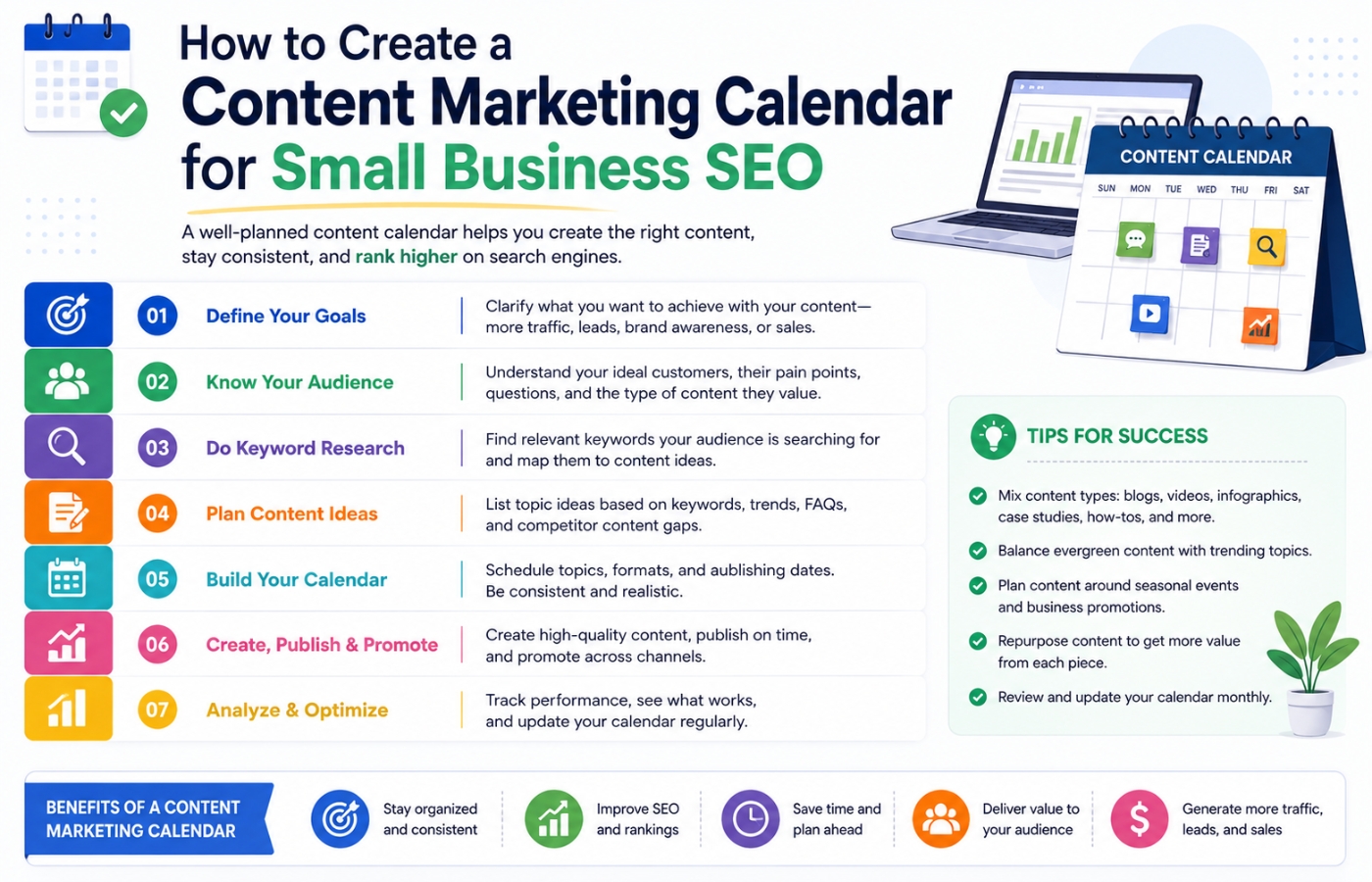
Consistency beats sporadic bursts. Use this simple framework to plan your content:
Step 1: Brainstorm 30–50 topics
-
What questions do customers ask you weekly?
-
What problems do you solve?
-
What seasonal topics matter (e.g., “winterize your pipes”)?
-
What local events or news can you comment on?
Step 2: Prioritize by SEO potential
Use a free tool like Google Keyword Planner or Ubersuggest to check search volume and competition. Prioritize topics with:
-
Low to medium competition
-
Clear commercial intent (e.g., “cost of X service”)
-
Relevance to your core offerings
Step 3: Set a realistic publishing schedule
-
New business: 1 post per week
-
Established business: 2–4 posts per month
-
Very lean (solo owner): 2 posts per month is fine
Step 4: Repurpose and update
-
Update top-performing posts every 6–12 months
-
Turn one long post into 3–4 social media snippets
-
Combine related posts into a downloadable PDF guide
Free tools for content planning:
-
Trello or Asana (content calendar)
-
Google Docs (collaborative writing)
-
Canva (simple images and infographics)
-
AnswerThePublic (question-based topic ideas)
Measuring Content Marketing Success for Small Business SEO
Do not guess. Track these key performance indicators (KPIs):
| Metric | What It Tells You | Target (Small Business) |
|---|---|---|
| Organic traffic | How many people find your content | Month-over-month growth |
| Keyword rankings | Which terms your content ranks for | Top 10 for 20+ long-tail keywords |
| Click-through rate (CTR) | How compelling your title/meta is | 3–5% is good |
| Time on page | Whether people actually read | 2+ minutes |
| Bounce rate | Whether content matches intent | Below 60% |
| Conversions | Form fills, calls, or purchases | Depends on industry |
| Backlinks | How many sites link to your content | 1–5 new links per month |
Free tools: Google Analytics, Google Search Console. Paid tools (affordable for small biz): SEMrush ($129/mo), Ahrefs ($99/mo), or Ubersuggest (freemium).
Common Content Marketing Mistakes Small Businesses Make
Writing for Yourself, Not Your Customer
Using jargon or focusing on your awards instead of customer problems.
Fix: Before writing, ask: “What question is this post answering?”
Inconsistent Publishing
Posting 5 times one month, then nothing for 3 months.
Fix: Set a realistic schedule and stick to it. Even once per month is better than sporadic bursts.
Ignoring Updates
A 2020 post about “COVID safety tips” is useless in 2026.
Fix: Review top posts quarterly. Update statistics, examples, and links.
No Calls-to-Action (CTAs)
Readers finish your post but have no idea what to do next.
Fix: Every post should end with a relevant CTA: “Call for a free estimate,” “Download our checklist,” or “Read our case studies.”
Thin Content (Under 600 words)
Google rarely ranks short posts for competitive terms.
Fix: Aim for 1,000+ words for informational posts. If you cannot write that much, combine related topics or add FAQ sections.
No Internal Links
Each post is an island, not connected to your important service pages.
Fix: Before publishing, add 2–3 links to other relevant pages on your site.
Real-World Example: Small Bakery Doubles Traffic with Content Marketing
The business: “Sweet Rise Bakery,” a small gluten-free bakery in Portland, Oregon. They had a beautiful website but only 200 organic visits per month. No blog. No content strategy.
The content marketing plan (90 days):
-
Published 12 blog posts targeting long-tail keywords:
-
“Where to buy gluten-free birthday cake in Portland”
-
“Vegan and gluten-free pastry options near me”
-
“How to store gluten-free bread so it stays fresh”
-
“Interview with local coffee shop using our pastries”
-
-
Each post included internal links to their menu page and order form
-
Shared each post on Instagram and Facebook
-
Added a “From Our Blog” section to their homepage
The results (6 months later):
-
Organic traffic: 200 → 850 visits/month (+325%)
-
Rankings: 8 keywords in top 3, 24 keywords in top 10
-
Online orders: +150% (directly attributed to blog visitors)
-
Backlinks: 3 local food bloggers linked to their “gluten-free birthday cake” post
Cost: $600 (freelance writer for 12 posts) + owner’s time (2 hours per week). **ROI:** Estimated $18,000 in additional annual revenue.
Conclusion: Start Content Marketing for SEO Today
SEO for small businesses without content marketing is like a car without an engine. You might have beautiful wheels and a fresh coat of paint, but you are not going anywhere. Content marketing provides the fuel — the blog posts, guides, FAQs, and local pages — that Google needs to understand your expertise and send you qualified traffic.
You do not need a massive budget or a full-time marketing team. Start small. Publish one detailed, useful post per week or even per month. Answer real customer questions. Link to your services. Update old content. Over time, those small efforts compound into a powerful asset that generates leads while you sleep.
The best time to start content marketing was two years ago. The second best time is today.
Want more qualified organic traffic and attract more customers through strategic content?
Get in touch with Orbitix today.