





Why Local SEO for Hotels Is Essential for More Bookings
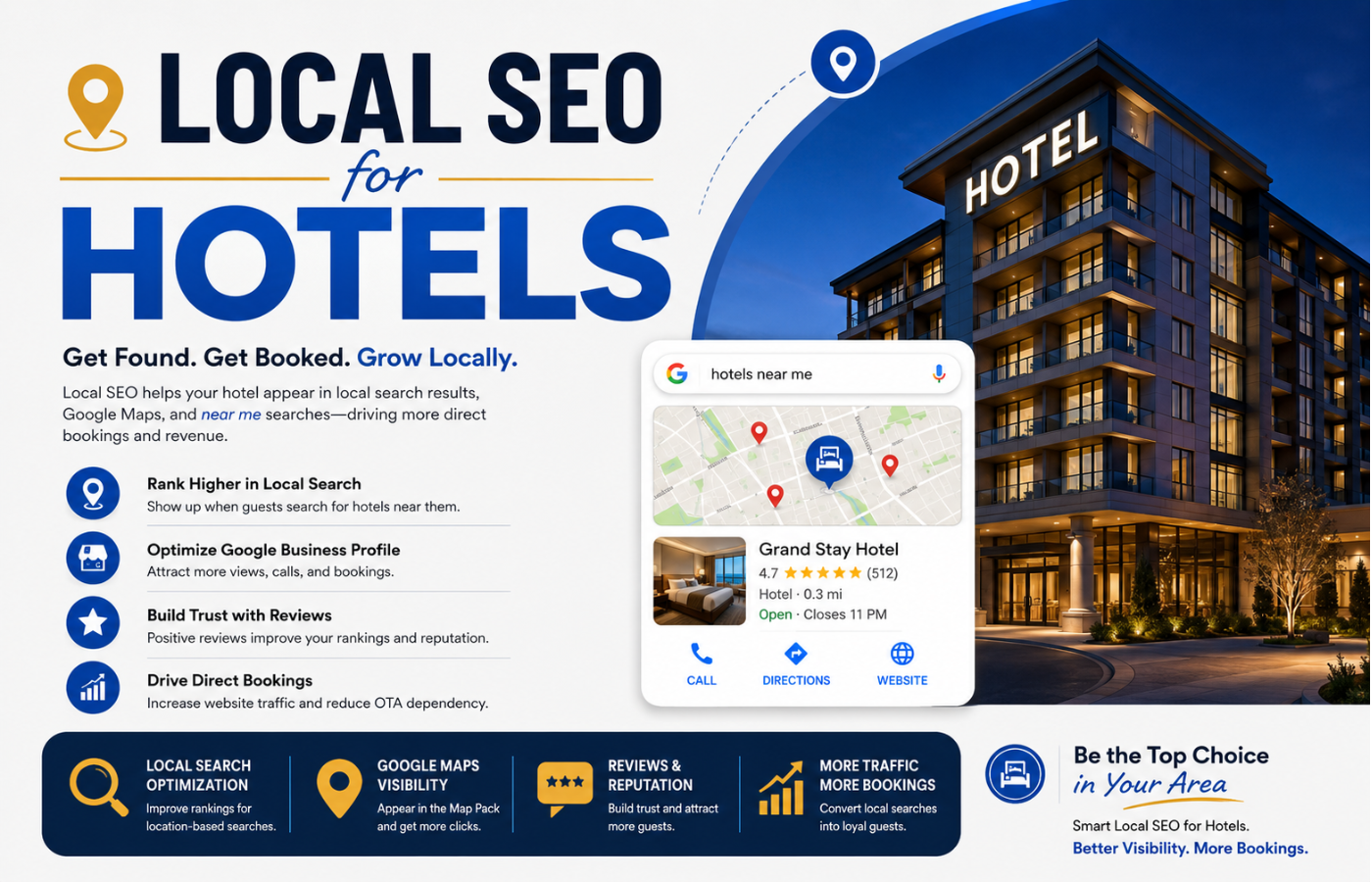
Local SEO for hotels is no longer a “nice-to-have” — it is the single most powerful driver of direct bookings in today’s travel landscape. But before understanding its impact, many hotel owners first ask, “what is local SEO?” Simply put, local SEO is the process of optimizing your hotel’s online presence so it appears in local search results when travelers search for accommodations nearby. When a traveler searches for “hotels near me” or “best place to stay in [city],” Google prioritizes businesses that have optimized their local presence. If your hotel is not ranking in the Local Pack (the top three map results) or showing up for “near me” searches, you are invisible to potential guests who are ready to book. Unlike paid ads that stop the moment your budget runs out, a strong local SEO strategy delivers consistent, high-intent traffic directly to your website. In this guide, we will break down exactly why local SEO for hotels is essential for filling rooms, increasing revenue, and outperforming competitors — without constantly raising ad spend.
The Shift from OTAs to Direct Bookings
For years, hotels have relied on Online Travel Agencies (OTAs) like Expedia, Booking.com, and TripAdvisor to fill rooms. But the cost of that convenience is high — commissions between 15% and 30% per booking. Worse, OTAs own the customer relationship, meaning you never capture guest data for future marketing.
How Local SEO for Hotels Directly Drives More Bookings
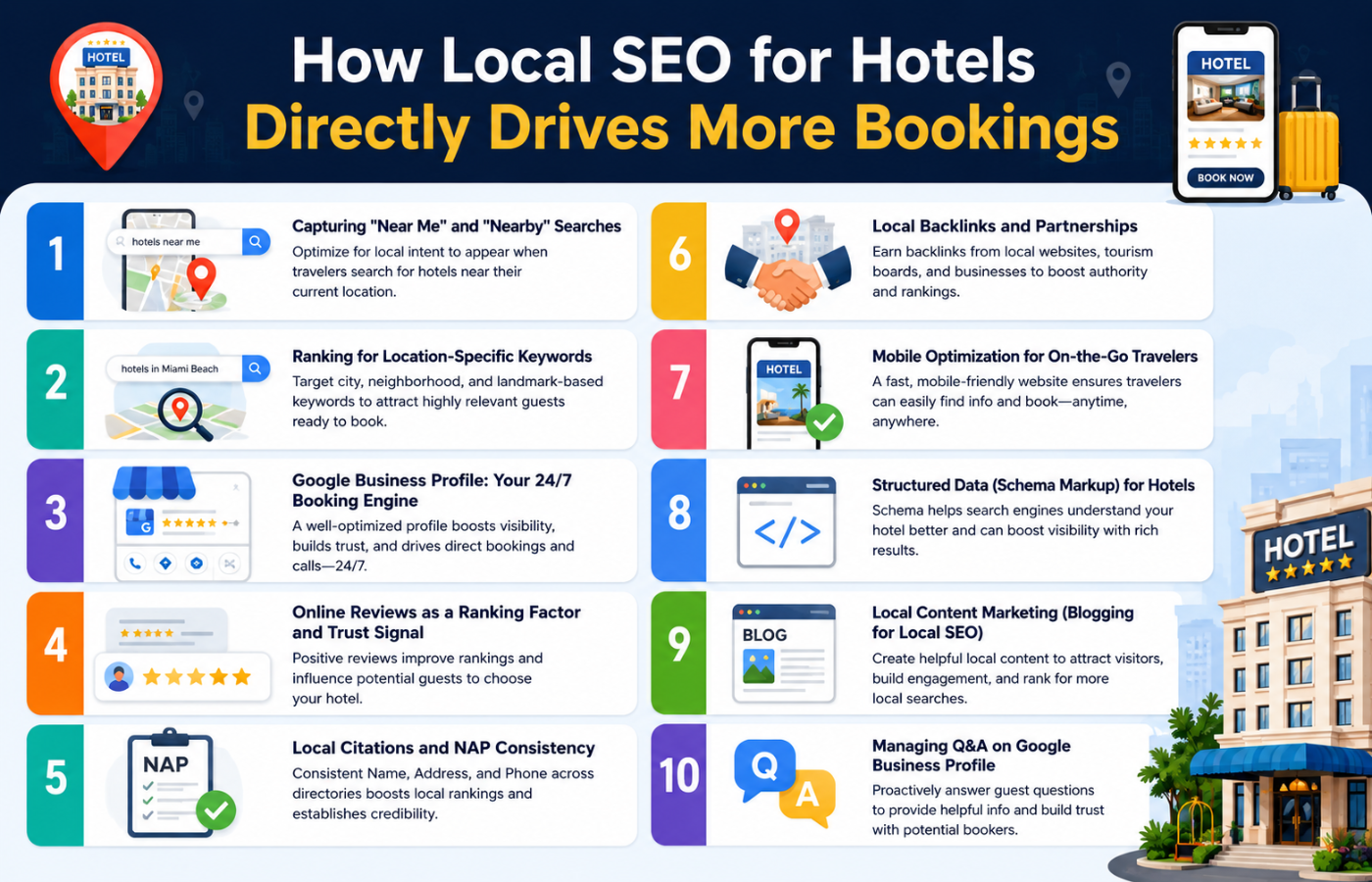
Let’s cut to the chase: local SEO for hotels works because it targets travelers at the exact moment of decision. Unlike traditional advertising that interrupts people, local search answers an active question: “Where c an I stay right now?” When you win that answer, you win the booking.
Below are the specific mechanisms by which local SEO for hotels turns searchers into guests.
1. Capturing “Near Me” and “Nearby” Searches
Over 50% of “near me” searches result in a physical visit within 24 hours. For hotels, that means a traveler who has just landed at the airport, checked out of a conference, or decided to extend their trip is pulling out their phone and typing:
-
“Hotels near me”
-
“Places to stay nearby”
-
“Hotel with pool close by”
-
“Pet-friendly hotel near downtown”
Google uses the searcher’s location to deliver results. If your hotel has a properly optimized Google Business Profile (GBP), consistent citations, and positive reviews, you will appear in these results. Appearing in the Local Pack (positions 1-3) can increase your booking rate by over 300% compared to being on page two.
Action tip: Ensure your GBP lists your hotel’s exact address, phone number, website, and categories (e.g., “Hotel,” “Boutique Hotel,” “Extended Stay Hotel”). Also enable messaging so guests can text you directly.
2. Ranking for Location-Specific Keywords
Beyond “near me,” travelers search for specific neighborhoods, landmarks, or districts. Examples include:
-
“Hotel near Navy Pier Chicago”
-
“Downtown Austin hotel”
-
“Beachfront hotel San Diego”
-
“Hotel walking distance to Bourbon Street”
Each of these queries represents a high-intent traveler who already knows where they want to be. If your hotel has a dedicated “location” page or a neighborhood page optimized for that keyword, you can capture that search. Generic hotel websites that only mention their city name once will never rank for these hyper-local terms.
Example structure: Create a page titled “Hotel Near [Landmark Name] – [Your Hotel Name]” with details on walking distance, public transit options, and nearby attractions. Then internally link that page to your homepage.
3. Google Business Profile: Your 24/7 Booking Engine
Your Google Business Profile is the most critical asset for local SEO for hotels. When optimized correctly, it displays:
-
Your hotel’s photos (rooms, pool, lobby, restaurant)
-
Guest reviews and star rating
-
Real-time availability (via booking partner integration)
-
Directions and phone number
-
Q&A where guests ask about parking, breakfast, etc.
Advanced GBP features for hotels:
-
Hotel attributes: GBP allows you to add amenities like “free Wi-Fi,” “breakfast included,” “outdoor pool,” “fitness center,” and “pet-friendly.” These appear as badges in search results.
-
Booking link: You can integrate your direct booking engine (e.g., Cloudbeds, SiteMinder, Booking.com direct link) so guests can reserve without leaving Google.
-
Check-in/check-out times: Add these to avoid phone calls asking basic questions.
A well-maintained GBP listing generates phone calls, website clicks, and direction requests — all of which are conversion signals that tell Google your hotel is relevant.
4. Online Reviews as a Ranking Factor and Trust Signal
Google’s local algorithm explicitly uses the number, recency, and sentiment of reviews to rank hotels. But beyond the algorithm, reviews are what convince a traveler to choose you over a competitor.
Review stats for hotels:
-
81% of travelers read reviews before booking.
-
A hotel with a 4.5+ star rating earns 30% more bookings than a 4.0-star hotel.
-
Responding to reviews (both positive and negative) improves your ranking.
Action plan:
-
Ask every satisfied guest to leave a review on Google (not just TripAdvisor). Provide a direct link via email or at checkout.
-
Respond within 24 hours. For positive reviews: thank the guest and mention something specific (e.g., “We’re so glad you enjoyed our rooftop bar!”). For negative reviews: apologize publicly, then take the conversation offline to resolve.
-
Never offer incentives for positive reviews (Google prohibits this), but you can run a “review contest” for a free drink at check-in as long as all reviews (positive and negative) are eligible.
5. Local Citations and NAP Consistency
Citations are mentions of your hotel’s Name, Address, and Phone Number (NAP) on other websites — directories like Yelp, TripAdvisor, Yellow Pages, local business associations, and travel blogs. Google cross-references these citations to verify that your hotel is legitimate and well-established.
The consistency rule: Your NAP must be absolutely identical everywhere. Even a small variation — “Suite 200” vs. “Ste 200” or “(555) 123-4567” vs. “555-123-4567” — confuses Google and hurts your ranking.
Tools to manage citations: Use tools like BrightLocal, Moz Local, or Yext to audit and distribute your NAP across 50+ directories.
High-value directories for hotels specifically:
-
TripAdvisor (critical)
-
Yelp Travel
-
Expedia Partner Central (even if you don’t use OTA bookings, claim your listing)
-
Google Business Profile (most important)
-
Bing Places
-
Apple Maps Connect
-
Local chamber of commerce websites
6. Local Backlinks and Partnerships
Backlinks (links from other websites to yours) are a major ranking factor. For local SEO for hotels, the most valuable backlinks come from other local businesses and organizations.
Where to get local backlinks:
-
Local tourism boards or convention and visitors bureaus (CVBs)
-
Nearby restaurants, event venues, or attractions (reciprocal linking)
-
Local news outlets (sponsor a community event to get mentioned)
-
Wedding blogs or event planners (if your hotel hosts weddings)
-
Real estate agents (if you offer extended stay or relocation packages)
Example outreach email:
“Hi [Event Planner Name], we noticed you recommend hotels for out-of-town wedding guests. We’re a boutique hotel just two blocks from the [Venue Name]. Would you consider adding us to your ‘Where to Stay’ page? We’d be happy to link back to your site from our ‘Weddings’ page.”
7. Mobile Optimization for On-the-Go Travelers
Nearly 70% of “hotel near me” searches happen on mobile devices. Travelers are on the go — at the airport, in a taxi, or walking down the street. If your website is not mobile-friendly, they will bounce to a competitor in seconds.
Mobile must-haves:
-
Responsive design (site adapts to any screen size)
-
Click-to-call phone number
-
One-click directions (opens Google Maps)
-
Simple booking form (no more than 3-4 fields)
-
Fast load time (under 2.5 seconds)
-
No pop-ups that cover the booking button
Google’s mobile-first indexing means it ranks the mobile version of your site, not the desktop version. If your mobile experience is poor, your local rankings will suffer.
8. Structured Data (Schema Markup) for Hotels
Schema markup is code you add to your website that helps search engines understand your content. For hotels, specific schema types include:
-
Hotel schema – name, address, star rating, price range
-
LocalBusiness schema – for overall business info
-
Review schema – to show star ratings in search results
-
GeoCoordinates schema – exact latitude/longitude
-
OpeningHours schema – check-in/check-out times
When implemented correctly, schema can generate rich results in Google — showing your star rating, price range, and availability directly in search results without the user clicking anything. This dramatically improves click-through rates.
Example: Search for “hotels in Chicago” on mobile. The hotels with star ratings and price indicators ($$) are using hotel schema.
9. Local Content Marketing (Blogging for Local SEO)
A blog might not seem essential for a hotel, but it is one of the most underutilized local SEO tools. Blog posts allow you to target long-tail keywords that your main website pages cannot.
Blog post ideas for hotels:
-
“10 Best Restaurants Within Walking Distance of [Hotel Name]”
-
“How to Spend a Rainy Day in [City] – Hotel Guest Guide”
-
“Our Favorite Local Coffee Shops for Early Risers”
-
“Family-Friendly Activities Near [Hotel Name]”
-
“The History of [Local Landmark] – A Guest’s Guide”
Each blog post should:
-
Naturally include your hotel’s name and location
-
Link back to your booking page
-
Embed a Google Map of nearby attractions
-
Be shared on social media and in email newsletters
Over time, these blog posts accumulate authority and rank for “things to do near [hotel name]” searches — bringing in travelers who haven’t even searched for a hotel yet.
10. Managing Q&A on Google Business Profile
Many hotels ignore the Q&A section of their Google Business Profile. That is a mistake. Travelers ask questions like:
-
“Does this hotel have free parking?”
-
“Is breakfast included?”
-
“Do you have an airport shuttle?”
-
“Can I check in after midnight?”
If you do not answer these questions publicly, a competitor or even a past guest might answer incorrectly. Worse, Google may pull an incorrect answer from a random review.
Best practice: Log into your GBP weekly and answer every question. Also preemptively add your own Q&A pairs (yes, you can ask and answer your own questions) for the most common inquiries. These Q&As become indexed content that helps you rank.
Measuring Success: Key Metrics for Local SEO for Hotels
You cannot improve what you do not measure. Track these KPIs to gauge the effectiveness of your local SEO efforts:
| Metric | What It Tells You | Target |
|---|---|---|
| Google Business Profile views | How often your listing appears in search | Month-over-month increase |
| GBP direction requests | High-intent guests planning to arrive | 50+ per month for small hotels |
| GBP phone calls | Urgent bookings (same-day) | Track via call tracking number |
| Website clicks from GBP | Direct traffic to your booking engine | 200+ per month |
| Local Pack ranking for “hotel near me” | Your visibility for the most important query | Top 3 |
| Review count and average rating | Trust and algorithm ranking | 4.5+ stars; 10+ new reviews/month |
| Organic traffic from location keywords | Guests finding you via search engines | 30% year-over-year growth |
Use Google Search Console to see exactly which local queries drive traffic to your site. Then double down on the pages that are already performing.
Common Local SEO Mistakes Hotels Make (And How to Avoid Them)
Even well-intentioned hotels sabotage their own local SEO. Avoid these errors:
Using an OTA booking link on GBP
Google allows you to add a booking link to your GBP. Do not use an Expedia or Booking.com link. Use your direct booking engine URL. Otherwise, you send potential guests to a competitor who charges commission.
Ignoring Google Posts
Google Posts (similar to social media updates) appear on your GBP. Use them to promote weekend specials, last-minute deals, or event packages. They expire after 7 days, so post weekly.
No photos of guest rooms
Listings with 10+ photos receive 50% more engagement. Include photos of: rooms (different room types), bathroom, pool, lobby, exterior, breakfast area, and nearby landmarks.
Inconsistent business hours
If you list “24 hours” for check-in but your front desk closes at 11 PM, guests will be frustrated — and they will leave negative reviews. Be accurate.
Not claiming your hotel on Apple Maps
Many iPhone users default to Apple Maps. Claim your listing via Apple Maps Connect for free. This is often overlooked by hotels focused only on Google.
Advanced Strategy: Local SEO for Hotels with Multiple Locations
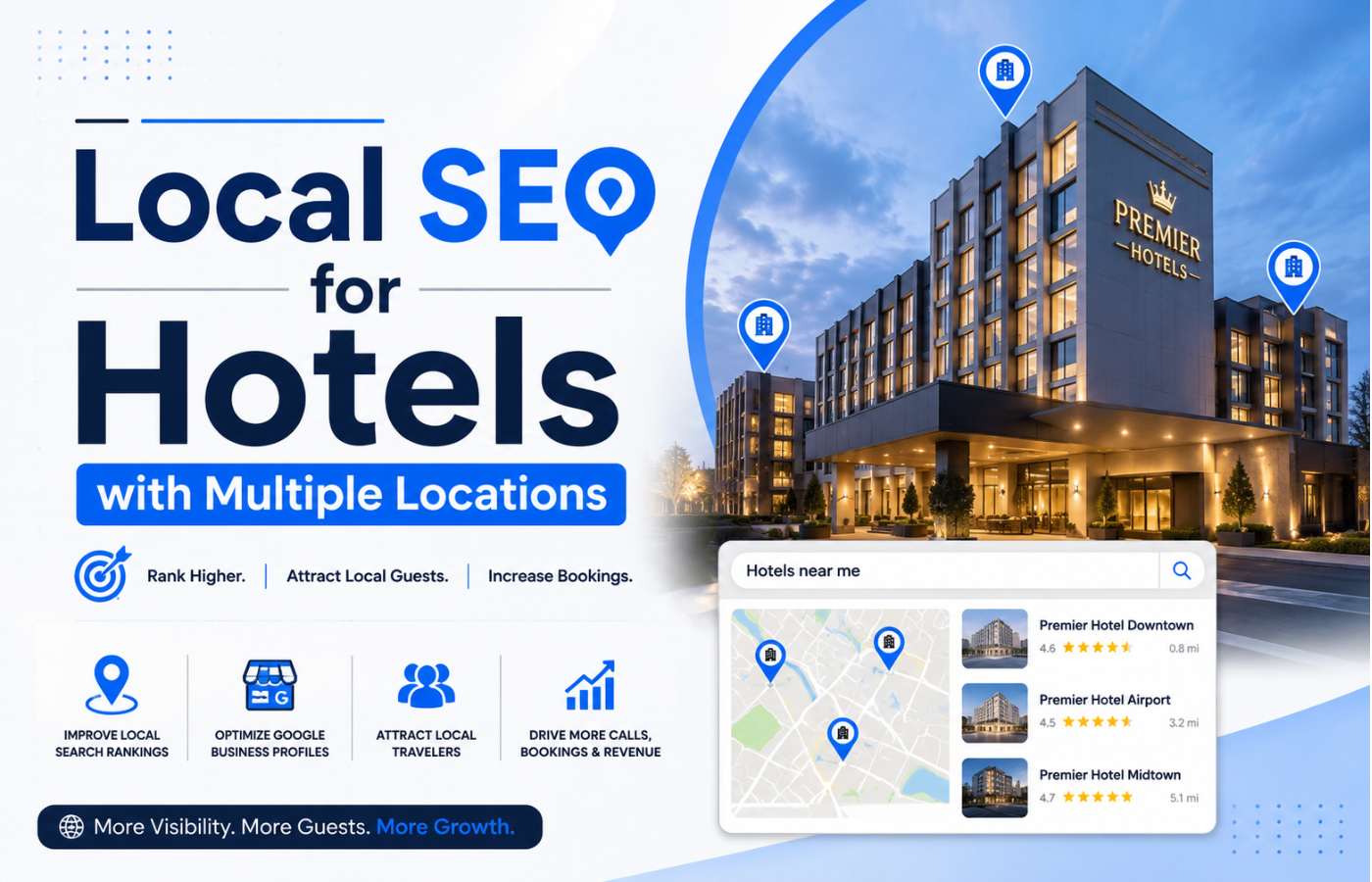
If your hotel brand has multiple properties (e.g., “Harbor Inn – Downtown” and “Harbor Inn – Airport”), you need a separate Google Business Profile and separate location pages on your website for each property. Do not try to rank one listing for two different neighborhoods.
Structure for multi-location hotels:
-
Main website: Brand homepage
-
Subfolder: /downtown/ (with its own GBP)
-
Subfolder: /airport/ (with its own GBP)
-
Each location page has unique photos, address, phone number, and local content
Google treats each location as a separate entity. Sharing one GBP for two addresses confuses both the algorithm and potential guests.
Real-World Example: How One Boutique Hotel Doubled Direct Bookings in 90 Days
Consider “The Maple Inn,” a 40-room boutique hotel in Portland, Oregon. Before optimizing for local SEO, they relied almost entirely on OTAs and ranked #11 in the Local Pack for “hotels near downtown Portland.”
Actions taken over 90 days:
-
Claimed and fully optimized their GBP (added 25 photos, all amenities, Q&A section)
-
Built 15 local citations (tourism board, local wedding blogs, chamber of commerce)
-
Created three neighborhood pages (“Pearl District,” “Alberta Arts,” “Downtown”)
-
Generated 22 new Google reviews by asking every guest at checkout
-
Responded to every review within 24 hours
-
Added hotel schema markup to their website
Results after 90 days:
-
Local Pack position: #11 → #3
-
Direct website traffic from GBP: +215%
-
Phone calls for same-day bookings: +87%
-
OTA commission costs: decreased by 34% (as direct bookings replaced third-party bookings)
Total cost: approximately $500 (for citation management tools and staff time). ROI: over 500% in increased profit margin.
This is the power of local SEO for hotels when executed correctly.
Conclusion: Start Local SEO for Hotels Today
You do not need a massive marketing budget to compete with chain hotels or established properties. Just like local SEO for builders helps construction companies attract nearby clients and improve online visibility, local SEO for hotels levels the playing field by rewarding relevance, authenticity, and guest satisfaction. When you optimize your Google Business Profile, build consistent citations, earn genuine reviews, and create local content, you become the answer to every traveler’s question: “Where should I stay?”
The hotel industry is highly competitive, but local search is still underutilized by most independent hotels. That is your opportunity. Start with the basics — claim your GBP, add photos, ask for reviews — then layer in advanced tactics like schema markup, local backlinks, and neighborhood pages.
Every day you delay, a competitor is capturing the “near me” searches that could have been yours.
Ready to fill your rooms with direct bookings?
Get in touch with Orbitix today.