







AI Content for SEO: Advantages, Risks, and Smart Implementation Tips
Why Google Doesn’t Penalise AI Content—But Penalises Bad Content
Google has made its stance clear: AI-generated content is not inherently penalised. What matters is quality, usefulness, and trustworthiness, regardless of whether a human or AI wrote it . In fact, Google removed the phrase “written by people” from its documentation in 2023, acknowledging that AI-crafted text is acceptable if it serves users well .
However, Google treats AI content the same as human content—low-quality, spammy, or misleading material won’t perform well . Attempts to manipulate Google’s AI systems, including AI Overviews, are now classified as major spam violations under updated spam policies . Google explicitly defines spam as “attempting to manipulate generative AI responses in Google Search” . That means AI content for SEO must always be people-first, not search-engine-first.
Advantages, Risks, and Smart Implementation Tips for AI Content for SEO
The Advantages
Scalability: AI tools can generate drafts, product descriptions, FAQs, and local pages at scale, freeing your team for strategic work .
Improved keyword targeting: AI helps with keyword research, clustering, and natural integration without stuffing .
Content freshness: AI makes it easier to update blogs and service pages regularly, which Google favours .
Multilingual and local SEO: AI translates and localises content for global audiences efficiently .
The Risks
Generic, thin content: AI trained on vast data often produces average, derivative text. 94.12% of the time, human-written content outranks AI content . When we pruned low-quality AI posts, we saw an 11–12% traffic lift .
Hallucinations: AI can confidently state false information—requiring rigorous fact-checking .
Duplicate content: Competitors using similar prompts produce similar content, increasing the risk of plagiarism flags .
Brand tone dilution: AI struggles to maintain a unique voice, producing content indistinguishable from competitors’ AI output .
Google penalties: Publishing unedited AI text at scale can be flagged as “scaled content abuse” under Google’s 2025 updates . Google’s Helpful Content System and E-E-A-T standards won’t tolerate generic, low-value AI output .
Smart Implementation Tips for AI Content for SEO
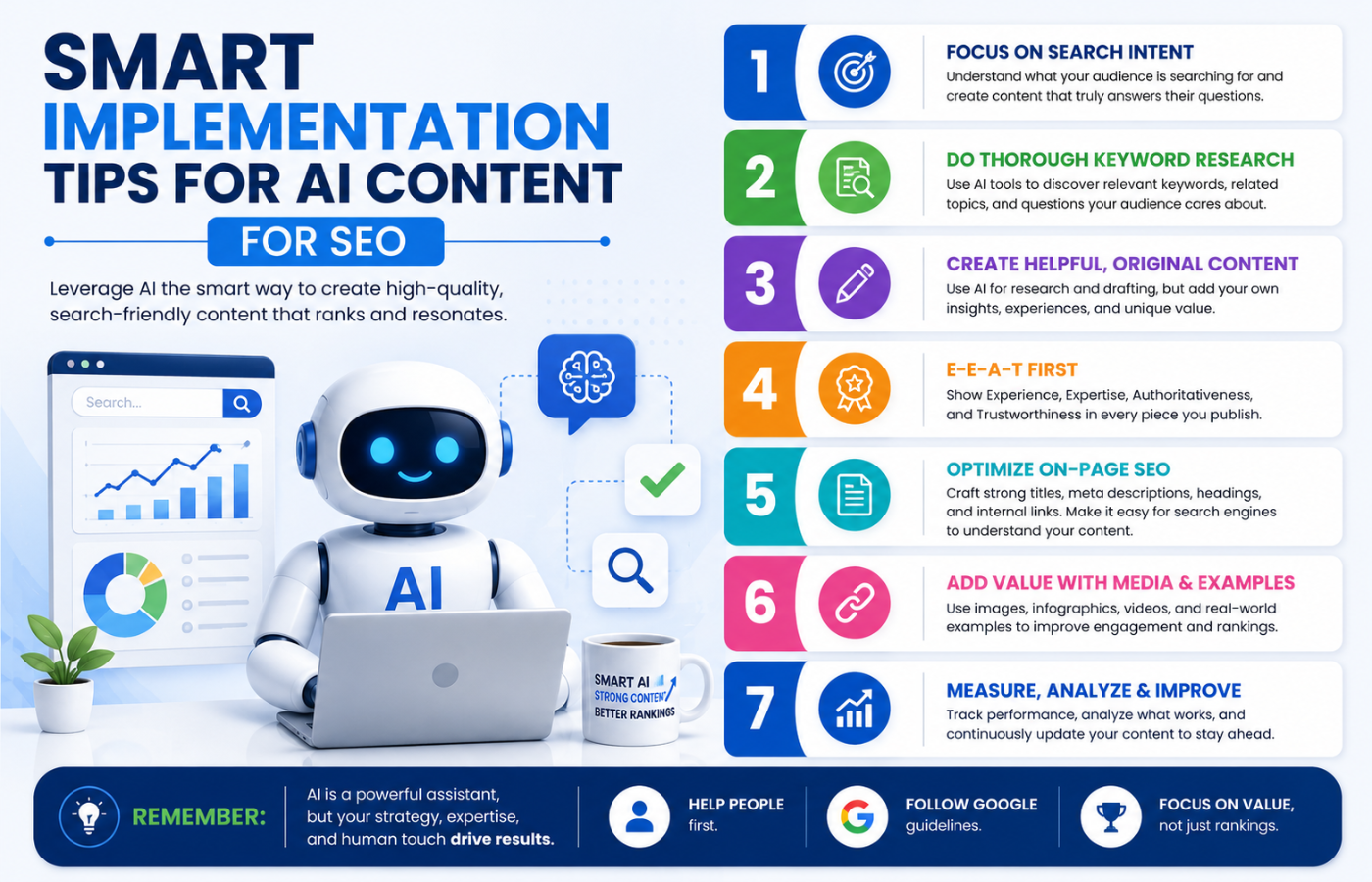
1. Start with a strategic prompt: Include keyword targets, audience, structure, and content goals . Vague prompts yield generic results.
2. Use AI for drafts—not final copy: Treat AI as a content assistant, not a replacement . Draft with AI, then edit ruthlessly .
3. Apply the CRAFT method: Cut fluff, Review and refine language, Add unique examples and data, Fact-check every claim, and ensure Trust through author bylines and credible sources .
4. Add human insights and E-E-A-T signals: Inject firsthand experience, case studies, personal anecdotes, and expert opinions. Raw AI output can’t provide the Experience factor Google rewards .
5. Fact-check everything: Verify every claim, statistic, and reference—especially for YMYL topics (health, finance, legal) .
6. Optimise structure and readability: Use clear headings, logical internal linking, descriptive image alt text, and schema markup . Structure content for humans and AI agents alike .
7. No special “AI-friendly” formatting required: Google confirms you don’t need LLMs.txt, Markdown pages, “chunking,” or special structured data. Traditional SEO works for AI Overviews too .
8. Review and edit every piece before publishing: Never publish AI output unedited. Always verify, fact-check, and align with your brand’s voice and goals .
Conclusion: AI Content for SEO—A Powerful Tool, Not a Shortcut
ant AI-powered content that ranks, engages, and converts—without triggering Google penalties?
Get in touch with Orbitix today.