







The Future of SEO, Content & Advertising: Marketing Trends for 2026
Why 2026 Is Different: The Recognition Economy
For nearly two decades, SEO had a clear mandate: get to the top of the SERP. Rankings were the scoreboard — position 1 meant visibility, traffic, and brand value . That model is breaking. AI Overviews are absorbing queries that previously generated clicks, and LLM platforms are becoming the first stop for research and decision-making. Zero-click is no longer niche — it’s increasingly becoming the default .
SEO trends 2026 reveal that a brand can rank #1 for trophy keywords, have a healthy link profile, and publish weekly content — yet remain invisible when potential customers ask an AI which brand solutions to consider . The new goal is recognition: being cited, mentioned, and preferred in AI-generated answers .
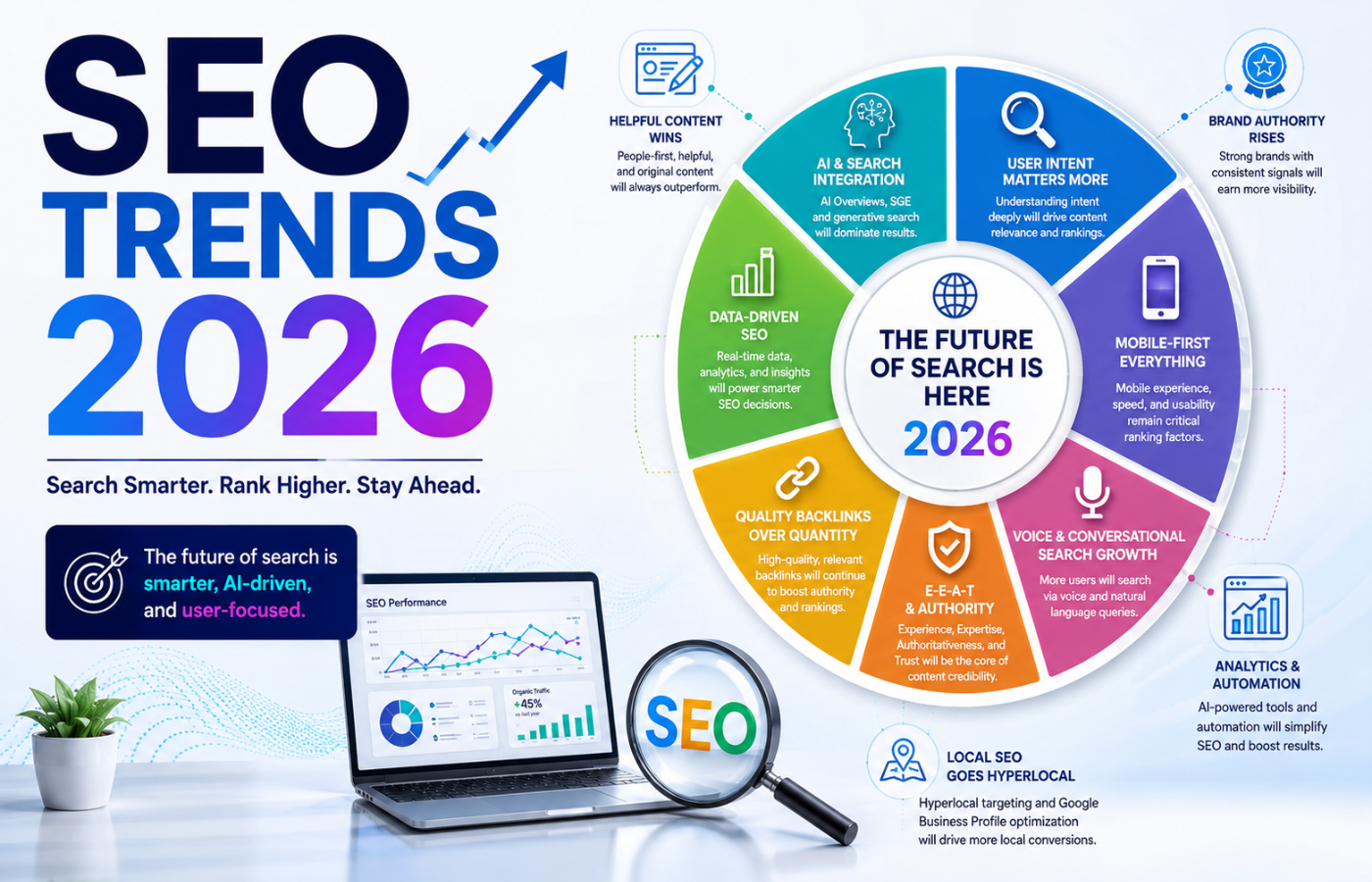
Key Marketing Trends Shaping 2026
1. From Rankings to Recognition
Visibility now depends on authority, citations, entity clarity, and brand presence across the broader web — not just SERP position . Ranking content is optimized around keywords; citable content is original, specific, and useful enough that others want to reference it .
What to do: Audit your entity presence. Ensure your brand description is consistent across your website, Knowledge Panel, LinkedIn, and industry directories . Create citable assets like original research, surveys, clear frameworks, and unique data that journalists, analysts, and AI systems actually want to cite .
2. Agentic Commerce & AI-Driven Discovery
Agentic commerce marks a shift where users rely on AI-driven agents to recommend, reorder, or select products on their behalf . Visibility is established before checkout ever happens, often without a traditional search query. Platforms like Shopify, Stripe, and WooCommerce are becoming distribution layers where agent compatibility influences which brands are surfaced .
What to do: Treat structured data as a baseline requirement, not a competitive advantage. Without clean, comprehensive entity and product data, brands will not rank lower — they will simply not appear in AI-driven shopping and comparison flows at all .
3. Generative Engine Optimization (GEO) Emerges
GEO is the practice of structuring content to appear in AI summaries and answer modules . While some “GEO experts” are pushing questionable advice (creating AI-friendly copies of sites, generating thin GEO pages), the core principles overlap heavily with good SEO: building topical authority, publishing unique content, structuring information clearly, and maintaining a strong technical foundation .
Important reality check: Traditional SEO still drives approximately 34x the traffic of GEO for now . Google processes roughly 8.5 billion searches per day, while ChatGPT has about 900 million weekly users . A balanced strategy optimizes for both.
4. Structured Data as a Retrieval Qualifier
In 2026, structured data shifts from ranking enhancer to retrieval qualifier. Search engines and AI systems increasingly rely on structured data as a layer of eligibility to determine whether content, products, and entities can be confidently retrieved, compared, or surfaced in AI-powered experiences .
What to do: Implement comprehensive schema markup (Product, LocalBusiness, Article, FAQ). For ecommerce brands, ensure pricing, availability, shipping details, and merchant data are consistently structured .
5. Brand Sentiment Becomes a Core Visibility Signal
AI systems synthesize signals from reviews, forums, social platforms, media coverage, and knowledge bases to form a composite view of legitimacy and expertise . Mentions — linked or unlinked — contribute to a broader understanding of how a brand is perceived across the web.
What to do: Focus on consistency across owned, earned, and shared channels. Pay attention not only to where your brand ranks, but also to how it is discussed, described, and contextualized across platforms .
6. Social Platforms as Secondary Search Indexes
Discovery increasingly happens outside traditional search engines. TikTok, LinkedIn, Reddit, and niche communities act as secondary search indexes where users validate expertise and intent . AI systems reference these platforms to verify whether a brand’s claims are substantiated in public discourse.
What to do: Align SEO strategy with social visibility. Ensure expertise, terminology, and positioning remain consistent across all discussions about your brand .
7. Content Standards Rise: Quality Becomes Machine Readability
Editorial quality is no longer judged only by human readers. AI systems evaluate content based on how efficiently it can be parsed, summarized, cited, and reused . Verbosity and circular explanations fail functionally — content must be concise, clearly structured, and well-attributed .
What to do: Create content that follows E-E-A-T guidelines, provides genuine human insights, and offers proprietary data that AI cannot replicate . 75% of marketers have expanded AI tool use across content processes, but human oversight remains critical for accuracy and brand voice .
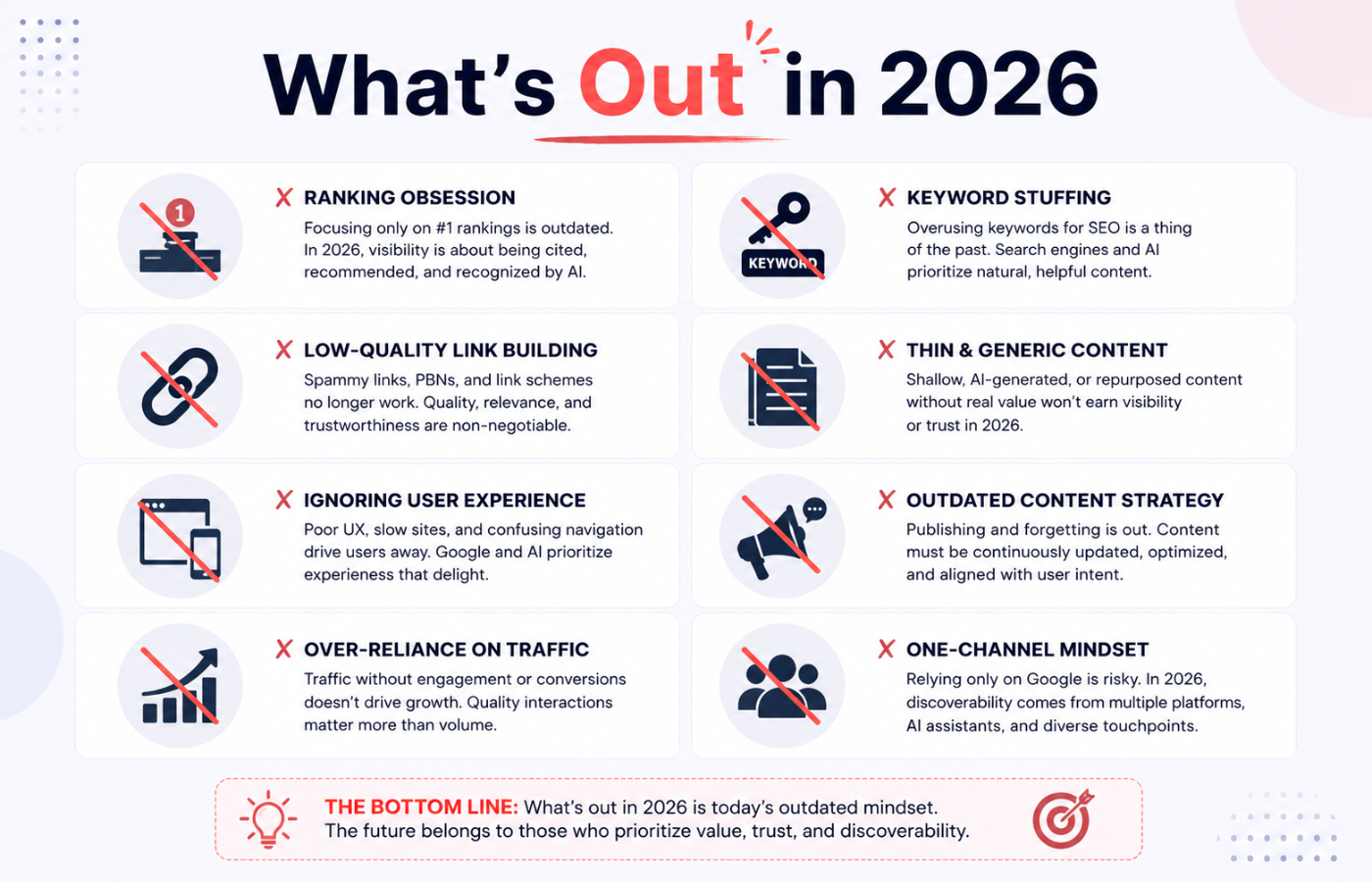
What’s Out in 2026
-
Chasing average position — rankings matter as training signals, not endpoints
-
Low-quality AI slop — Google and AI systems increasingly filter generic content
-
Shortcuts and thin GEO tactics — promotional listicles and mass-generated pages are being penalized
-
Treating accessibility as optional — inclusivity and privacy are becoming essentials, not add-ons
Conclusion: The Future Is AI-First
Want an SEO strategy that adapts to AI search, agentic commerce, and the recognition economy — so your brand gets cited, recommended, and chosen in 2026?
Get in touch with Orbitix today.