







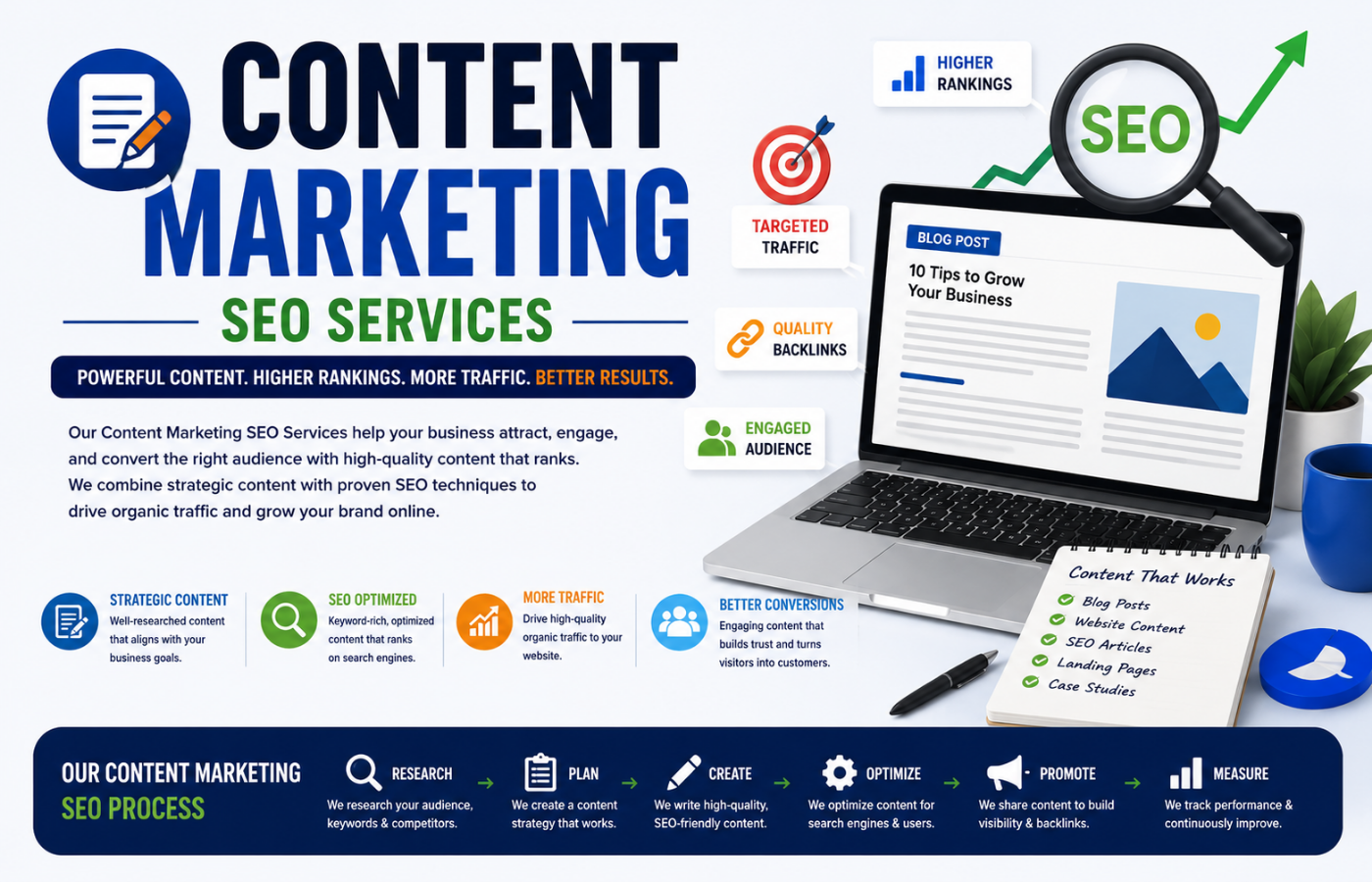
How Content Marketing SEO Services Improve Search Engine Rankings
Why Content Alone Won’t Rank
Google does not care about your beautiful prose. It cares about relevance, authority, and user satisfaction. You can write a 5,000-word guide, but if it lacks proper heading structure, internal links, schema markup, or answers the searcher’s actual question, it will sit on page 7 forever. Content marketing SEO services add the technical and strategic framework that transforms raw content into ranking assets.
What Content Marketing SEO Services Do to Improve Rankings
Effective content marketing SEO services follow a systematic process:
1. Search Intent Mapping
Before writing a single word, successful services identify:
-
Informational intent: User wants to learn (“how to change a tyre”)
-
Commercial intent: User wants to compare (“best running shoes”)
-
Transactional intent: User wants to buy (“buy Nike Air Max”)
-
Navigational intent: User wants a specific site (“Facebook login”)
Why it matters: Targeting the wrong intent guarantees poor rankings. Google matches intent perfectly.
2. Topic Clusters & Pillar Pages
Instead of isolated posts, cluster content around pillars:
Pillar page: “Complete Guide to Email Marketing”
Cluster content:
-
“How to build an email list from scratch”
-
“Best email automation workflows for e-commerce”
-
“Welcome email templates that convert”
Each cluster post links to the pillar and vice versa. This structure signals topical authority to Google.
3. On-Page Optimisation at Scale
Every piece of content receives:
-
Target keyword in H1, first 100 words, and one H2
-
LSI keywords (semantically related terms) naturally throughout
-
Meta title and description optimised for CTR
-
Heading hierarchy (one H1, logical H2-H6 structure)
-
Internal links to 3-5 relevant existing pages
-
External links to 1-2 authoritative sources
-
Image alt text with descriptive keywords
4. Content Structuring for Featured Snippets
Google rewards content formatted for position zero:
-
Paragraph snippets: Direct answer within 40-60 words
-
List snippets: Bulleted or numbered steps
-
Table snippets: Comparison data in clean tables
-
Video snippets: Timestamped, transcribed content
Content marketing SEO services specifically structure sections to win these rich results.
5. Freshness & Content Refreshing
Old content decays. Services systematically:
-
Identify underperforming pages (dropping rankings)
-
Update stats, examples, and references
-
Add new sections to match current search intent
-
Refresh meta descriptions and internal links
-
Update publication date (signals freshness to Google)
Why it matters: Google favours fresh, up-to-date content. Refreshed pages often regain lost rankings within weeks.
6. Topic Gap Analysis
What are your competitors ranking for that you are not? Services:
-
Identify missing topics in your content library
-
Prioritise by search volume and difficulty
-
Create content briefs for each gap
-
Track rankings after publication
7. Internal Linking Architecture
Strategic internal links distribute “link equity” to important pages:
-
Link from high-authority pages to newer pages
-
Use descriptive anchor text (not “click here”)
-
Create hub-and-spoke structures around pillars
-
Ensure no orphan pages (every page has inbound links)
8. Schema Markup for Content
Structured data helps Google understand your content:
-
Articleschema for blog posts -
FAQschema for question sections -
HowToschema for tutorials -
Videoschema for embedded content
Rich snippets increase CTR by 30-40%, driving more traffic to your ranking content.
The Content-to-Rank Funnel
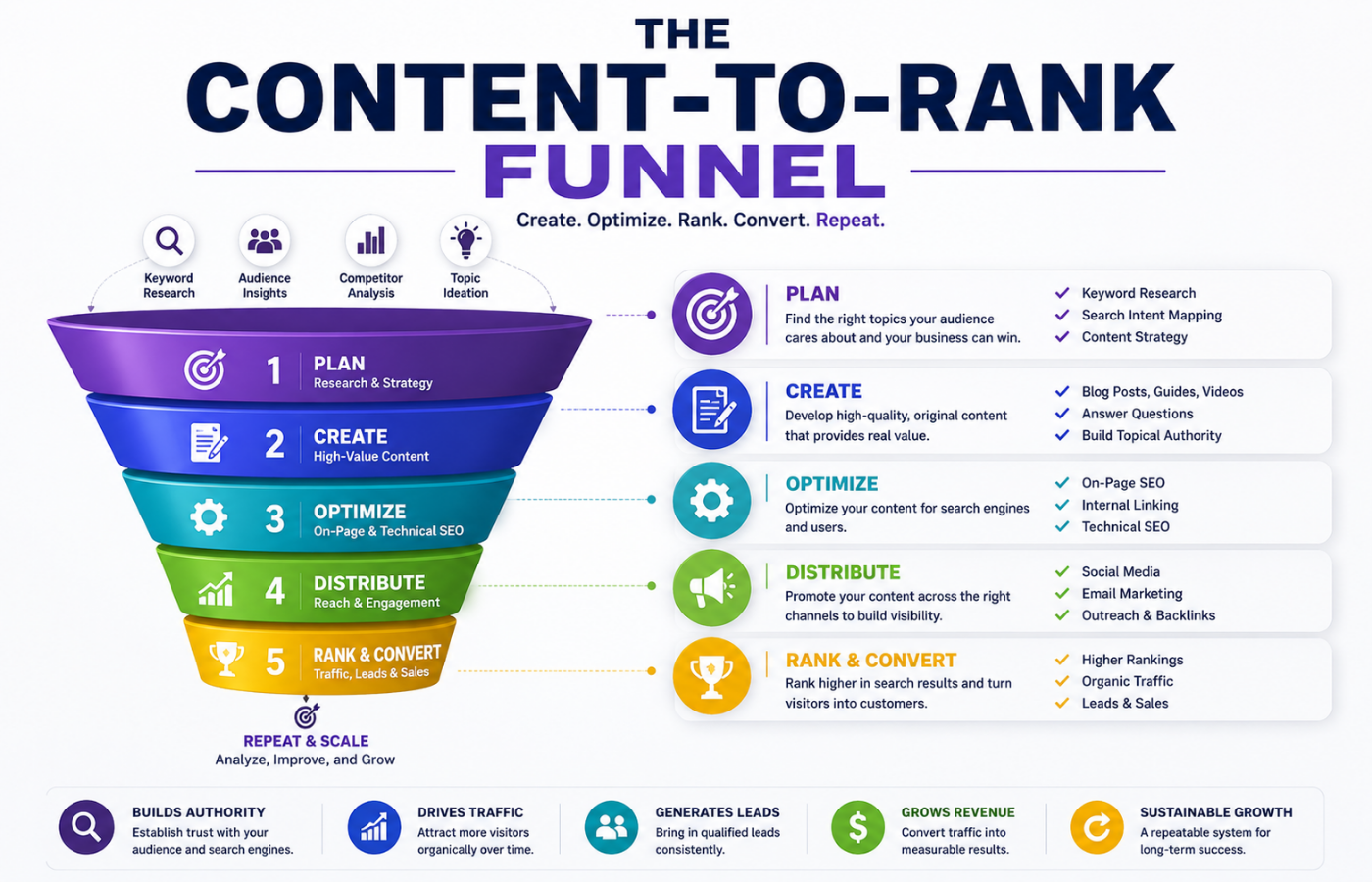
| Stage | SEO Activity | Ranking Impact |
|---|---|---|
| Research | Search intent mapping, gap analysis | Targets the right keywords |
| Creation | On-page optimisation, structure for snippets | Google understands content |
| Publication | Internal linking, schema markup | Authority flows to new page |
| Post-publish | Content refreshing, link building | Maintains or improves position |
| Scaling | Topic clusters, pillar pages | Builds topical authority |
Common Content Marketing SEO Mistakes
| Mistake | Fix |
|---|---|
| Writing without keyword research | Research intent and volume before writing |
| Ignoring internal linking | Link to 3-5 related posts per article |
| No schema markup | Add Article, FAQ, or HowTo schema |
| Publishing once, never updating | Refresh top 20% of content quarterly |
| Targeting wrong intent | Match content type to searcher intent |
| Thin content (under 1,000 words) | Aim for 1,500-2,500 words for competitive topics |
| No clear H1 or heading hierarchy | One H1, logical H2-H6 structure |
Measuring Content SEO Success
Track these metrics monthly:
-
Keyword rankings for target terms (movement up or down)
-
Organic traffic to each content piece
-
Featured snippet ownership (position zero)
-
Click-through rate (CTR) from search results
-
Time on page (engagement signal)
-
Internal link clicks (helps distribute authority)
Conclusion: Content + SEO = Rankings
Want content that actually ranks on Google — not just blog posts that nobody ever finds?
Get in touch with Orbitix today.