







Organic Search Engine Marketing for E-commerce Websites
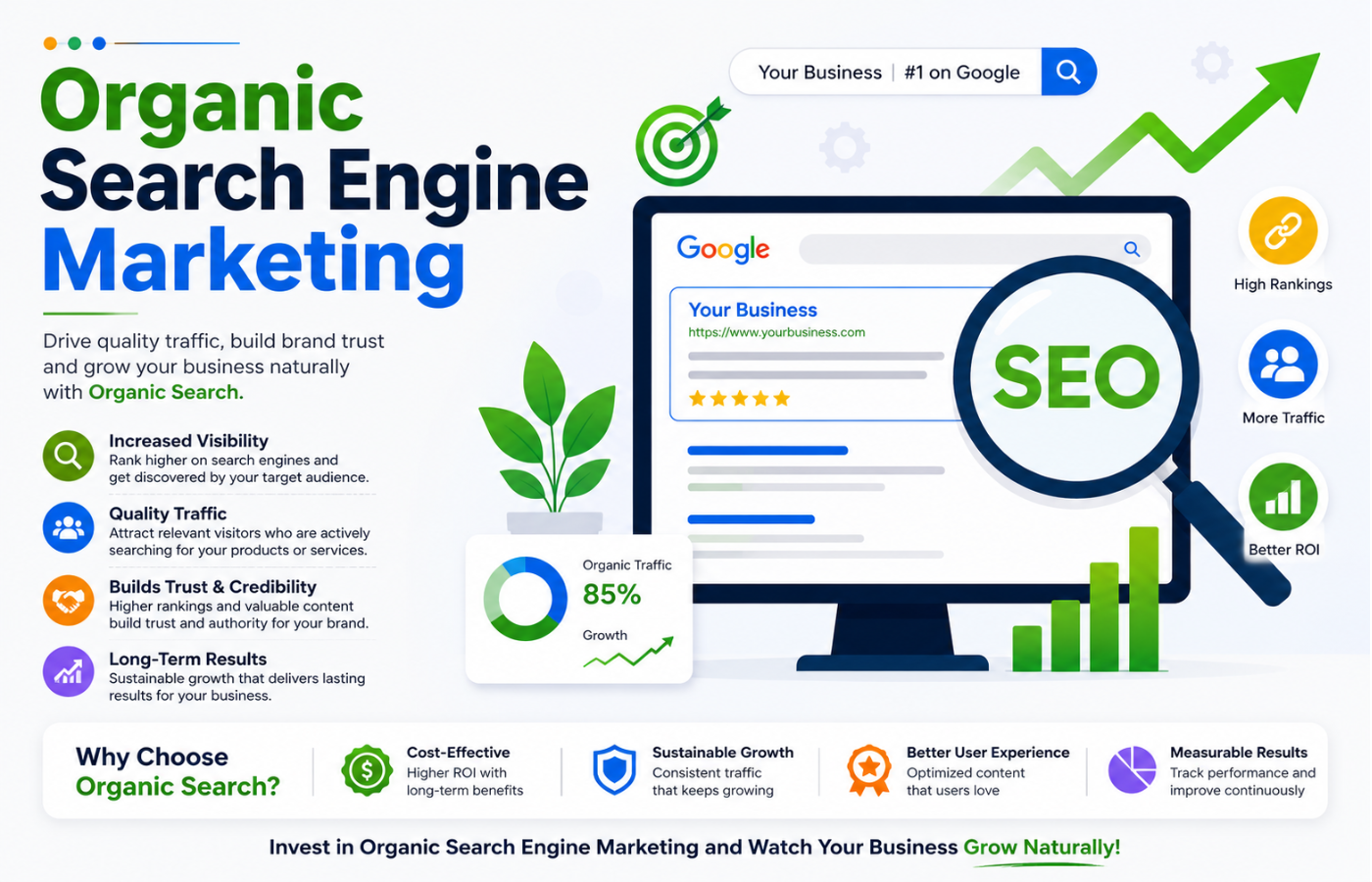
Organic Search Engine Marketing is the strategic process of driving unpaid, highly targeted traffic to an online store by optimizing content for search engines like Google, Bing, and emerging answer engines like Perplexity and ChatGPT. For e-commerce websites, this approach is the digital equivalent of owning prime retail real estate—without paying rent per visitor. While paid ads stop the moment you pause your budget, a well-executed organic strategy builds compounding equity, turning product pages into perpetual customer magnets. In this detailed guide, we will explore how e-commerce brands can leverage keyword research, technical SEO, content clusters, and link building to dominate search results and drive sustainable revenue.
What is Organic Search Engine Marketing (OSEM)?
Organic Search Engine Marketing (OSEM) refers to all the activities that help your e-commerce website rank higher in the unpaid (“organic”) search results. Unlike Search Engine Advertising (PPC), where you bid on keywords, OSEM focuses on:
-
On-page optimization: Product titles, meta descriptions, headers, and internal linking.
-
Technical SEO: Site speed, mobile-friendliness, structured data (schema).
-
Content marketing: Buying guides, blog posts, and category descriptions.
-
Off-page signals: Backlinks from reputable sites and brand mentions.
For e-commerce and service-based businesses like seo for painters, OSEM is particularly powerful because users often search with high purchase intent. A user searching for “buy waterproof hiking boots” or “best seo for painters services” is much closer to making a decision than someone casually browsing social media.
Why Organic Search Engine Marketing Outperforms Paid Ads for E-commerce
When discussing Organic Search Engine Marketing, many e-commerce owners ask, “Why not just run Google Shopping ads?” While paid ads offer immediacy, OSEM delivers superior long-term ROI. Here is why:
1. Compounding Returns vs. Rent-Seeking
With PPC, you pay for every click. Stop paying → traffic stops. With OSEM, a well-optimized product page can rank for years, generating clicks and sales at zero marginal cost. For example, a “best coffee grinder under $100” guide published in 2021 can still drive affiliate or direct sales in 2026.
2. Trust and Credibility Bias
Studies consistently show that 70-80% of users skip paid ads to click organic results. Shoppers trust the algorithm’s organic recommendations more than advertisements. Ranking organically signals authority and quality.
3. Higher Click-Through Rates (CTR) for E-commerce
According to Backlinko, the #1 organic result receives 10x more clicks than a paid result on the same page. For e-commerce, a featured snippet or product listing with rich results (reviews, price, availability) dominates the mobile shopping experience.
4. Synergy with Answer Engines
Modern AEO (Answer Engine Optimization) extends traditional OSEM. When a user asks Siri, Alexa, or ChatGPT “Where can I buy organic cotton bedsheets?”, the answer is pulled from high-authority e-commerce pages that have implemented schema markup (Product, Offer, AggregateRating). OSEM is the foundation for being cited by AI agents.
The 6 Pillars of Organic Search Engine Marketing for E-commerce
To succeed, you need more than basic SEO. You need an integrated system.
Pillar 1: Product-Level Keyword Strategy
Generic keywords like “shoes” are too competitive. Instead, target long-tail, transactional keywords:
| Keyword Type | Example | Purchase Intent |
|---|---|---|
| Informational | “how to clean leather boots” | Low (top-of-funnel) |
| Commercial | “best leather boots for winter” | Medium (comparison) |
| Transactional | “buy Red Wing Iron Ranger boots” | High (ready to purchase) |
Action step: Use tools like Semrush or Ahrefs to find keywords with “high commercial intent” – terms that include “buy,” “for sale,” “discount code,” or specific model numbers.
Pillar 2: E-commerce Technical SEO
Search engines must crawl and index your product pages efficiently. Common e-commerce pitfalls:
-
Thin content: Product descriptions copied from the manufacturer. Fix by writing unique, detailed copy (bullet points, specs, use cases).
-
Faceted navigation: URL parameters (e.g.,
?color=red&size=large) create duplicate content. Userel="canonical"tags or parameter handling in Google Search Console. -
Site speed: A 1-second delay reduces conversions by 7%. Compress images, use a CDN, and switch to a fast hosting provider.
Pillar 3: Schema Markup for Rich Results
Implement the following structured data types:
-
Product schema: Name, description, image, SKU, offers.
-
AggregateRating schema: Show star ratings in search results.
-
Availability schema: “InStock”, “LimitedAvailability”, “OutOfStock”.
-
BreadcrumbList schema: Helps Google understand site hierarchy.
With proper schema, your product listing can display price, stock status, and reviews directly in the search results – dramatically improving CTR.
Pillar 4: Content Hubs & Buying Guides
Google rewards depth. Create a content hub around your product categories:
-
Category pillar page: “Complete guide to running shoes”
-
Cluster content: “Best running shoes for flat feet,” “How to choose running shoe size,” “Running shoe vs. cross-trainer.”
Internal link from each blog post back to relevant product pages. This signals topical authority and keeps users on your site longer.
Pillar 5: Link Building for E-commerce
Product pages rarely earn backlinks naturally. You need to build links to:
-
Resource pages: “Best gifts for runners” → Pitch your running shoe guide.
-
Broken links: Find broken product review links on blogs; suggest your page as a replacement.
-
Digital PR: Launch original data (e.g., “Survey: 50% of shoppers abandon cart due to hidden fees”) – journalists link to unique data.
Pillar 6: Answer Engine Optimization (AEO) for Voice & AI
Since your title includes “Organic Search Engine Marketing” in an AEO context, note that AEO optimizes for direct answers:
-
Use question-based headings (Who, What, When, Where, Why, How).
-
Provide concise, bullet-point answers within the first 100 words of a section.
-
Mark up FAQ schema on product pages for common queries like “Does this fit true to size?”
When an AI agent answers a shopper’s question, it will cite your page if you have clear, structured, and factual content.
Measuring Success: KPIs for E-commerce OSEM
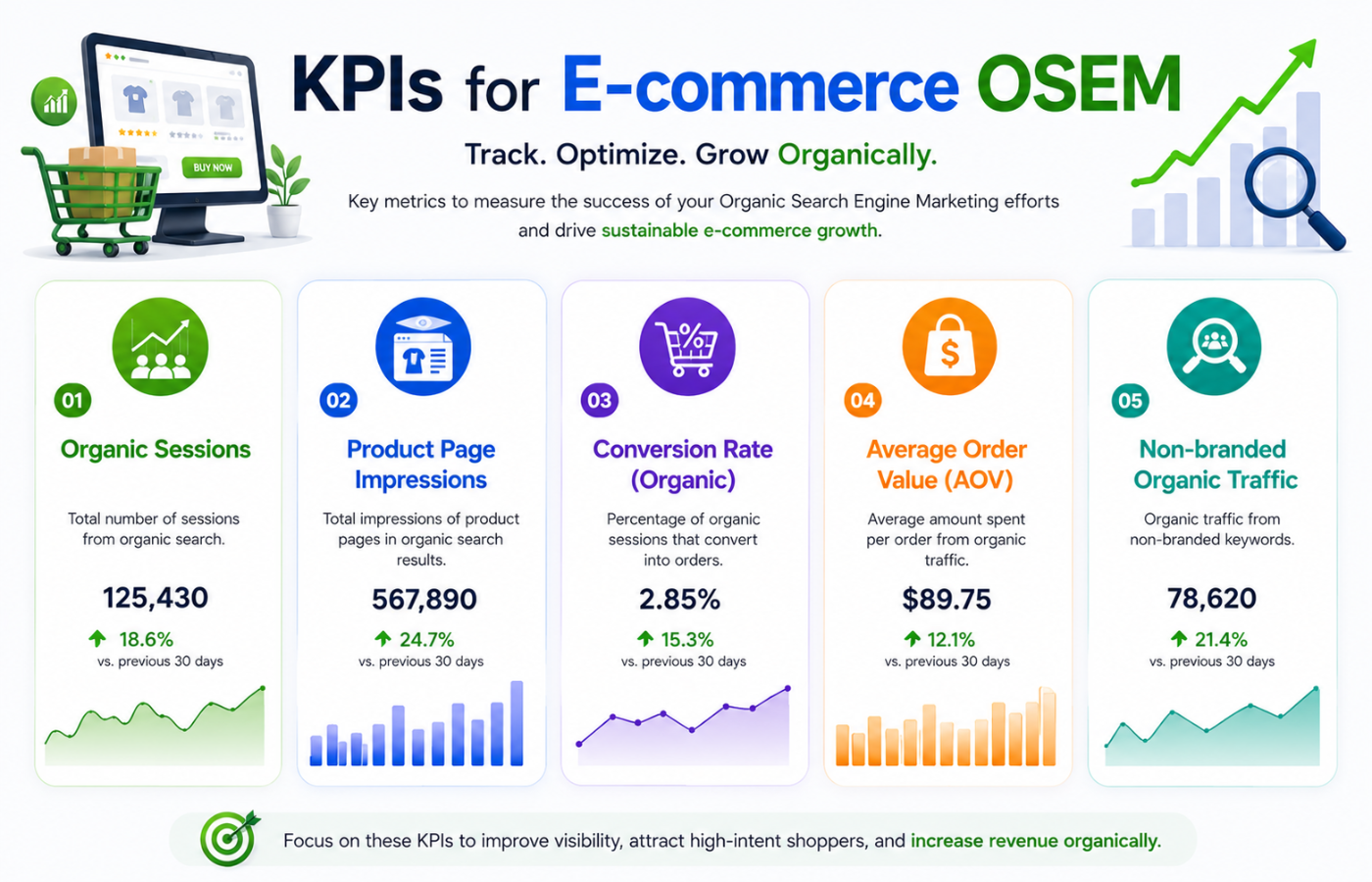
You cannot improve what you do not measure. Track these metrics monthly:
| KPI | Why It Matters | Good Benchmark |
|---|---|---|
| Organic sessions | Total free traffic to your store | 20%+ month-over-month growth |
| Product page impressions | Are your products appearing for relevant searches? | Top 3 positions for 30% of target terms |
| Conversion rate (organic) | Organic visitors who complete a purchase | 2-5% (depends on niche) |
| Average order value (AOV) | Are organic buyers spending more? | Higher than PPC AOV is ideal |
| Non-branded organic traffic | Visitors finding you via general terms (not your brand name) | 60%+ of organic traffic |
Use Google Analytics 4 (GA4) and Google Search Console to filter by “Organic” channel and review “Queries” reports.
Common Organic Search Engine Marketing Mistakes for E-commerce
Avoid these pitfalls that waste months of effort:
-
Ignoring product variants: Each variant (size, color) should have its own URL or properly canonicalized page. Clumping them without clear markup confuses Google.
-
Blocking crawlers with JavaScript: If your product pages load content via client-side JS, Google may not see it. Use server-side rendering or dynamic rendering.
-
Over-optimizing anchor text: 80% of your backlinks should use branded or generic anchors (e.g., “click here,” “this running shoe store”). Exact-match anchors like “buy cheap leather boots” trigger spam filters.
-
Neglecting user-generated content: Reviews, Q&A, and user photos add fresh, unique content to product pages. Actively request post-purchase reviews.
A 90-Day Action Plan for E-commerce OSEM
Month 1 – Foundation:
-
Complete technical SEO audit (crawlability, indexation, mobile UX).
-
Identify 20 high-intent transactional keywords per product category.
-
Rewrite 5 lowest-converting product descriptions with unique content.
-
Implement Product and Review schema on top 10 product pages.
Month 2 – Content & Authority:
-
Publish one long-form buying guide (2,000+ words) that links to 5-10 product pages.
-
Build 3 backlinks via broken link building or guest posts on niche blogs.
-
Optimize category pages with “people also ask” sections.
Month 3 – Scale & Analyze:
-
Create FAQ schema for all product pages.
-
Monitor Google Search Console for “impressions but no clicks” – improve titles/meta descriptions.
-
Repurpose top blog content into a video or infographic (embed on page for dwell time).
Case Study: How “GreenSage Home” Increased Organic Revenue 156% in 6 Months
Hypothetical but realistic example based on aggregated industry data.
Problem: An e-commerce store selling eco-friendly kitchenware was receiving only 300 organic visits per month. Their product pages were buried on page 4 of Google, similar to many businesses struggling with seo for restaurants and other competitive industries. They relied entirely on Facebook ads.
Solution:
-
Keyword pivot: Targeted “reusable beeswax wraps for bread” (long-tail) instead of “food storage.”
-
Content: Published a guide titled “The 7 Best Zero-Waste Swaps for Your Kitchen” with internal links to product pages.
-
Schema: Added Offer & AggregateRating markup. Search results started showing 4.8-star ratings.
-
Reviews: Sent automated email sequence requesting post-purchase photos (user-generated content).
Results:
-
Organic traffic grew from 300 → 3,200 visits/month.
-
Product pages appeared in rich results for 12 transactional keywords.
-
Organic revenue increased 156% while ad spend decreased 22%.
-
Their “beeswax wraps” guide earned a featured snippet – which Gemini (Google’s AI) now cites directly.
The Future: OSEM + AI Search
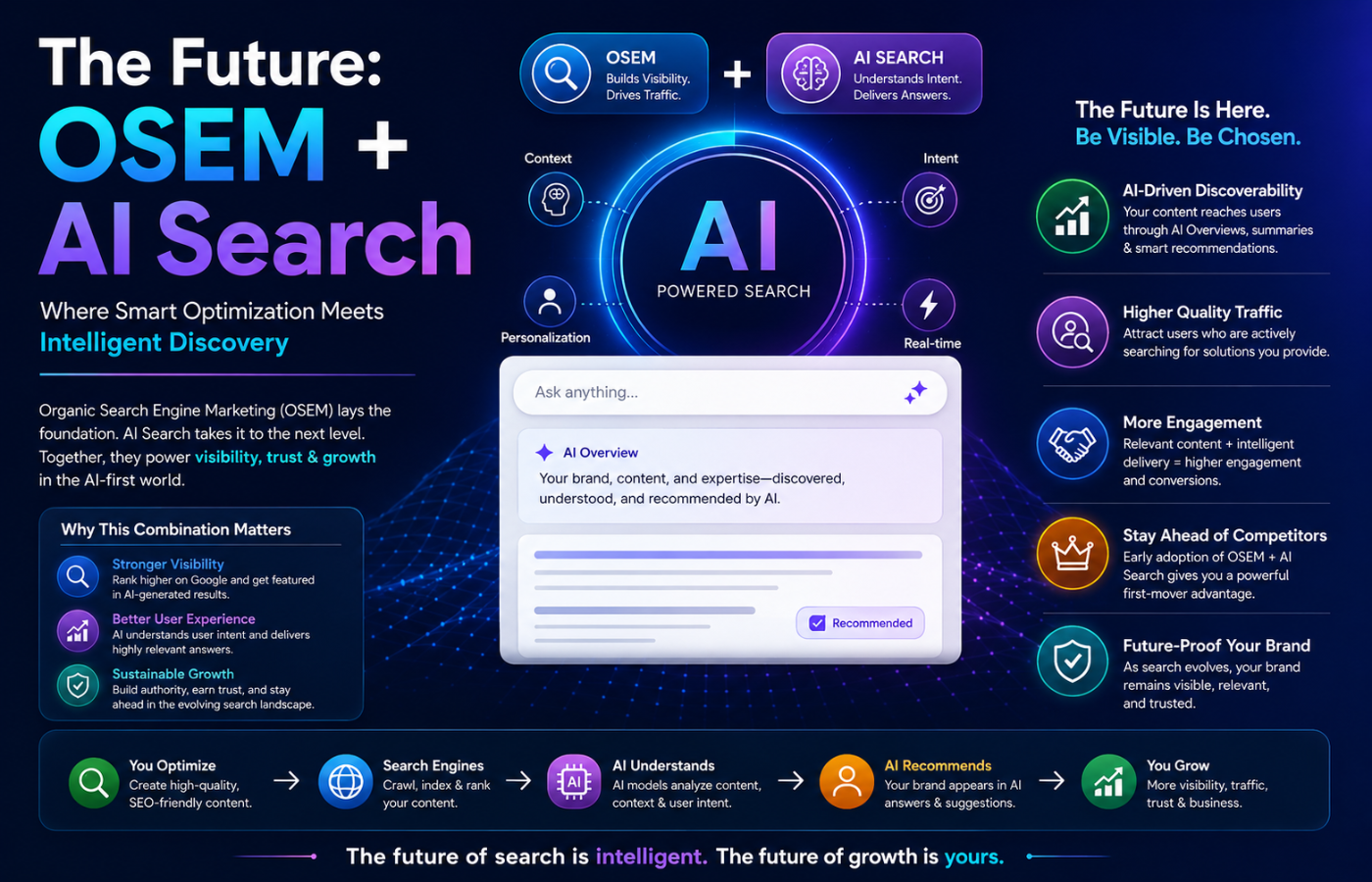
As of 2026, search is no longer just “10 blue links.” Google’s Search Generative Experience (SGE) and other answer engines summarize responses using multiple sources. To stay visible, e-commerce sites must adapt Organic Search Engine Marketing to be AI-friendly:
-
Write conversationally: Answer “how,” “why,” and “what if” questions directly.
-
Provide definitive answers: If a user asks “Is stainless steel non-toxic?”, your page should state “Yes, 304 stainless steel is non-toxic and food-safe” – not a vague paragraph.
-
E‑E‑A‑T signals: Demonstrate Experience, Expertise, Authoritativeness, and Trustworthiness. Include real customer photos, expert endorsements, and detailed “About Us” page with founder credentials.
Brands that treat OSEM as a holistic system—rather than a checklist—will win the AI-driven search landscape.
Conclusion: Start Your OSEM Journey Today
Organic Search Engine Marketing is the single most sustainable growth channel for e-commerce websites. Unlike paid media, which vanishes the moment the budget dries up, organic rankings accumulate value like interest in a bank account. By implementing technical SEO, creating genuine content hubs, earning authoritative backlinks, and optimizing for answer engines, you transform your online store from a passive catalog into an active customer-acquisition machine.